

Learn how we are working to transform how we use and produce energy.
Illinois Clean Manufacturing Roadmap
RMI’s report outlines a path for state policymakers to meet the climate and health targets mandated by the Illinois Climate Equity and Jobs Act while maintaining the state’s manufacturing might.
Why we share this work for free
RMI is an independent nonprofit working to accelerate the clean energy transition. We publish research like this to inform decision-makers and drive real-world impact.
Our work is supported by philanthropy as well as partnerships, including fee-for-service engagements. This support makes it possible for us to share our independent insights for free.
If you find this work valuable, you can support it anytime.
Get more insights like this
Stay up to date with the latest research, analysis, and tools from RMI by opting in to receive occasional emails below. You’ll get new reports, event invitations, and practical insights to help us all accelerate the clean energy transition.
Loading form...
Your download should start automatically. If it doesn’t, click the download button below.
This work is made possible by philanthropy
RMI is a nonprofit supported by donors and partners. Philanthropy enables us to produce independent research and make resources like this freely available.
If you find this report valuable, please consider supporting our work. You can also explore how we partner with organizations to drive impact.
Jump to Section
See the Illinois two-page factsheet here.
Manufacturing is a driving force of the Illinois economy: approximately 580,000 Illinoisans are employed in manufacturing jobs, and the state was the fifth-largest exporter of goods in the nation in 2024. The industrial sector is also a significant source of climate pollution, comprising 18% of Illinois’s total emissions. To meet the climate and health targets mandated by the Illinois Climate Equity Jobs Act while maintaining the state’s manufacturing might policymakers must work to reduce emissions from its industrial sector in a way that allows businesses to stay regionally and globally competitive.
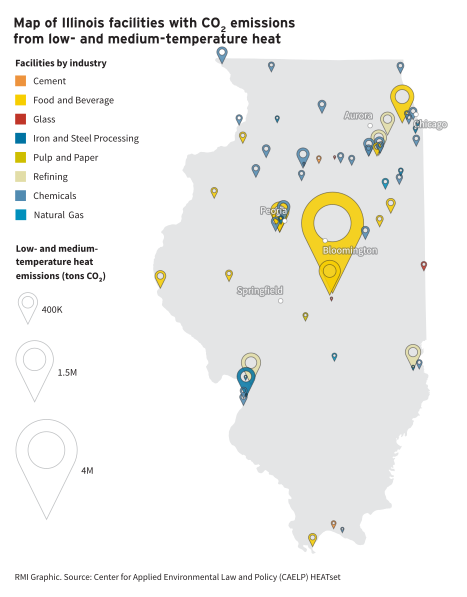
Many of Illinois’s industrial emissions come from burning natural gas in low and medium temperature ranges for which low-emissions technologies like industrial heat pumps, electric boilers, and thermal energy storage have already proven viable. The actions contained in this report can help Illinois policymakers ease the transition to clean manufacturing and production methods as these next-generation technologies continue down the cost curve and continue to improve in performance.
In this roadmap, we focus on solutions that are technologically and commercially ready for near-term deployment and fall into three main categories: energy efficiency, electrification, and geothermal heat. Despite the technological maturity of many of these technologies, nearly every facility in Illinois remains reliant on natural gas to fuel its operations. A series of informational interviews among facilities that have considered adopting low-emissions equipment cited three common barriers, including technology integration, equipment financing, and system-level capabilities.
There is no silver bullet to overcome these barriers, but the state can leverage its administrative capacity, funding resources, and input from its industries to unlock the greatest emissions reduction potential. In concert, a number of these strategies described in the report can be powerful levers to change Illinois’ industrial emissions landscape and drive private investment in clean technology.
Authors

Molly Freed
Manager
Camellia Moors
Associate
Ankur Dass
Senior Associate
Emily Albergo
Associate
Allie Jobe
Associate
Hannah Thonet
ManagerRelated Insights

Reality Check: For Power Plants, Changing the Fuel Doesn’t Fix the Economics

Beyond the First Frontier: What Comes Next for Carbon Removal
Help build the clean energy future. Donate today.
Independent research. Real-world solutions. Supported by donors.
RMI can pursue the highest-impact climate and energy solutions because we’re supported by people who believe change is possible. Every gift helps advance the work needed to make clean energy the default choice worldwide.
For other ways to give to RMI, including checks or gifts of stock, please visit Other Ways to Give.
