

Learn how we are working to transform how we use and produce energy.
Powering the Data-Center Boom with Low-Carbon Solutions
China’s Perspective and Global Insights
Why we share this work for free
RMI is an independent nonprofit working to accelerate the clean energy transition. We publish research like this to inform decision-makers and drive real-world impact.
Our work is supported by philanthropy as well as partnerships, including fee-for-service engagements. This support makes it possible for us to share our independent insights for free.
If you find this work valuable, you can support it anytime.
Get more insights like this
Stay up to date with the latest research, analysis, and tools from RMI by opting in to receive occasional emails below. You’ll get new reports, event invitations, and practical insights to help us all accelerate the clean energy transition.
Loading form...
Your download should start automatically. If it doesn’t, click the download button below.
This work is made possible by philanthropy
RMI is a nonprofit supported by donors and partners. Philanthropy enables us to produce independent research and make resources like this freely available.
If you find this report valuable, please consider supporting our work. You can also explore how we partner with organizations to drive impact.
Jump to Section
As the global digital and intelligent transformation accelerates, the demand for computing power has been rising rapidly. The release of Open AI’s ChatGPT has attracted widespread attention to generative artificial intelligence (AI), which is penetrating all aspects of business and daily life. With the continuous improvement of the complexity and capabilities of AI models, the demand for computing power is also increasing dramatically.
The exponential growth of computing power has led to a significant increase in data-center energy consumption, resulting in increased carbon emissions for the entire industry. In 2022, global data centers consumed about 460 terawatt-hours (TWh) of electricity, accounting for about 1.7 percent of global electricity consumption. It is estimated that data-center electricity consumption will keep growing at an annual rate of 6–22 percent reaching 750–2,300 TWh by 2030. This will lead to annual carbon emissions of approximately 340 million–1,040 million tons, about 0.9–2.8 percent of global carbon emissions based on the 2023 level.
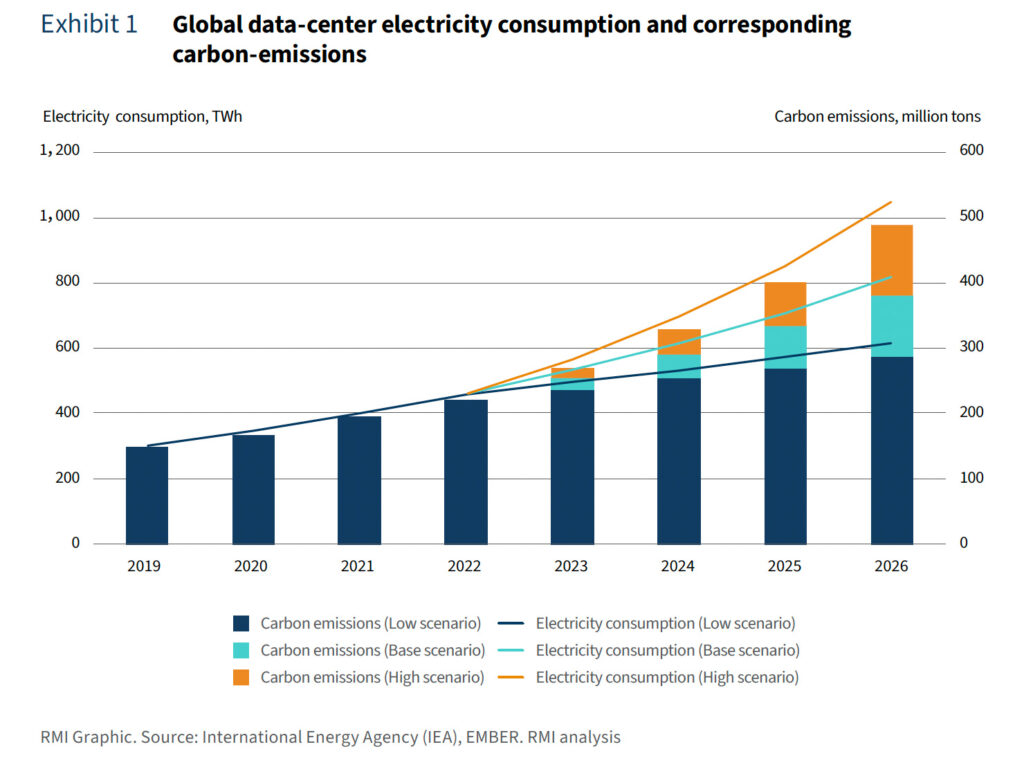
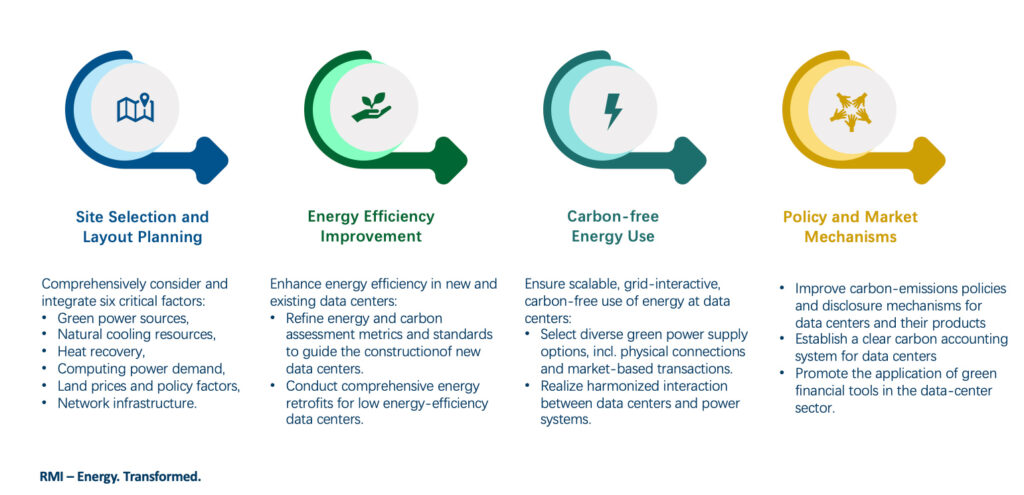
Transitioning data centers to reduce emissions is a global imperative, but it faces four key challenges: poor coordination in energy infrastructure planning, untapped energy efficiency potential in buildings and IT systems, difficulty in scaling up green electricity consumption, and weak policy and market incentives. This report analyzes these challenges and proposes pathways for decoupling the growth of data centers from rising emissions. Key actions include optimizing data center location and design, improving energy efficiency through applying more rigorous standards, adopting low-carbon and grid-friendly power consumption behaviors, and fostering green development through policy and market collaboration.





Related Insights

Steel’s Transformation: China and Australia’s next horizon of clean steel

Efficiency Reimagined: The next phase of China’s industrial energy transition


Help build the clean energy future. Donate today.
Independent research. Real-world solutions. Supported by donors.
RMI can pursue the highest-impact climate and energy solutions because we’re supported by people who believe change is possible. Every gift helps advance the work needed to make clean energy the default choice worldwide.
For other ways to give to RMI, including checks or gifts of stock, please visit Other Ways to Give.
