

Learn how we are working to transform how we use and produce energy.
From Wildfire to Wealth
Growing resilient forest economies in Colorado’s wildfire-prone communities
Why we share this work for free
RMI is an independent nonprofit working to accelerate the clean energy transition. We publish research like this to inform decision-makers and drive real-world impact.
Our work is supported by philanthropy as well as partnerships, including fee-for-service engagements. This support makes it possible for us to share our independent insights for free.
If you find this work valuable, you can support it anytime.
Get more insights like this
Stay up to date with the latest research, analysis, and tools from RMI by opting in to receive occasional emails below. You’ll get new reports, event invitations, and practical insights to help us all accelerate the clean energy transition.
Loading form...
Your download should start automatically. If it doesn’t, click the download button below.
This work is made possible by philanthropy
RMI is a nonprofit supported by donors and partners. Philanthropy enables us to produce independent research and make resources like this freely available.
If you find this report valuable, please consider supporting our work. You can also explore how we partner with organizations to drive impact.
Jump to Section
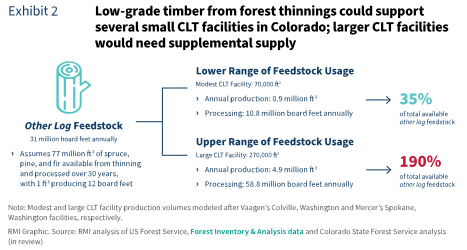
Colorado is facing more frequent wildfires, a shortage of affordable housing, and limited high-quality job opportunities in rural areas. Businesses that process small-diameter trees (9 inches or less) from wildfire mitigation efforts into mass timber, a class of high performance wood building products, could help tackle these issues while also reducing carbon emissions from the construction sector, which is the state’s third-largest source of pollution.
Challenges to developing a mass timber industry in Colorado include supply uncertainties from federally managed forests and a limited logging and milling infrastructure. However, growing demand for sustainable building materials and updated building codes present significant opportunities for businesses and communities if these obstacles can be addressed.
The study recommends a phased strategy for wood product businesses:
- Rightsize Now (2–3 years): Increase log supply to existing mills and launch small-scale operations producing nail-laminated timber, dowel-laminated timber, and cross-laminated timber. This approach can quickly boost wood product output, strengthen local businesses, and prepare for future growth.
- Plan for Scale (5–10 years): As timber supply expands, scale up to high-volume production of cross-laminated timber, glue-laminated timber, wood fiber insulation, and other advanced products using automated techniques, unlocking new business opportunities and adding value to forest residues.
We would like to express our sincere gratitude to the Gates Family Foundation, Mighty Arrow Foundation, National Forest Foundation, and the United States Forest Service for their generous support. Their contributions have been instrumental in our efforts to efficiently and accurately gather the relevant information for this report. We also acknowledge and appreciate the valuable collaboration of the Colorado Mass Timber Coalition for their tireless work in advancing this initiative.



Related Insights


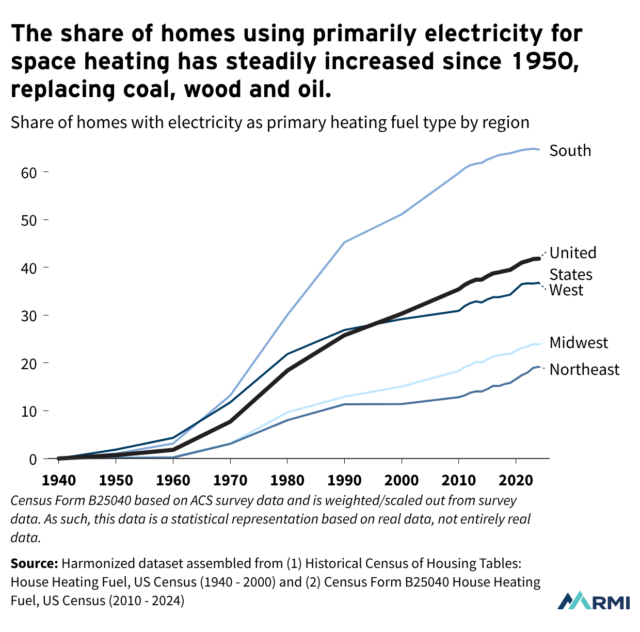
More Americans Are Heating Their Homes with Electricity than Ever Before
Help build the clean energy future. Donate today.
Independent research. Real-world solutions. Supported by donors.
RMI can pursue the highest-impact climate and energy solutions because we’re supported by people who believe change is possible. Every gift helps advance the work needed to make clean energy the default choice worldwide.
For other ways to give to RMI, including checks or gifts of stock, please visit Other Ways to Give.
