

Learn how we are working to transform how we use and produce energy.
Four Essential Assumptions for Future-Ready Grid Modeling
Why we share this work for free
RMI is an independent nonprofit working to accelerate the clean energy transition. We publish research like this to inform decision-makers and drive real-world impact.
Our work is supported by philanthropy as well as partnerships, including fee-for-service engagements. This support makes it possible for us to share our independent insights for free.
If you find this work valuable, you can support it anytime.
Get more insights like this
Stay up to date with the latest research, analysis, and tools from RMI by opting in to receive occasional emails below. You’ll get new reports, event invitations, and practical insights to help us all accelerate the clean energy transition.
Loading form...
Your download should start automatically. If it doesn’t, click the download button below.
This work is made possible by philanthropy
RMI is a nonprofit supported by donors and partners. Philanthropy enables us to produce independent research and make resources like this freely available.
If you find this report valuable, please consider supporting our work. You can also explore how we partner with organizations to drive impact.
Jump to Section
Integrated resource planning (IRP) is becoming more complex due to increasing renewable energy integration, retirements of fossil fuel plants, growing customer-sited and distributed energy resources, and impacts of climate change. Traditional grid modeling assumptions, once acceptable for modeling grids supported by centralized fossil fuel plants, are becoming outdated and risk undervaluing the role of renewables, energy storage, and demand flexibility in grid planning. This creates a challenge and opportunity for utilities, which perform grid modeling in IRP, and regulators, who are tasked with evaluating utility modeling assumptions, methodologies, and outputs. As grid dynamics evolve, accurate modeling is essential for ensuring informed decisions that prioritize reliability, affordability, and distributional equity.
This report illustrates the need to reassess four key assumptions in IRP modeling to align with the requirements of an increasingly decentralized, flexible, and weather-dependent grid, and describes the key grid planning models where these assumptions are most relevant:
- Capacity expansion models, which are used to determine the optimal mix of new and retiring resources over a long-term planning horizon, typically identifying least-cost portfolios of generation and storage while meeting policy constraints;
- Production cost models, which simulate the operations of these resource portfolios over shorter timeframes, often on an hourly or sub-hourly basis, to evaluate how effectively they meet demand while minimizing costs; and
- Resource adequacy models, which test whether the grid can reliably supply power under a range of conditions, including extreme weather and peak demand periods.
Each of these models provide distinct insights, and, together with updating the following essential assumptions, can support a comprehensive approach to modern grid planning:
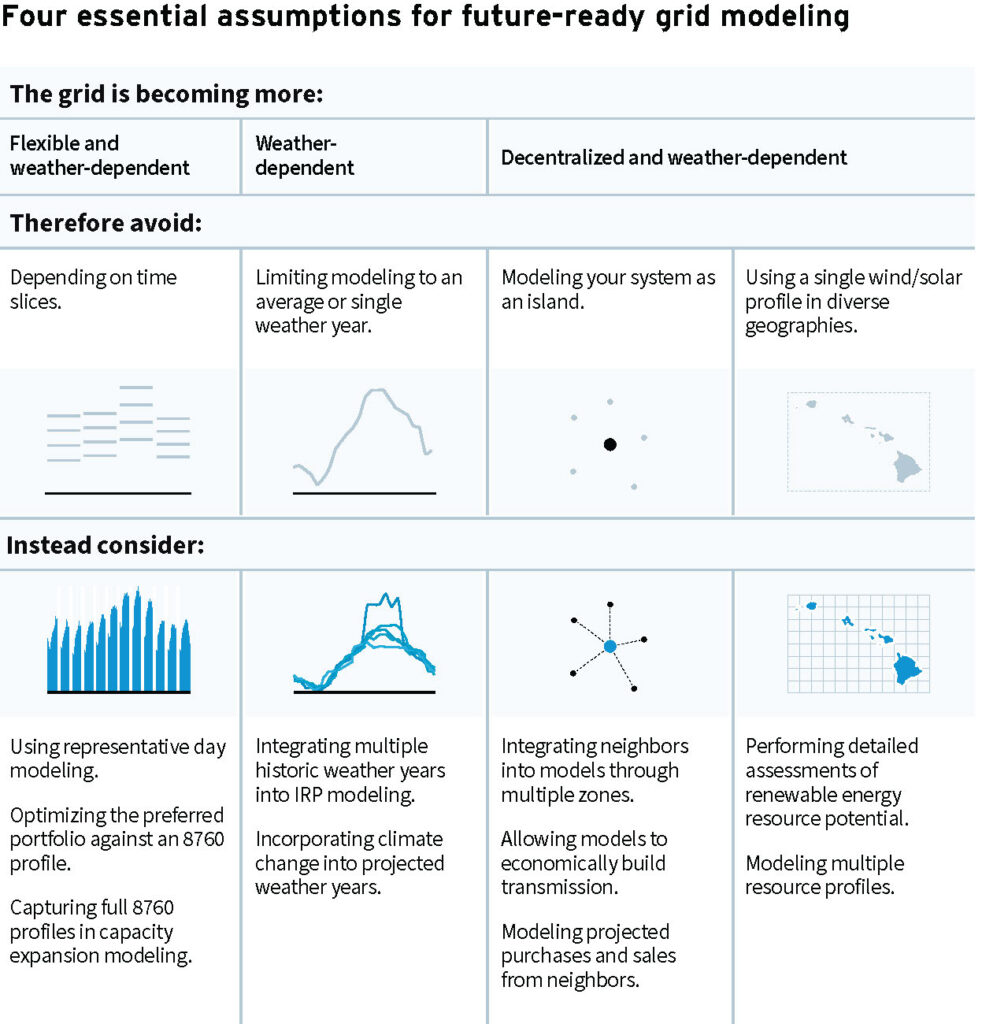
Additionally, this report highlights how incorporating human impacts like health, affordability, and distributional equity into planning is critical for resilient and affordable energy systems that serve the entire community. Technical modeling improvements alone are not sufficient to realize these benefits. Increasingly, the power sector must account for the broader impacts of energy investments and operations, particularly on communities that may be affected by resource development, emissions, and environmental degradation. Modern grid planning can and must take a holistic approach, balancing traditional objectives with the goal of minimizing harm and maximizing benefits for all, particularly vulnerable communities, by incorporating an energy equity lens.
By updating assumptions that consider the increasingly decentralized nature of the grid, weather-dependency, and flexibility, grid modeling can help ensure economic and reliable outcomes. And by contextualizing modeling results with customer impacts in mind, it can light the way to equitable energy systems.



Related Insights

The Case for Grid-Connected Data Centers: Cleaner, More Affordable, and Fast Enough

Reality Check: For Power Plants, Changing the Fuel Doesn’t Fix the Economics
Help build the clean energy future. Donate today.
Independent research. Real-world solutions. Supported by donors.
RMI can pursue the highest-impact climate and energy solutions because we’re supported by people who believe change is possible. Every gift helps advance the work needed to make clean energy the default choice worldwide.
For other ways to give to RMI, including checks or gifts of stock, please visit Other Ways to Give.