

Learn how we are working to transform how we use and produce energy.
Comprehensive Guide to Financing the Zero-Emission Trucking Transition in India
Why we share this work for free
RMI is an independent nonprofit working to accelerate the clean energy transition. We publish research like this to inform decision-makers and drive real-world impact.
Our work is supported by philanthropy as well as partnerships, including fee-for-service engagements. This support makes it possible for us to share our independent insights for free.
If you find this work valuable, you can support it anytime.
Get more insights like this
Stay up to date with the latest research, analysis, and tools from RMI by opting in to receive occasional emails below. You’ll get new reports, event invitations, and practical insights to help us all accelerate the clean energy transition.
Loading form...
Your download should start automatically. If it doesn’t, click the download button below.
This work is made possible by philanthropy
RMI is a nonprofit supported by donors and partners. Philanthropy enables us to produce independent research and make resources like this freely available.
If you find this report valuable, please consider supporting our work. You can also explore how we partner with organizations to drive impact.
Jump to Section
Decarbonizing India’s trucking sector is crucial for the nation to achieve its carbon-neutrality goal, enhance energy security, and improve public health. Recognizing the benefits of zero-emission trucks (ZETs), government and industry stakeholders have begun to set the groundwork for their deployment. For fleets, manufacturers, and charging infrastructure providers to transition to ZETs, access to financing is essential. Developing financial strategies that lower risks and make funding more accessible will help bridge the cost gap between diesel trucks and ZETs, accelerating their adoption across India.
While the technology, risks, and economic viability of diesel trucks are well understood by banks and non-banking financial institutions, ZETs and their associated infrastructure are still nascent and emerging asset classes. This creates hesitation among financiers, who are concerned about perceived risks related to asset and residual value. To initiate, de-risk, and scale the transition to ZETs, it is crucial to identify tailored financial tools and market interventions that can unlock investment for ZETs and address the hurdles currently slowing ZET growth.
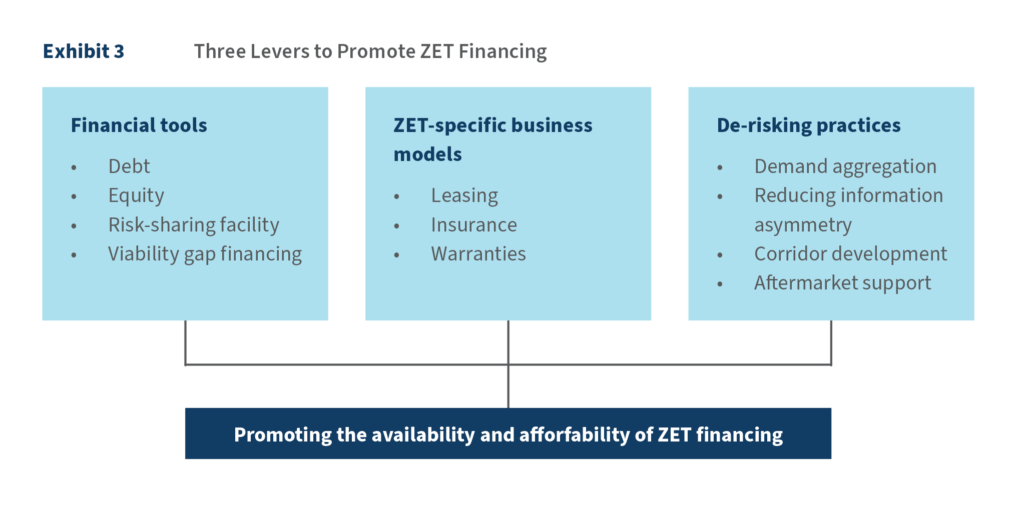
The comprehensive report establishes an actionable framework for stakeholders to mobilize finance across four key segments of the ZET industry: ZET manufacturing, ZET purchase, charging infrastructure, and requisite grid upgrades. The report outlines three key levers for creating a robust ZET financing ecosystem:
- Identify a mix of financial tools, such as debt, equity, risk-sharing facilities, and viability gap financing, to support ZET market development.
- Develop ZET-specific business practices that more effectively manage and distribute risks, including options like leasing, insurance, and warranties.
- Implement de-risking practices such as demand aggregation, reducing information asymmetry, corridor development, and aftermarket support.
With actions by the government, industry leaders, and financiers, India can effectively drive investment in the ZET sector to realize the long-term socio-economic benefits of adopting ZETs.


Related Insights

India’s Used EV Battery Market Needs Trust. Battery Aadhaar Can Help.

Help build the clean energy future. Donate today.
Independent research. Real-world solutions. Supported by donors.
RMI can pursue the highest-impact climate and energy solutions because we’re supported by people who believe change is possible. Every gift helps advance the work needed to make clean energy the default choice worldwide.
For other ways to give to RMI, including checks or gifts of stock, please visit Other Ways to Give.
