

Learn how we are working to transform how we use and produce energy.
A Marketplace for Equitable Building Retrofits
How lessons from Massachusetts can help scale decarbonization to meet climate goals.
Why we share this work for free
RMI is an independent nonprofit working to accelerate the clean energy transition. We publish research like this to inform decision-makers and drive real-world impact.
Our work is supported by philanthropy as well as partnerships, including fee-for-service engagements. This support makes it possible for us to share our independent insights for free.
If you find this work valuable, you can support it anytime.
Get more insights like this
Stay up to date with the latest research, analysis, and tools from RMI by opting in to receive occasional emails below. You’ll get new reports, event invitations, and practical insights to help us all accelerate the clean energy transition.
Loading form...
Your download should start automatically. If it doesn’t, click the download button below.
This work is made possible by philanthropy
RMI is a nonprofit supported by donors and partners. Philanthropy enables us to produce independent research and make resources like this freely available.
If you find this report valuable, please consider supporting our work. You can also explore how we partner with organizations to drive impact.
Jump to Section
Decarbonizing existing buildings is challenging but necessary to achieve climate goals. To accelerate progress, we need to make energy retrofits more accessible, affordable, and commonplace. A viable market for decarbonization and a streamlined retrofitting process can help make these efforts more equitable and cost-effective today.
The majority of US buildings that will exist in 2050 are already standing. Reducing climate pollution from leaky and inefficient existing buildings that run on fossil fuels is fundamental to any climate strategy. Yet the typical retrofitting process depends heavily on owners and is fraught with uncertainty. Conflicting guidance, high costs, fragmented financing, and administrative burdens are all significant hurdles that owners and service providers face impeding the widespread adoption of retrofitting solutions. There is an urgency to develop a robust market for building decarbonization to meet climate targets. Efforts to induce and support this shift should be focused on scalable solutions, favorable policies, and programmatic systems.
In recent years, RMI has focused on accelerating deep energy retrofits for affordable housing across Massachusetts to catalyze the growth of a viable regional market for building decarbonization by facilitating key “lighthouse projects.” These projects serve as exemplary models for eliminating on-site fossil fuels, maximizing efficiencies, reducing emissions, and enhancing comfort and health for low- and middle-income residents. This report outlines our progress in Massachusetts to date, synthesizing observations of the current market, including enabling factors for decarbonization such as extensive stakeholder engagement and knowledge-sharing platforms. We identify common challenges including difficulties with decarbonization assessments, financial barriers, and administrative burdens.
As a result of these direct project engagements, the report also distills lessons learned into suggested paradigm shifts to scale building decarbonization, such as adopting holistic building design approaches and integrating standardized frameworks. RMI proposes foundational and strategic actions to reinforce a landscape conducive to building retrofits that benefit low-income households and preserve a livable climate for future generations. By developing, refining, and sharing best practices, processes, and strategies across the industry, stakeholders can stimulate a thriving market for building decarbonization and drive progress toward a low-carbon future.


Related Insights
The Opportunity for Heat Pumps to Put Downward Pressure on Electricity Rates
Building Smarter, More Efficient Air Conditioners for Real World Conditions

How Heat Pumps Reduce Energy Bills and Air Pollution in the San Francisco Bay Area
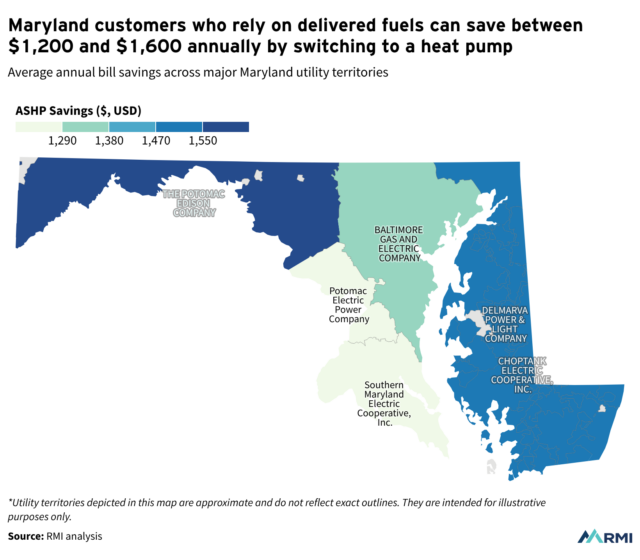
Delivered Fuel Customers in Maryland See Strong Energy Bill Savings in a Switch to Heat Pumps
Help build the clean energy future. Donate today.
Independent research. Real-world solutions. Supported by donors.
RMI can pursue the highest-impact climate and energy solutions because we’re supported by people who believe change is possible. Every gift helps advance the work needed to make clean energy the default choice worldwide.
For other ways to give to RMI, including checks or gifts of stock, please visit Other Ways to Give.
