

Learn how we are working to transform how we use and produce energy.
How to Restructure Utility Incentives
The Four Pillars of Comprehensive Performance-Based Regulation
Why we share this work for free
RMI is an independent nonprofit working to accelerate the clean energy transition. We publish research like this to inform decision-makers and drive real-world impact.
Our work is supported by philanthropy as well as partnerships, including fee-for-service engagements. This support makes it possible for us to share our independent insights for free.
If you find this work valuable, you can support it anytime.
Get more insights like this
Stay up to date with the latest research, analysis, and tools from RMI by opting in to receive occasional emails below. You’ll get new reports, event invitations, and practical insights to help us all accelerate the clean energy transition.
Loading form...
Your download should start automatically. If it doesn’t, click the download button below.
This work is made possible by philanthropy
RMI is a nonprofit supported by donors and partners. Philanthropy enables us to produce independent research and make resources like this freely available.
If you find this report valuable, please consider supporting our work. You can also explore how we partner with organizations to drive impact.
Jump to Section
Performance-based regulation (PBR) is an alternative to traditional cost-of-service regulation (COSR) that aims to improve the alignment between the incentives utilities face and the interests of customers and society. Though PBR is not new, it has been attracting more attention in recent years due to the growing mismatch between traditional COSR and modern policy goals.
This report provides guidance to regulators and stakeholders on how to use PBR to better achieve important objectives such as affordability, resilience, decarbonization, and social equity. It draws a distinction between incremental and comprehensive forms of PBR, and it defines the latter as resting on four pillars. These pillars consist of incentivizing cost efficiency, removing the throughput incentive, equalizing the incentives between capital expenditures and operating expenses, and incentivizing targeted outcomes. Together, they address the key shortcomings of traditional COSR.
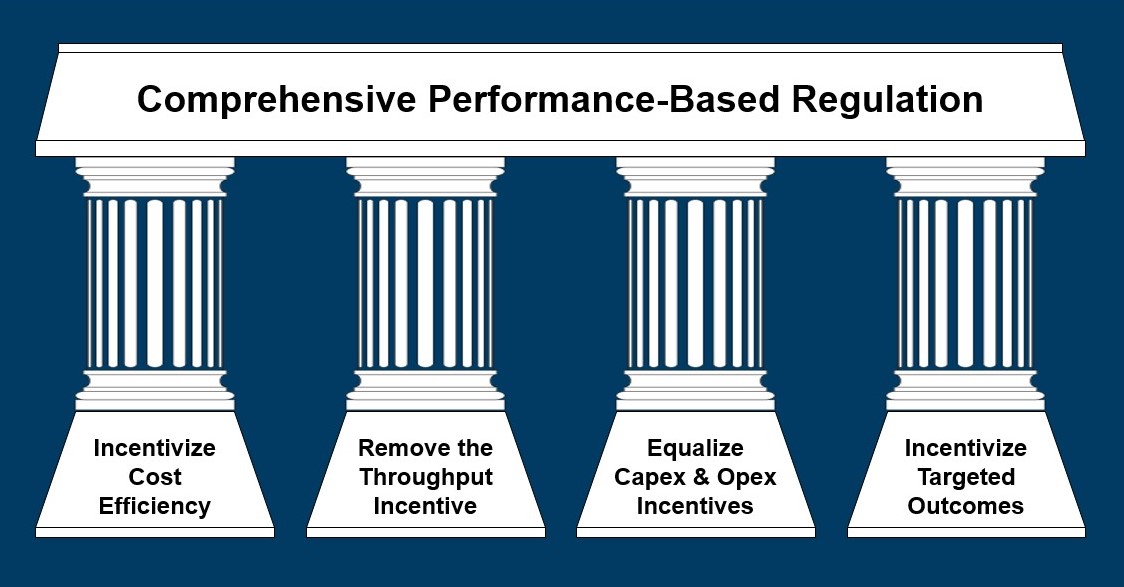
The report also provides an overview of the PBR tools available, discusses how the Four Pillars Model can be used to support the reform process, and provides tips for regulators and stakeholders on how to effectively navigate the process. Hawaii’s comprehensive PBR framework is discussed as a case study.


Related Insights

Gas Utility Depreciation: Recommendations for an Uncertain Future


States Are Opening the Door to Data Center Investment in Virtual Power Plants

Help build the clean energy future. Donate today.
Independent research. Real-world solutions. Supported by donors.
RMI can pursue the highest-impact climate and energy solutions because we’re supported by people who believe change is possible. Every gift helps advance the work needed to make clean energy the default choice worldwide.
For other ways to give to RMI, including checks or gifts of stock, please visit Other Ways to Give.
