

Learn how we are working to transform how we use and produce energy.
Why we share this work for free
RMI is an independent nonprofit working to accelerate the clean energy transition. We publish research like this to inform decision-makers and drive real-world impact.
Our work is supported by philanthropy as well as partnerships, including fee-for-service engagements. This support makes it possible for us to share our independent insights for free.
If you find this work valuable, you can support it anytime.
Get more insights like this
Stay up to date with the latest research, analysis, and tools from RMI by opting in to receive occasional emails below. You’ll get new reports, event invitations, and practical insights to help us all accelerate the clean energy transition.
Loading form...
Your download should start automatically. If it doesn’t, click the download button below.
This work is made possible by philanthropy
RMI is a nonprofit supported by donors and partners. Philanthropy enables us to produce independent research and make resources like this freely available.
If you find this report valuable, please consider supporting our work. You can also explore how we partner with organizations to drive impact.
Jump to Section
In The Great Reallocation, RMI shows that contrary to popular belief, the buildout of renewable energy supply does not require a surge in capital expenditure (capex). As fossil fuel capex falls, the net growth in capex is only 2 percent per year, in line with the past seven years, and much lower than in the decade after 2000.
Financing the energy transition is a story of capital reallocation. Over the next seven years, renewable capex will roughly double and fossil fuel capex will roughly halve under core IEA scenarios. Falling fossil fuel capex will therefore provide half of the growth in renewable capex.
This capital reallocation is very achievable. The required growth in energy supply capex of 2 percent is lower than expected global GDP growth of 3 percent, and lower than the annual increase in energy supply capex from 2000–2010 of 9 percent. Given that the capital formation in 2022 was $27 trillion, the additional capex on energy supply would constitute only 1 percent of global capex.
Achieving the achievable still requires work. The key now is to ensure that capex moves from generation to grids, and from developed markets to emerging markets. The primary impediments to change are policy and expertise rather than the volume or availability of capital.
Investment in energy supply under IEA’s APS (billion $)
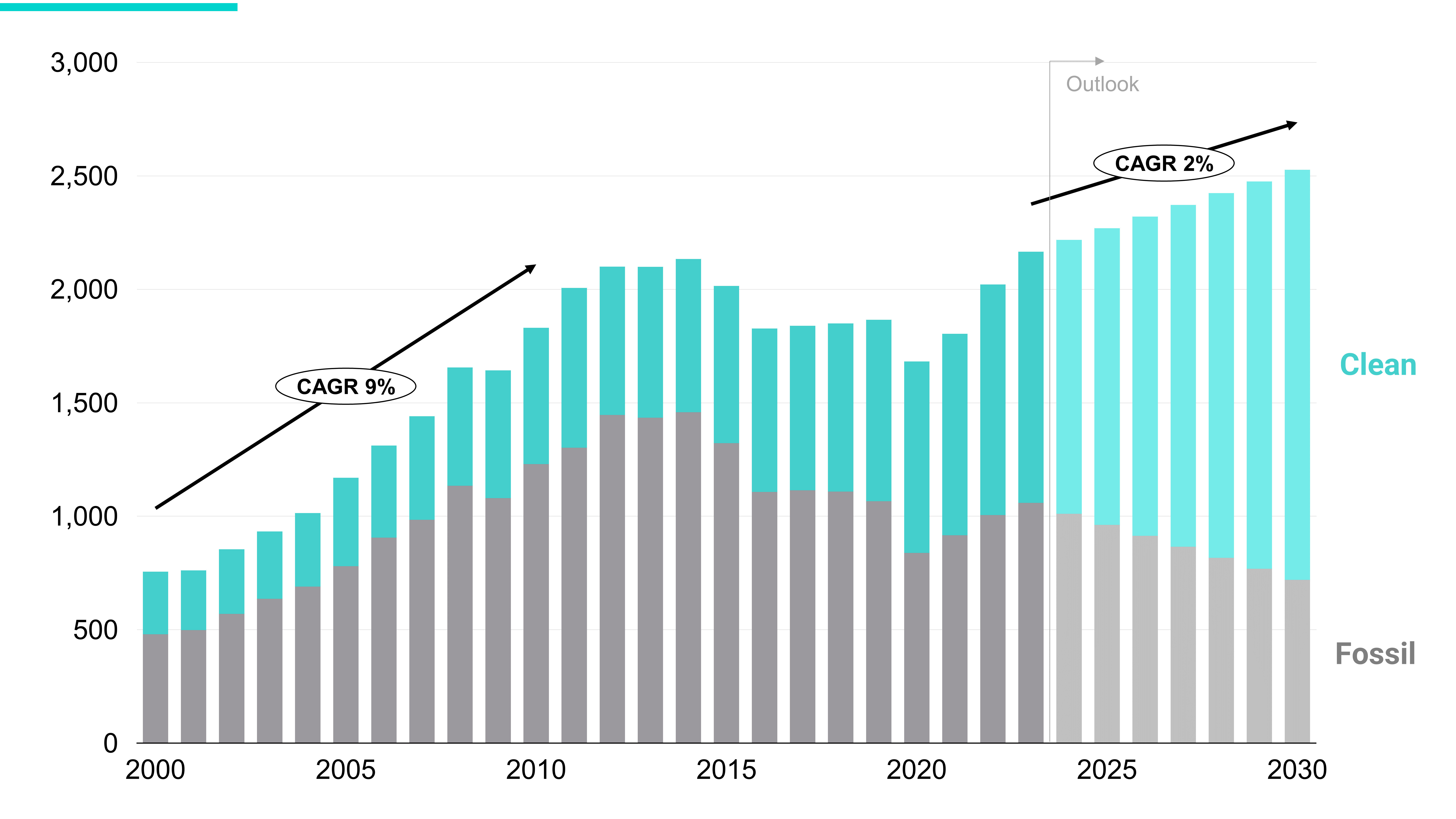
Source: IEA WEI 2016, WEI 2023, RMI adjustments

Related Insights
Turning Buyer Demand into Low-Carbon Copper Production
Gas Utility Depreciation: Recommendations for an Uncertain Future

Building Charging Networks That Meet Drivers’ Needs Without Breaking the Bank

Steel’s Transformation: China and Australia’s next horizon of clean steel
Help build the clean energy future. Donate today.
Independent research. Real-world solutions. Supported by donors.
RMI can pursue the highest-impact climate and energy solutions because we’re supported by people who believe change is possible. Every gift helps advance the work needed to make clean energy the default choice worldwide.
For other ways to give to RMI, including checks or gifts of stock, please visit Other Ways to Give.
