

Learn how we are working to transform how we use and produce energy.
Why we share this work for free
RMI is an independent nonprofit working to accelerate the clean energy transition. We publish research like this to inform decision-makers and drive real-world impact.
Our work is supported by philanthropy as well as partnerships, including fee-for-service engagements. This support makes it possible for us to share our independent insights for free.
If you find this work valuable, you can support it anytime.
Get more insights like this
Stay up to date with the latest research, analysis, and tools from RMI by opting in to receive occasional emails below. You’ll get new reports, event invitations, and practical insights to help us all accelerate the clean energy transition.
Loading form...
Your download should start automatically. If it doesn’t, click the download button below.
This work is made possible by philanthropy
RMI is a nonprofit supported by donors and partners. Philanthropy enables us to produce independent research and make resources like this freely available.
If you find this report valuable, please consider supporting our work. You can also explore how we partner with organizations to drive impact.
Jump to Section
The logistics sector serves as a crucial catalyst for economic activity, fulfilling the requirements of businesses and consumers globally. The sector is projected to undergo exponential growth in this decade, from US$8.9 trillion in 2023 to US$18.2 trillion by 2030. While the logistics sector is essential for trade and supply chains, it’s also a major source of carbon emissions and air pollution. The sector is responsible for a tenth of global emissions, underscoring the need for adopting sustainable strategies to reduce emissions.
This urgency is particularly pronounced within the Group of Twenty (G20), which consists of the EU and 19 individual countries (Argentina, Australia, Brazil, Canada, China, France, Germany, India, Indonesia, Italy, Japan, South Korea, Mexico, Russia, Saudi Arabia, South Africa, Turkey, the UK, and the United States). Collectively, the G20 nations are home to two-thirds of the world’s population and account for 85 percent of the global Gross Domestic Product (GDP). The G20 nations are also responsible for nearly 80 percent of global greenhouse gas emissions, a significant portion of which comes from the logistics sector.
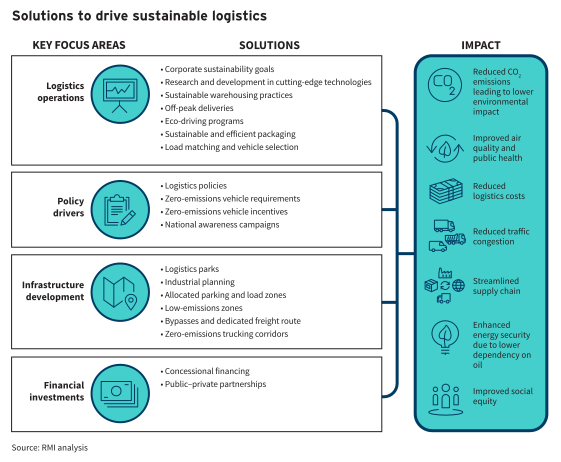
The Green Logistics Playbook provides an actionable toolkit for G20 leaders, offering concrete solutions and successful case studies on sustainable logistics practices across G20 nations that can address climate change, enhance livelihoods, improve public health, and foster economic growth. The solutions presented in the report are divided across four key strategies:
- Logistics operations: Driving robust innovation, research and development, and on-the-ground deployment of sustainable logistics measures.
- Policy drivers: Incentivizing the adoption of efficient logistics practices and conveying potent market signals to prioritize sustainability within the sector.
- Infrastructure development: Strategically planning and deploying a network of physical facilities for storing and transporting goods.
- Financial investments: Facilitating public–private partnerships to mobilize finance for infrastructure and projects geared toward sustainability.
The report outlines system-level changes that the G20, as a global collaborative forum, can achieve by partnering with the participating nations.
Authors

Marie McNamara
Manager
Samhita Shiledar
Principal
Chetna Nagpal
Dave Mullaney
Nikita Bankoti

Pranav Lakhina
ManagerRelated Insights

Help build the clean energy future. Donate today.
Independent research. Real-world solutions. Supported by donors.
RMI can pursue the highest-impact climate and energy solutions because we’re supported by people who believe change is possible. Every gift helps advance the work needed to make clean energy the default choice worldwide.
For other ways to give to RMI, including checks or gifts of stock, please visit Other Ways to Give.