

Learn how we are working to transform how we use and produce energy.
Why we share this work for free
RMI is an independent nonprofit working to accelerate the clean energy transition. We publish research like this to inform decision-makers and drive real-world impact.
Our work is supported by philanthropy as well as partnerships, including fee-for-service engagements. This support makes it possible for us to share our independent insights for free.
If you find this work valuable, you can support it anytime.
Get more insights like this
Stay up to date with the latest research, analysis, and tools from RMI by opting in to receive occasional emails below. You’ll get new reports, event invitations, and practical insights to help us all accelerate the clean energy transition.
Loading form...
Your download should start automatically. If it doesn’t, click the download button below.
This work is made possible by philanthropy
RMI is a nonprofit supported by donors and partners. Philanthropy enables us to produce independent research and make resources like this freely available.
If you find this report valuable, please consider supporting our work. You can also explore how we partner with organizations to drive impact.
Jump to Section
China’s power market reforms have been evolving for 20 years. The core aim of the reforms has been to introduce more competition along the power sector value chain to diversify investments and optimize the overall operation. Beginning in 2002, power generation was separated from grid utilities who oversaw transmission, distribution, and retail. In 2015, the “current round of reforms” was introduced to bring competition to the electricity energy market and the distribution and retail market. However, unique challenges add complexity in communicating China’s power system and market reforms to an international audience:
- China-specific rules that deviate from international common practices.
- China’s policies vary across different municipal levels and are at various stages of implementation.
- Cultural and contextual nuances that are difficult to convey accurately in translation.
RMI aims to build a solid bridge between international audiences and China’s power system and market progress. RMI has been consistently helping our audience accurately understand the details and impacts of the China power system and market reforms, to provide insights on pacing up the energy transition.
Since China’s 2020 announcement of achieving carbon peaking by 2030 and carbon neutrality by 2060, China has accelerated its power system transition and market reforms. The latest power sector top-level design hopes to build a national unified power market that promotes a much higher penetration of renewables without compromising supply security and reliability. The coming years are a crucial time for China to achieve these goals.
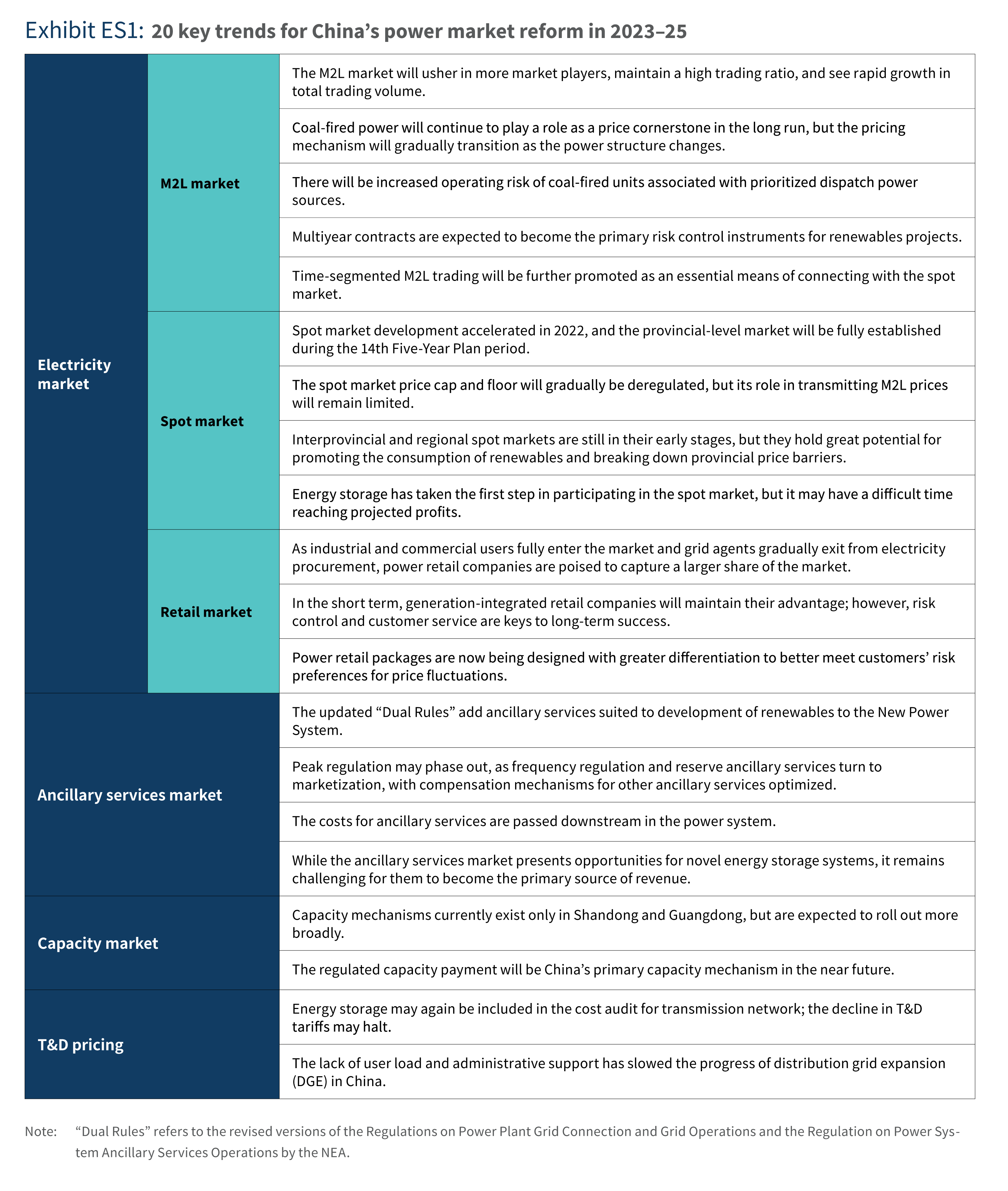
Beginning this year, we will start an annual series to provide insights on the ongoing and emerging trends in China’s power market reforms. This report analyzes the power market’s components, including the electricity energy market, ancillary services market, capacity market, and transmission and distribution pricing. We will examine recent market developments and provide an outlook on power marketization in the next one to three years.




Related Insights

Steel’s Transformation: China and Australia’s next horizon of clean steel

Efficiency Reimagined: The next phase of China’s industrial energy transition

Help build the clean energy future. Donate today.
Independent research. Real-world solutions. Supported by donors.
RMI can pursue the highest-impact climate and energy solutions because we’re supported by people who believe change is possible. Every gift helps advance the work needed to make clean energy the default choice worldwide.
For other ways to give to RMI, including checks or gifts of stock, please visit Other Ways to Give.