

Learn how we are working to transform how we use and produce energy.
Harnessing the Power of S-Curves
How S-Curves Work and What We Can Do to Accelerate Them
Why we share this work for free
RMI is an independent nonprofit working to accelerate the clean energy transition. We publish research like this to inform decision-makers and drive real-world impact.
Our work is supported by philanthropy as well as partnerships, including fee-for-service engagements. This support makes it possible for us to share our independent insights for free.
If you find this work valuable, you can support it anytime.
Get more insights like this
Stay up to date with the latest research, analysis, and tools from RMI by opting in to receive occasional emails below. You’ll get new reports, event invitations, and practical insights to help us all accelerate the clean energy transition.
Loading form...
Your download should start automatically. If it doesn’t, click the download button below.
This work is made possible by philanthropy
RMI is a nonprofit supported by donors and partners. Philanthropy enables us to produce independent research and make resources like this freely available.
If you find this report valuable, please consider supporting our work. You can also explore how we partner with organizations to drive impact.
Jump to Section
In our Peaking Series, we introduced The Peak, Plateau, and Decline and presented historical examples to show how demand for fossil fuels faces inevitable decline. The S-curve growth of new innovations is the main driver of this process of decline.
The full report, available for download, breaks down the system dynamics of the S-curve in easy-to-understand pieces and can be used to help you take the right action at the right time.
Summary
The adoption rate of innovations is non-linear; it is slow at first, then rapidly rises before flattening out again as it reaches market saturation. Such trajectories of growth are commonly known as the S-curve. The rapidly rising part of the S-curve is often underestimated in projections and expectations of new technologies. This is exactly what has happened with wind, batteries, and solar technologies in the past decade, with prices dropping faster and further than many believed possible.
The shape of the S-curve is a result of system feedbacks such as learning curves, economies of scale, technological reinforcement, and social diffusion.
The process of an S-curve is complex and context specific, and some innovations are more likely to scale than others, but all transitions follow the same pattern of shifting dynamics:
- Phase 1: Visionaries recognize a problem or opportunity and conceptualize a better way to do things.
- Phase 2: Innovators move the concept from the laboratory, models, and sketches to working prototypes or pilots.
- Phase 3: Early adopters form niche markets, connecting supply and demand. Performance increases and costs decline but the innovation remains at a premium and not widely available.
- Phase 4: The innovation reaches mass market as it outperforms incumbents in costs and performance. This is the steep part of the S-curve.
- Phase 5: Growth slows as the innovation reaches market saturation. The innovation may be transferred to new markets or serve as the basis for further innovations.
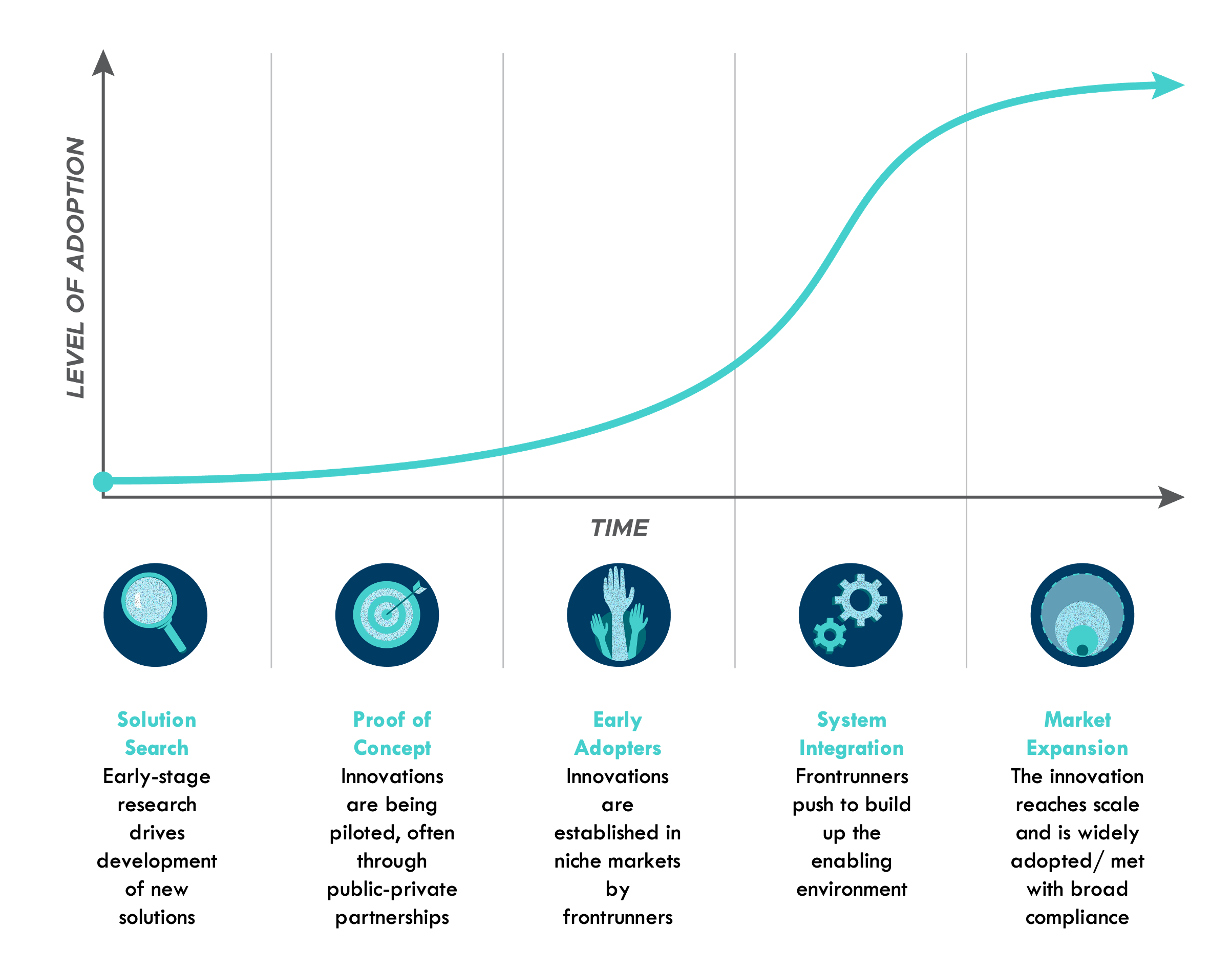
Barriers and system dynamics are predictable, manageable, and solvable through each of these phases. This means that as transitions unfold, stakeholders who have a good understanding of various innovations and their phases can develop targeted strategies to stay ahead of, and take advantage of, new markets. Generally, the fastest movers will stand to capture the biggest rewards, and the slowest movers will be left with the biggest losses.


Related Insights
For Clean Energy Projects, How Community Benefits Are Delivered Matters

Tracking WestTEC: Where 100+ Transmission Projects Stand and What Comes Next
Help build the clean energy future. Donate today.
Independent research. Real-world solutions. Supported by donors.
RMI can pursue the highest-impact climate and energy solutions because we’re supported by people who believe change is possible. Every gift helps advance the work needed to make clean energy the default choice worldwide.
For other ways to give to RMI, including checks or gifts of stock, please visit Other Ways to Give.
