

Learn how we are working to transform how we use and produce energy.
Why we share this work for free
RMI is an independent nonprofit working to accelerate the clean energy transition. We publish research like this to inform decision-makers and drive real-world impact.
Our work is supported by philanthropy as well as partnerships, including fee-for-service engagements. This support makes it possible for us to share our independent insights for free.
If you find this work valuable, you can support it anytime.
Get more insights like this
Stay up to date with the latest research, analysis, and tools from RMI by opting in to receive occasional emails below. You’ll get new reports, event invitations, and practical insights to help us all accelerate the clean energy transition.
Loading form...
Your download should start automatically. If it doesn’t, click the download button below.
This work is made possible by philanthropy
RMI is a nonprofit supported by donors and partners. Philanthropy enables us to produce independent research and make resources like this freely available.
If you find this report valuable, please consider supporting our work. You can also explore how we partner with organizations to drive impact.
Jump to Section
Building operations in India account for about a third of its energy use. Approximately another 10 percent of the country’s energy is used in the production of building material and construction of new buildings. In the absence of peremptory energy-efficiency improvements and policy measures, the buildings sector is estimated to consume over three times more energy by 2050 than what is consumed today. Notably, there is no energy transformation without a buildings sector transformation.
To meet India’s COP26 goals, its buildings sector must adopt an integrative whole-system approach to cost-effectively address embodied and operational emissions across both the demand side and supply side. This can be done by first utilizing low-carbon design and construction, then reducing the operation building-energy needs, then serving the needs as efficiently as possible, and finally optimizing the demand and providing clean energy supply to the buildings. With this approach, India could cut down its buildings-related emissions by a factor of four in 2050 as compared with a business-as-usual scenario.
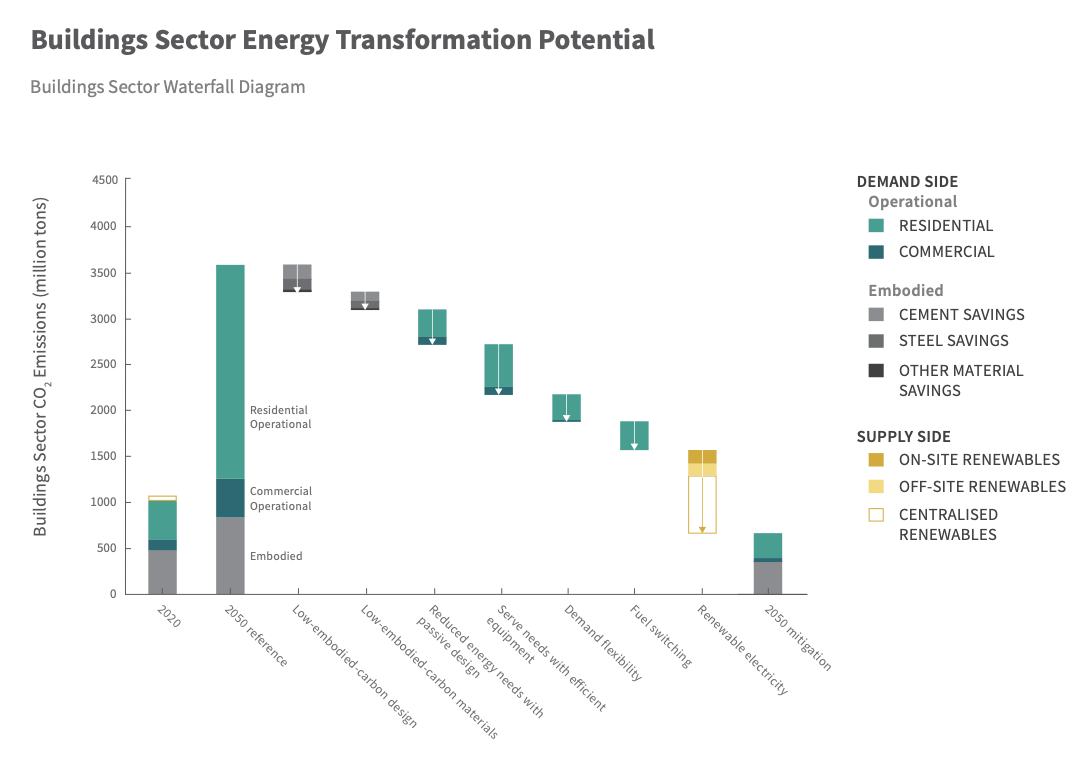
Source: Lawrence Berkeley National Laboratory, RMI Analysis
This report equips policymakers, building material manufacturers, building developers, end-users, and NGOs with technologies, policies, and market initiatives that can drive forward transformative solutions for the buildings sector. The solutions highlighted here are a result of decades of global research and collaboration with interdisciplinary thought leaders.


Related Insights

India’s Used EV Battery Market Needs Trust. Battery Aadhaar Can Help.
Help build the clean energy future. Donate today.
Independent research. Real-world solutions. Supported by donors.
RMI can pursue the highest-impact climate and energy solutions because we’re supported by people who believe change is possible. Every gift helps advance the work needed to make clean energy the default choice worldwide.
For other ways to give to RMI, including checks or gifts of stock, please visit Other Ways to Give.
