

Learn how we are working to transform how we use and produce energy.
Roadmap to Reaching Zero Embodied Carbon in Federal Building Projects
How federal agencies can lead on climate through low-embodied-carbon policies and procurement standards.
Why we share this work for free
RMI is an independent nonprofit working to accelerate the clean energy transition. We publish research like this to inform decision-makers and drive real-world impact.
Our work is supported by philanthropy as well as partnerships, including fee-for-service engagements. This support makes it possible for us to share our independent insights for free.
If you find this work valuable, you can support it anytime.
Get more insights like this
Stay up to date with the latest research, analysis, and tools from RMI by opting in to receive occasional emails below. You’ll get new reports, event invitations, and practical insights to help us all accelerate the clean energy transition.
Loading form...
Your download should start automatically. If it doesn’t, click the download button below.
This work is made possible by philanthropy
RMI is a nonprofit supported by donors and partners. Philanthropy enables us to produce independent research and make resources like this freely available.
If you find this report valuable, please consider supporting our work. You can also explore how we partner with organizations to drive impact.
Jump to Section
The US federal government is the largest single purchaser of building construction materials in the United States. RMI’s new roadmap charts a path to achieving zero embodied carbon from federal buildings projects by 2050 and quantifies the emissions reduction benefits of low-carbon building and material programs. With momentum from the Inflation Reduction Act, which includes more than $5 billion to incentivize the use of low-carbon building materials in public projects, the time is ripe for federal action on embodied carbon.
Embodied carbon is the millions of tons of carbon emitted during the extraction, manufacturing, transport, construction, and end-of-life disposal of the materials that make up our buildings, such as concrete, steel, and insulation. Embodied carbon emissions from the building sector alone account for 11 percent of annual global greenhouse gas (GHG) emissions.
In addition to ensuring a robust “Buy Clean Initiative” that prioritizes the use of American-made low-carbon construction materials, our analysis shows that whole-project emissions standards can be set by the federal government to zero or “carbon-positive” levels, creating a framework for agencies to build carbon-storing projects by 2045. Altogether, the impact of these standards could directly reduce GHG emissions by a cumulative 17 million tons of CO2 by 2050, equivalent to removing 3.6 million gas-powered cars from the road for a year.
The core strategies underpinning RMI’s roadmap to zero embodied carbon by 2050 are:
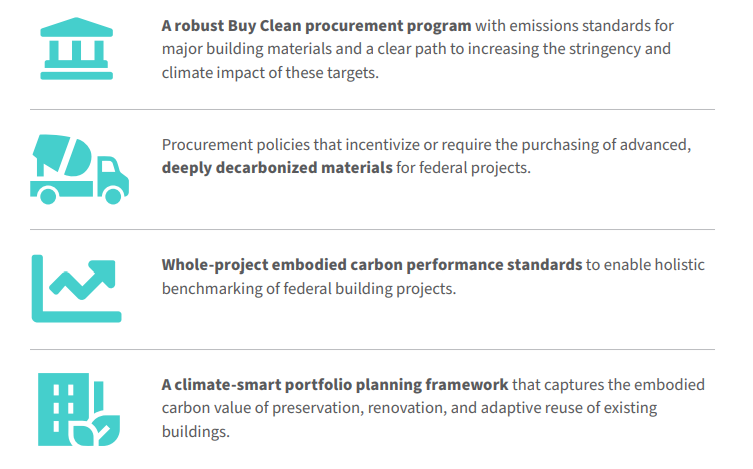
Beyond these strategies, the federal government’s actions will catalyze the market for low-carbon materials and spur industrial decarbonization. This report will help federal agencies understand their broader role in advancing the movement to decarbonize building materials by establishing nationwide standards and databases that will increase consistency in embodied emissions benchmarking. It also aims to assist the federal government to further catalyze markets for disruptive, deeply decarbonized materials, such as zero-carbon cement, zero-carbon steel, mass timber, or bio-based insulation and finish materials, through industrial, trade, and workforce development policies.
Now is the time for the federal government to lead by example on reducing embodied carbon emissions and further align with the Intergovernmental Panel on Climate Change’s call to limit global warming to 1.5°C to avoid the most catastrophic impacts of climate change.
Authors

Connor Usry
Victor Olgyay
Anish Tilak
Related Insights
The Opportunity for Heat Pumps to Put Downward Pressure on Electricity Rates
Building Smarter, More Efficient Air Conditioners for Real World Conditions

How Heat Pumps Reduce Energy Bills and Air Pollution in the San Francisco Bay Area
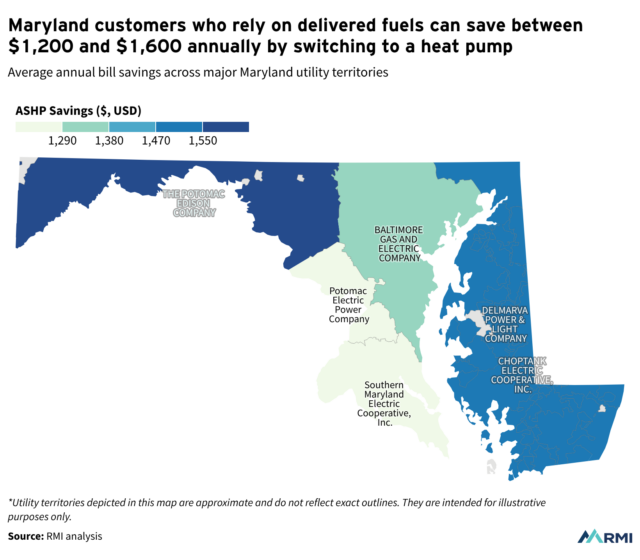
Delivered Fuel Customers in Maryland See Strong Energy Bill Savings in a Switch to Heat Pumps
Help build the clean energy future. Donate today.
Independent research. Real-world solutions. Supported by donors.
RMI can pursue the highest-impact climate and energy solutions because we’re supported by people who believe change is possible. Every gift helps advance the work needed to make clean energy the default choice worldwide.
For other ways to give to RMI, including checks or gifts of stock, please visit Other Ways to Give.
