

Learn how we are working to transform how we use and produce energy.
Why we share this work for free
RMI is an independent nonprofit working to accelerate the clean energy transition. We publish research like this to inform decision-makers and drive real-world impact.
Our work is supported by philanthropy as well as partnerships, including fee-for-service engagements. This support makes it possible for us to share our independent insights for free.
If you find this work valuable, you can support it anytime.
Get more insights like this
Stay up to date with the latest research, analysis, and tools from RMI by opting in to receive occasional emails below. You’ll get new reports, event invitations, and practical insights to help us all accelerate the clean energy transition.
Loading form...
Your download should start automatically. If it doesn’t, click the download button below.
This work is made possible by philanthropy
RMI is a nonprofit supported by donors and partners. Philanthropy enables us to produce independent research and make resources like this freely available.
If you find this report valuable, please consider supporting our work. You can also explore how we partner with organizations to drive impact.
Jump to Section
Freight transport is the backbone of India’s economy. It plays a critical role in ensuring a smooth flow of goods and services to satisfy the needs of businesses and consumers. India moves 4.6 billion tons of freight annually, and the trucking sector moves 70 percent of India’s freight. As distance traveled by trucks increases, reliance on fossil fuel vehicles will continue to worsen air pollution and public health, and increase CO2 emissions and transportation costs.
Zero-emissions trucks (ZETs) — including battery-electric trucks and fuel-cell-electric trucks — can reduce air pollution and transportation costs while enhancing industrial competitiveness, benefiting both citizens and the Indian economy. Road freight accounts for more than 25 percent of annual oil imports. ZET adoption can avoid 838 billion liters of diesel consumption cumulatively by 2050, resulting in upward of $1.5 trillion of reduced oil expenditures. Widespread ZET adoption can reduce associated trucking particular matter and nitrous oxide pollution by nearly 40 percent by 2050, substantially improving air quality. Similarly, replacing diesel trucks with ZETs in India could eliminate up to 3.8 cumulative gigatons of carbon emissions between now and 2050 — one of the world’s most significant decarbonization opportunities in the transportation sector.
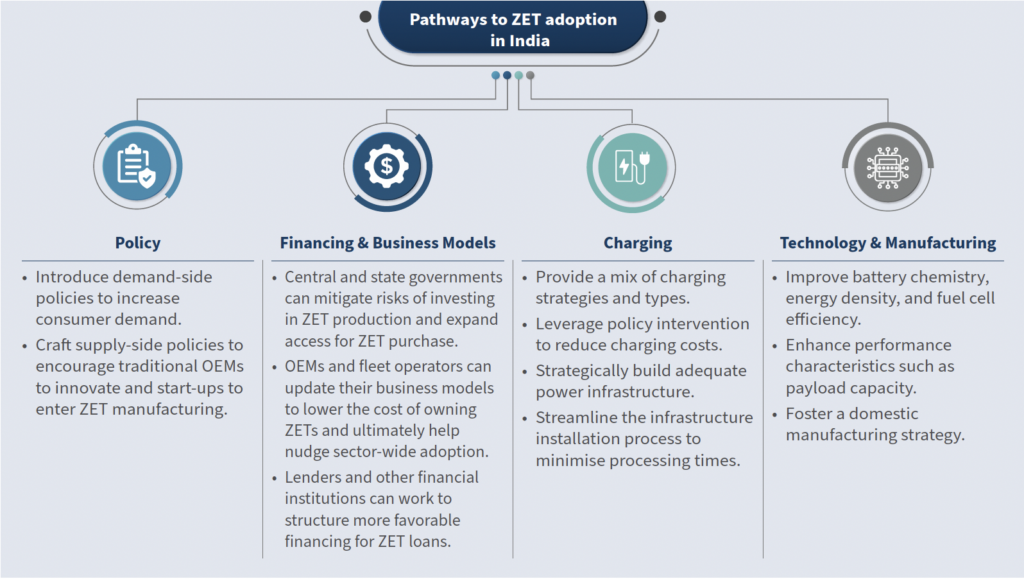
This report outlines the economic case for scaling ZET adoption and presents a blend of near-term and long-term strategies and solutions — including policy, financing, access to charging, and technology innovation — that can enable India to capitalize on the far-reaching benefits of a zero-emissions trucking future. The report also shows that the estimated total cost of ownership for medium-duty ZETs under a mature production scenario is lower than diesel trucks and could feasibly reach parity in the heavy-duty truck segment by 2027.
Globally, the ZET transition is underway; major conglomerates are electrifying their fleets, and countries have begun to focus on reducing emissions from the road freight sector. India has an opportunity to capitalize on the nascent ZET market and become a key player in the global transition to zero-emissions trucking.


Related Insights

India’s Used EV Battery Market Needs Trust. Battery Aadhaar Can Help.
Help build the clean energy future. Donate today.
Independent research. Real-world solutions. Supported by donors.
RMI can pursue the highest-impact climate and energy solutions because we’re supported by people who believe change is possible. Every gift helps advance the work needed to make clean energy the default choice worldwide.
For other ways to give to RMI, including checks or gifts of stock, please visit Other Ways to Give.
