

Learn how we are working to transform how we use and produce energy.
Pioneering Electric Buses in Pune
A Case Study of the City’s Initial Procurement and Operations
Why we share this work for free
RMI is an independent nonprofit working to accelerate the clean energy transition. We publish research like this to inform decision-makers and drive real-world impact.
Our work is supported by philanthropy as well as partnerships, including fee-for-service engagements. This support makes it possible for us to share our independent insights for free.
If you find this work valuable, you can support it anytime.
Get more insights like this
Stay up to date with the latest research, analysis, and tools from RMI by opting in to receive occasional emails below. You’ll get new reports, event invitations, and practical insights to help us all accelerate the clean energy transition.
Loading form...
Your download should start automatically. If it doesn’t, click the download button below.
This work is made possible by philanthropy
RMI is a nonprofit supported by donors and partners. Philanthropy enables us to produce independent research and make resources like this freely available.
If you find this report valuable, please consider supporting our work. You can also explore how we partner with organizations to drive impact.
Jump to Section
Electrifying public transport is critical to decarbonizing urban mobility. Although the domestic electric bus (e-bus) market in India is nascent, projections indicate 4 in 10 buses sold in the country could be electric by 2030. As a leading early adopter of e-buses, the city of Pune, Maharashtra, represents a valuable case study on public transport electrification.
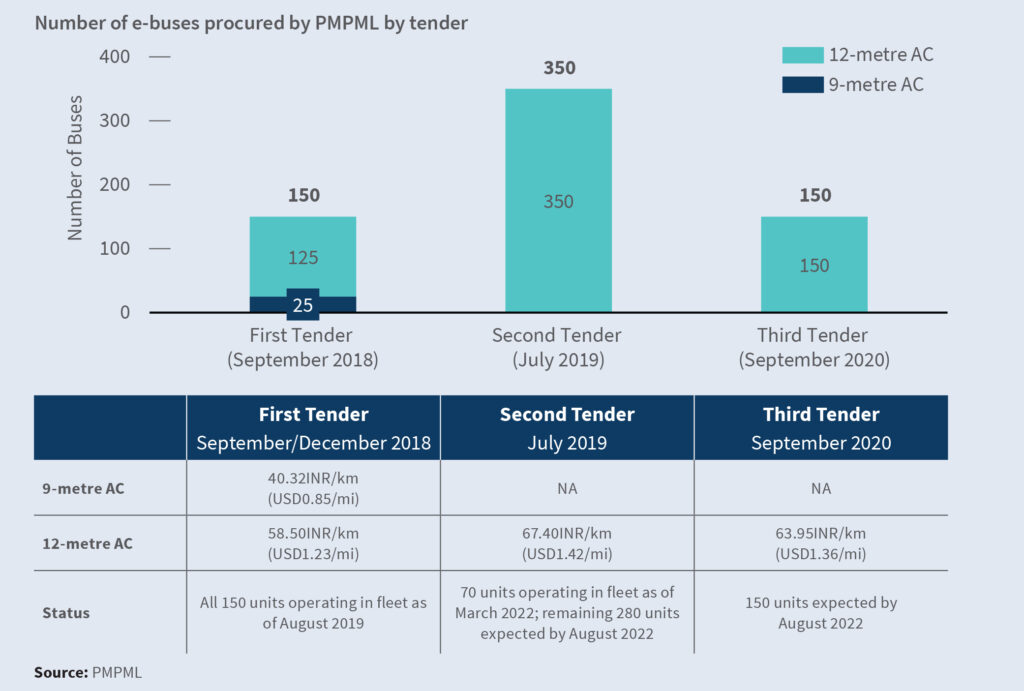
Pune’s public transport agency, Pune Mahanagar Parivahan Mahamandal Limited (PMPML), currently has 220 e-buses operating in its fleet of 2,169 buses — one of the largest municipal e-bus fleets operating in India. Once PMPML commissions the remaining 430 e-buses it has tendered, Pune will be on track to meet the target outlined in the state government’s electric vehicle policy — 25 percent electrification of the public transport bus fleet by 2025 — three years ahead of schedule.
Pune’s experience in e-bus procurement and operation offers valuable insights and points of reference on the forms of interagency coordination, policy support, business model design, tendering and contracting terms, and infrastructure planning to enable e-bus adoption in Indian cities. This case study provides an overview of the city’s motivation, planning process, and tenders and contracts; summarizes key enablers and challenges; quantifies economic, environmental, and public health benefits; and includes testimonials and next steps.
Through this case study, the city administration — the Pune Municipal Corporation, Pune Smart City Development Corporation, and PMPML — RMI, and RMI India aim to inspire and inform the efforts of other cities in India and the Global South to successfully incorporate e-buses in their own public transport fleets.


Related Insights

India’s Used EV Battery Market Needs Trust. Battery Aadhaar Can Help.
Help build the clean energy future. Donate today.
Independent research. Real-world solutions. Supported by donors.
RMI can pursue the highest-impact climate and energy solutions because we’re supported by people who believe change is possible. Every gift helps advance the work needed to make clean energy the default choice worldwide.
For other ways to give to RMI, including checks or gifts of stock, please visit Other Ways to Give.
