

Learn how we are working to transform how we use and produce energy.
Scaling Clean: Assessing Market Options for Clean Energy and Capacity in PJM
This report draws on original RMI analysis as well as extensive discussions with PJM states, utilities, customers, and clean energy developers.
Why we share this work for free
RMI is an independent nonprofit working to accelerate the clean energy transition. We publish research like this to inform decision-makers and drive real-world impact.
Our work is supported by philanthropy as well as partnerships, including fee-for-service engagements. This support makes it possible for us to share our independent insights for free.
If you find this work valuable, you can support it anytime.
Get more insights like this
Stay up to date with the latest research, analysis, and tools from RMI by opting in to receive occasional emails below. You’ll get new reports, event invitations, and practical insights to help us all accelerate the clean energy transition.
Loading form...
Your download should start automatically. If it doesn’t, click the download button below.
This work is made possible by philanthropy
RMI is a nonprofit supported by donors and partners. Philanthropy enables us to produce independent research and make resources like this freely available.
If you find this report valuable, please consider supporting our work. You can also explore how we partner with organizations to drive impact.
Jump to Section
Spurred by state decarbonization policy, strong customer demand, and rapidly improving technology, carbon-free energy is playing a growing role in PJM, the United States’ largest wholesale electricity market. However, the pace of PJM’s energy transition is much too slow to avoid the worst impacts of climate change. To accelerate and sustain decarbonization while retaining reliability and affordability, PJM will need to better incorporate the capabilities and services of carbon-free resources in its markets.
Through the Resource Adequacy Senior Task Force (RASTF), PJM stakeholders are considering significant changes to the RTO’s capacity market rules, including the creation of a voluntary clean energy market. In this report, we review two clean energy market designs under consideration (the Forward Clean Energy Market and Integrated Clean Capacity Market), share analysis that clarifies the opportunities that clean energy markets provide, and make recommendations to PJM and its stakeholders as they consider next steps.
Key Findings
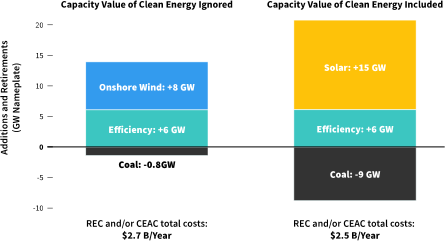
- Accounting for the capacity value of clean energy resources lowers costs and reduces emissions.
- If we assume all market actors accurately account for the capacity value of clean resources, the two market designs and the status quo produce identical, “optimal” outcomes.
- State carve-out policies (e.g., policies specifying targets for specific technologies or in-state generation resources) have meaningful cost and emissions implications that should be considered together with their benefits.
- If a centralized clean energy market helped attract new buyers, the increased voluntary demand would accelerate clean energy deployment and fossil asset retirement.
Recommendations Based on Our Analysis and Conversations with PJM Stakeholders
- PJM and RASTF stakeholders should keep “clean procurement” in the task force’s scope and pursue reforms that remove barriers to the participation of clean energy resources in the capacity market.
- States should collaboratively define a standardized clean energy product that can be competitively procured throughout PJM, which could streamline clean energy credit transactions, lower costs, and accelerate emissions reductions.
- A regional clean energy procurement process should foster participation from all potential buyers, including cities and businesses with clean energy goals.
- PJM and stakeholders should prioritize approaches that accelerate near-term decarbonization, can adapt to a more deeply decarbonized grid, and are politically feasible.
Authors

Katie Siegner
Manager
Chaz Teplin
Principal
Sarah Toth Kotwis
Technical Manager
Grant Glazer
Related Insights
Reality Check: For Power Plants, Changing the Fuel Doesn’t Fix the Economics

The Opportunity for Heat Pumps to Put Downward Pressure on Electricity Rates

For Clean Energy Projects, How Community Benefits Are Delivered Matters
Tracking WestTEC: Where 100+ Transmission Projects Stand and What Comes Next
Help build the clean energy future. Donate today.
Independent research. Real-world solutions. Supported by donors.
RMI can pursue the highest-impact climate and energy solutions because we’re supported by people who believe change is possible. Every gift helps advance the work needed to make clean energy the default choice worldwide.
For other ways to give to RMI, including checks or gifts of stock, please visit Other Ways to Give.
