

Learn how we are working to transform how we use and produce energy.
Why we share this work for free
RMI is an independent nonprofit working to accelerate the clean energy transition. We publish research like this to inform decision-makers and drive real-world impact.
Our work is supported by philanthropy as well as partnerships, including fee-for-service engagements. This support makes it possible for us to share our independent insights for free.
If you find this work valuable, you can support it anytime.
Get more insights like this
Stay up to date with the latest research, analysis, and tools from RMI by opting in to receive occasional emails below. You’ll get new reports, event invitations, and practical insights to help us all accelerate the clean energy transition.
Loading form...
Your download should start automatically. If it doesn’t, click the download button below.
This work is made possible by philanthropy
RMI is a nonprofit supported by donors and partners. Philanthropy enables us to produce independent research and make resources like this freely available.
If you find this report valuable, please consider supporting our work. You can also explore how we partner with organizations to drive impact.
Jump to Section
India has outlined an ambitious target of 500 GW of non-fossil fuel-based energy generation in India by 2030 and to reduce the total projected carbon emissions by 1 billion tons by same period. To attain these targets, India needs a significant amount of grid storage and a large increase in the number of electric vehicles (EVs).
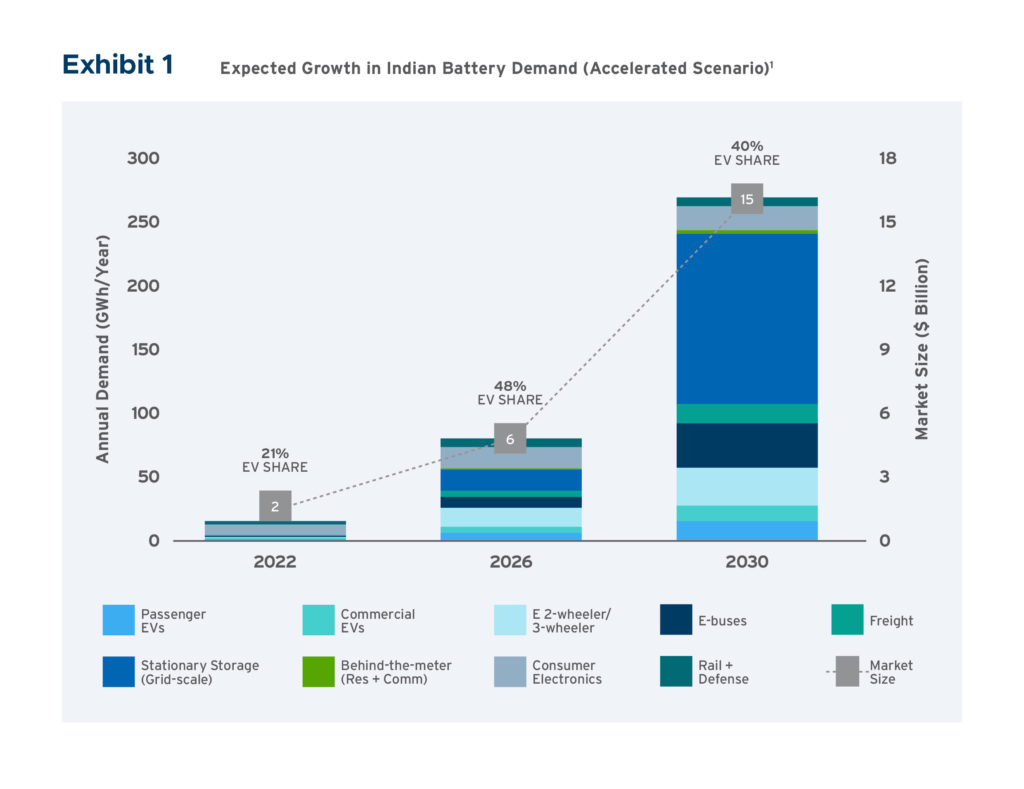
This report maps the requirement for energy storage across key sectors and projects the demand for batteries in India to 2030. The report foresees a cumulative demand between 106 GWh to 260 GWh for batteries depending on the pace of EV adoption and grid decarbonization. While mobility is the primary driver of demand growth, energy storage is expected to see significant uptake for grid support applications to enable a resilient power sector and facilitate the integration of increasingly higher shares of variable renewable energy.
This report is the first of a three-report series designed to create a shared understanding among stakeholders of current status and future trends that are emerging in the advanced chemistry cells (ACC) battery sector and to build awareness of India’s supportive programs on ACC battery storage, most importantly the Productive Linked Incentives (PLI) scheme for battery cell manufacturing.
This assessment informs the opportunity and criticality for India’s emergence as a major global hub for advanced cells manufacturing. Sizing the storage market can enable stakeholders – policymakers and industry, to strategically plan investments in domestic manufacturing and associated supply chain for ACC energy storage in India. Capturing a lion’s share of the value proposition of energy storage locally can reduce reliance on imports of cells and make India a global leader in battery manufacturing. The positive market outlook and investment opportunity must be complemented with stable, long-term policies by the government at all stages of the value chain to drive demand and create a sustainable, circular industry.


Related Insights

India’s Used EV Battery Market Needs Trust. Battery Aadhaar Can Help.

Help build the clean energy future. Donate today.
Independent research. Real-world solutions. Supported by donors.
RMI can pursue the highest-impact climate and energy solutions because we’re supported by people who believe change is possible. Every gift helps advance the work needed to make clean energy the default choice worldwide.
For other ways to give to RMI, including checks or gifts of stock, please visit Other Ways to Give.
