

Learn how we are working to transform how we use and produce energy.
Banking on Electric Vehicles in India
A Blueprint for Inclusion of EVs in Priority Sector Lending Guidelines
Why we share this work for free
RMI is an independent nonprofit working to accelerate the clean energy transition. We publish research like this to inform decision-makers and drive real-world impact.
Our work is supported by philanthropy as well as partnerships, including fee-for-service engagements. This support makes it possible for us to share our independent insights for free.
If you find this work valuable, you can support it anytime.
Get more insights like this
Stay up to date with the latest research, analysis, and tools from RMI by opting in to receive occasional emails below. You’ll get new reports, event invitations, and practical insights to help us all accelerate the clean energy transition.
Loading form...
Your download should start automatically. If it doesn’t, click the download button below.
This work is made possible by philanthropy
RMI is a nonprofit supported by donors and partners. Philanthropy enables us to produce independent research and make resources like this freely available.
If you find this report valuable, please consider supporting our work. You can also explore how we partner with organizations to drive impact.
Jump to Section
Cumulative investment in India’s electric vehicle (EV) transition could be as large as INR 19.7 lakh crore ($US266 billion) between 2020 and 2030. Although public and private sector initiatives are accelerating capital deployment to meet this potential, retail lending to support the financing of EVs has been slow to pick up.
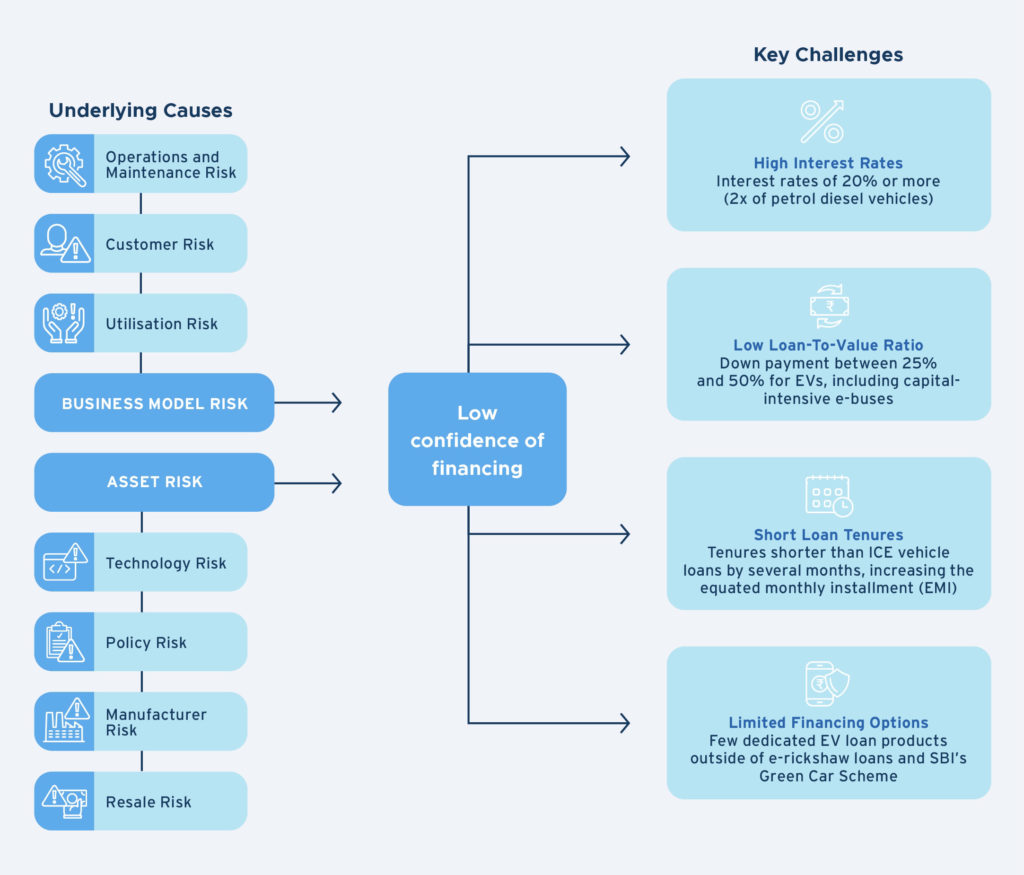
Banks and non-banking finance companies (NBFCs) currently hesitate to lend for EVs due to perceived and real asset and business model risks. As a result, if financing is available, EV buyers are unable to obtain interest rates and tenures that are comparable to internal combustion engine vehicles. This has created the need for a regulatory measure that can mainstream financing of EVs.
The Reserve Bank of India’s Priority Sector Lending (PSL) guidelines require scheduled banks to allocate 40 percent of their total credit to sectors of national priority. Including EVs as a priority sector has the potential to enhance financing for credit-deficient segments and use cases and institutionalize EVs in India’s financial system.
NITI Aayog is working with the Reserve Bank of India to operationalize the inclusion of EVs as a priority sector. There is also a need to engage other ministries, financial institutions, and the EV industry in the design of the guidelines. This report is intended to support ongoing and future deliberations on consideration of priority sector status for EVs and the design of guidelines for EVs. The report provides:
- Context on the structure, mechanics, and history of PSL
- Considerations and recommendations to inform the inclusion of EVs in the PSL guidelines
- Actions needed to implement and ensure success of EVs as a priority sector


Related Insights

India’s Used EV Battery Market Needs Trust. Battery Aadhaar Can Help.

Help build the clean energy future. Donate today.
Independent research. Real-world solutions. Supported by donors.
RMI can pursue the highest-impact climate and energy solutions because we’re supported by people who believe change is possible. Every gift helps advance the work needed to make clean energy the default choice worldwide.
For other ways to give to RMI, including checks or gifts of stock, please visit Other Ways to Give.
