

Learn how we are working to transform how we use and produce energy.
Why we share this work for free
RMI is an independent nonprofit working to accelerate the clean energy transition. We publish research like this to inform decision-makers and drive real-world impact.
Our work is supported by philanthropy as well as partnerships, including fee-for-service engagements. This support makes it possible for us to share our independent insights for free.
If you find this work valuable, you can support it anytime.
Get more insights like this
Stay up to date with the latest research, analysis, and tools from RMI by opting in to receive occasional emails below. You’ll get new reports, event invitations, and practical insights to help us all accelerate the clean energy transition.
Loading form...
Your download should start automatically. If it doesn’t, click the download button below.
This work is made possible by philanthropy
RMI is a nonprofit supported by donors and partners. Philanthropy enables us to produce independent research and make resources like this freely available.
If you find this report valuable, please consider supporting our work. You can also explore how we partner with organizations to drive impact.
Jump to Section
China’s carbon-neutrality target establishes a direction for realizing a zero-carbon China and will greatly support the drive toward ecological civilization and green, sustainable, and high-quality development. It will also be a strong driving force for revolution in the energy sector. In addition, the carbon-neutrality goal will activate the market and encourage more long-term value investors to focus on zero-carbon development and invest in zero-carbon assets, projects, and technologies.
In this report we identify seven key investment areas for China’s zero-carbon transition: resource recycling, energy efficiency, demand-side electrification, zero-carbon power generation, energy storage, hydrogen, and digitalization. These zero-carbon technologies are currently at different phases in terms of market expectations and industrial maturity. They therefore face different challenges and opportunities, which require different policy and market enablers to become more bankable. The market size of these seven areas will reach nearly ¥15 trillion (US$2.32 trillion) by 2050. Meanwhile, from 2020 to 2050, there will be about ¥70 trillion (US$10.8 trillion) in infrastructure investment leveraged directly or indirectly.
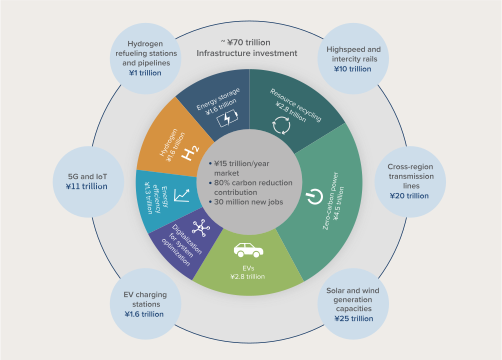
We analyze the trends and market sizes of these technologies while envisioning a development pathway for these clean tech solutions. Additionally, we provide policy and investment recommendations for each area according to its development stage and role in the zero-carbon economy.
Zero-carbon China will be the new direction of long-term value investment, thanks to the global trend of zero-carbon development and transition, as well as the Chinese government’s increasingly clear strategic goal of zero carbon. Considering that zero-carbon China is still at an early stage of development, the government should introduce related policies and measures in the seven investment areas and continuously improve the investment environment. Investors should also strengthen their understanding of zero-carbon investment sectors and expand their capabilities in order to be fully prepared for these new opportunities and reap the value returns.



Related Insights

Steel’s Transformation: China and Australia’s next horizon of clean steel

Efficiency Reimagined: The next phase of China’s industrial energy transition

Help build the clean energy future. Donate today.
Independent research. Real-world solutions. Supported by donors.
RMI can pursue the highest-impact climate and energy solutions because we’re supported by people who believe change is possible. Every gift helps advance the work needed to make clean energy the default choice worldwide.
For other ways to give to RMI, including checks or gifts of stock, please visit Other Ways to Give.
