

Learn how we are working to transform how we use and produce energy.
Unlocking Hidden Value in Class B/C Office Buildings
Why we share this work for free
RMI is an independent nonprofit working to accelerate the clean energy transition. We publish research like this to inform decision-makers and drive real-world impact.
Our work is supported by philanthropy as well as partnerships, including fee-for-service engagements. This support makes it possible for us to share our independent insights for free.
If you find this work valuable, you can support it anytime.
Get more insights like this
Stay up to date with the latest research, analysis, and tools from RMI by opting in to receive occasional emails below. You’ll get new reports, event invitations, and practical insights to help us all accelerate the clean energy transition.
Loading form...
Your download should start automatically. If it doesn’t, click the download button below.
This work is made possible by philanthropy
RMI is a nonprofit supported by donors and partners. Philanthropy enables us to produce independent research and make resources like this freely available.
If you find this report valuable, please consider supporting our work. You can also explore how we partner with organizations to drive impact.
Jump to Section
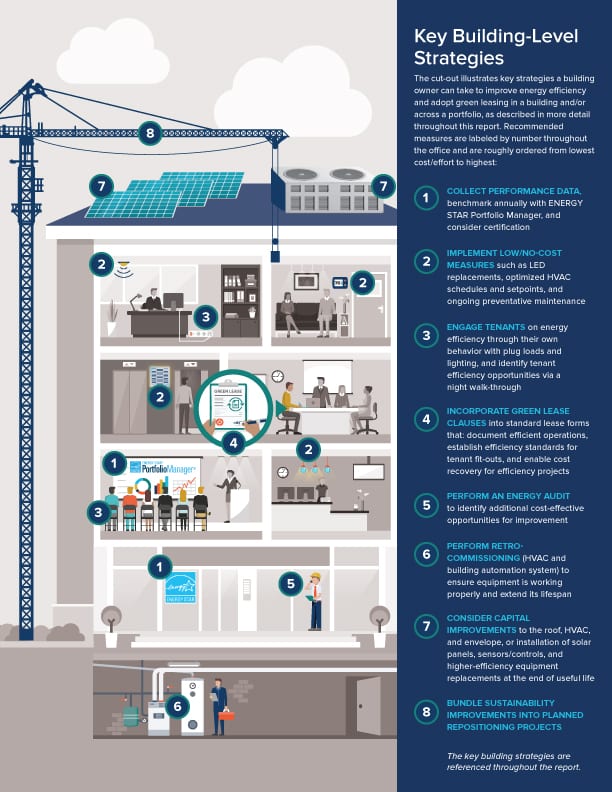
It’s time that Class B and C office owners recognize the largely untapped business opportunity to improve the energy performance of their properties through energy efficiency and green leasing. Compared to business-as-usual operations, Class B/C properties could save roughly 15 percent of their energy costs with a bundle of low-to-no-cost measures, and 35 percent or more with larger investments. That can translate into net operating income increases of 2.4 percent to 5.6 percent, and property value increases of $5 to $11 per square foot (i.e., $343,000 to $800,000 for a 75,000 square foot building).
Even with these financial benefits, there’s a reason that the Class B/C office market hasn’t yet wholeheartedly adopted energy efficiency and green leasing into normal course business practices—it’s at a disadvantage compared to the Class A market. These properties are information constrained, resource constrained, and funding constrained.
The recommended low-cost, high-impact strategies and case studies in this report were developed based on primary and secondary research, including a series of in depth interviews with a wide range of Class B/C office professionals. They are intended to simplify and streamline energy efficiency and green leasing opportunities for Class B/C office owners and provide strategies that are appropriately tailored to the reality of the market, anchored around overcoming core barriers for Class B/C building owners.



Related Insights
Gas Utility Depreciation: Recommendations for an Uncertain Future

Help build the clean energy future. Donate today.
Independent research. Real-world solutions. Supported by donors.
RMI can pursue the highest-impact climate and energy solutions because we’re supported by people who believe change is possible. Every gift helps advance the work needed to make clean energy the default choice worldwide.
For other ways to give to RMI, including checks or gifts of stock, please visit Other Ways to Give.
