

Learn how we are working to transform how we use and produce energy.
Why we share this work for free
RMI is an independent nonprofit working to accelerate the clean energy transition. We publish research like this to inform decision-makers and drive real-world impact.
Our work is supported by philanthropy as well as partnerships, including fee-for-service engagements. This support makes it possible for us to share our independent insights for free.
If you find this work valuable, you can support it anytime.
Get more insights like this
Stay up to date with the latest research, analysis, and tools from RMI by opting in to receive occasional emails below. You’ll get new reports, event invitations, and practical insights to help us all accelerate the clean energy transition.
Loading form...
Your download should start automatically. If it doesn’t, click the download button below.
This work is made possible by philanthropy
RMI is a nonprofit supported by donors and partners. Philanthropy enables us to produce independent research and make resources like this freely available.
If you find this report valuable, please consider supporting our work. You can also explore how we partner with organizations to drive impact.
Jump to Section
This paper serves as an introduction to the virtual power purchase agreement (VPPA)—its place in the off-site renewable energy procurement market, how the VPPA works, and why VPPAs have been a popular instrument in the United States thus far. This paper is aimed at renewable energy buyers who are seeking to understand the VPPA mechanism.
There are two types of off-site power purchase agreements (PPAs) in the market:
Physical PPA—Within a physical PPA contract, the corporate buyer takes ownership of the electrons produced by the renewable energy project. This transaction places responsibility on the buyer for monetizing/selling the electrons, which is typically achieved by selling them into the wholesale electricity market. Depending on the contract structure, the buyer could also pay for transmission charges.
Virtual PPA—Within a VPPA contract, the corporate buyer does not own and is not responsible for the physical electrons generated by the project. The VPPA is purely a financial transaction, exchanging a fixed-price cash flow for a variable-priced cash flow and renewable energy certificates (RECs). Because the VPPA is purely financial, the buyer still needs to meet its electricity load through traditional channels—therefore, the VPPA means the buyer’s relationship with its utility at the retail level remains unchanged.
For background, the physical PPA was the dominant form of transaction in the early years of the corporate renewable energy market, as the companies procuring energy then typically had very large energy needs and were sophisticated energy managers in their own rights. The virtual PPA has gained prominence in the past few years and is the fastest-growing transaction structure today, allowing smaller buyers and those companies without energy trading expertise to participate. The VPPA has enabled many companies to make quick and significant progress toward ambitious renewable energy goals.
VPPAs are easily scalable and enable buyers to satisfy a large portion of their sustainability goals with a relatively small number of deals. For example, Fifth Third Bank was able to meet its 100% renewable energy goal with just one VPPA. Also, because VPPAs are purely financial transactions, they allow buyers that have highly distributed electricity load—or load in regulated markets—to meet their renewable energy goals quickly and efficiently.
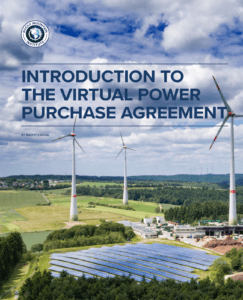
Download the Introduction to the Virtual Power Purchase Agreement Report
Authors

Rachit Kansal
ManagerRelated Insights



Help build the clean energy future. Donate today.
Independent research. Real-world solutions. Supported by donors.
RMI can pursue the highest-impact climate and energy solutions because we’re supported by people who believe change is possible. Every gift helps advance the work needed to make clean energy the default choice worldwide.
For other ways to give to RMI, including checks or gifts of stock, please visit Other Ways to Give.
