Skip to content

Advanced Clean Trucks Dashboard

Truck electrification is feasible today. To advance their electrification
efforts, utilities, city governments, and fleet operators need robust data and
analysis. RMI’s Advanced Clean Trucks Dashboard can help, as it answers the most
pressing questions stakeholders have, including:

  • How many trucks are there in a county?
  • How many of those trucks are electrifiable?
  • How many of those trucks are medium-duty or heavy-duty?
  • How many miles do those trucks drive?
  • How much energy would those trucks need if they were electrified?
  • What kind of infrastructure would these trucks need if they electrified?
  • How would truck charging impact grid load?
  • How would truck electrification impact local air quality?
  • What kinds of health benefits are associated with trucking
    electrification?

The dashboard addresses these questions using real-world trucking data, focused
on 15 states that have adopted (or are planning to adopt) the Advanced Clean
Trucks (ACT) rule.

Utilities can use the dashboard to understand how much energy
electric trucks will need and when they will charge. They can also gain an
understanding of how these trucks’ power needs will affect the grid.

City governments wanting to promote trucking electrification
in their city can quantify the public health impacts of e-trucks, understand the
impacts of trucking electrification on municipal utilities, learn how to fund
public charging infrastructure, and determine how many electric trucks would need
to use public infrastructure to charge.

Fleet operators can use the dashboard to understand which
trucks they should electrify first, whether trucks should share chargers or have
individual chargers, and how long it takes to recharge a truck.

Trucking
Electrification 101

To cut greenhouse gas emissions by at least 50 percent by 2030, we must
transition to zero-emissions medium-duty and heavy-duty trucks — no small feat for
a sector that consumes 2.4 million barrels of oil a day, despite only comprising
10 percent of vehicles on the road.

Replacing gas-powered trucks, which produce more
than 500 million metric tons of CO2
in the United States annually
— a staggering 23 percent of the transportation sector’s carbon footprint, with
battery electric trucks, significantly reduces their emissions.

Electrifying e-trucks in the United States would avoid 1.8–1.9 billion
metric tons of CO2e
by 2045, equivalent to the emissions released
by 400 million passenger cars for a year.

Today’s Trucking
Market

Trucks drive over 275 billion miles and move 11 billion tons of freight each
year. Analysts expect the market for trucks to
continue
to grow
as manufacturers race to catch up to the increasing demands of
e-commerce; the American Trucking Association projects freight tonnage to grow by
25 percent by 2045. If trucking continues business-as-usual operations, trucking
emissions are projected to increase by 50 percent in that time.

The Current State of Trucking Electrification

The North American Council for Freight Efficiency (NACFE) 2023 Run on Less
Electric demonstration highlighted progress in truck electrification. The
demonstration tracked 10 fleets operating 22 battery-electric trucks in the United
States, Canada, and Mexico to understand daily miles driven, battery state of
charge, and other metrics.

The demonstration found that battery electric trucks were mature enough for
investment in four market segments — vans and step vans, medium-duty box trucks,
terminal tractors, and heavy-duty regional haul tractors. Consistent with the Run
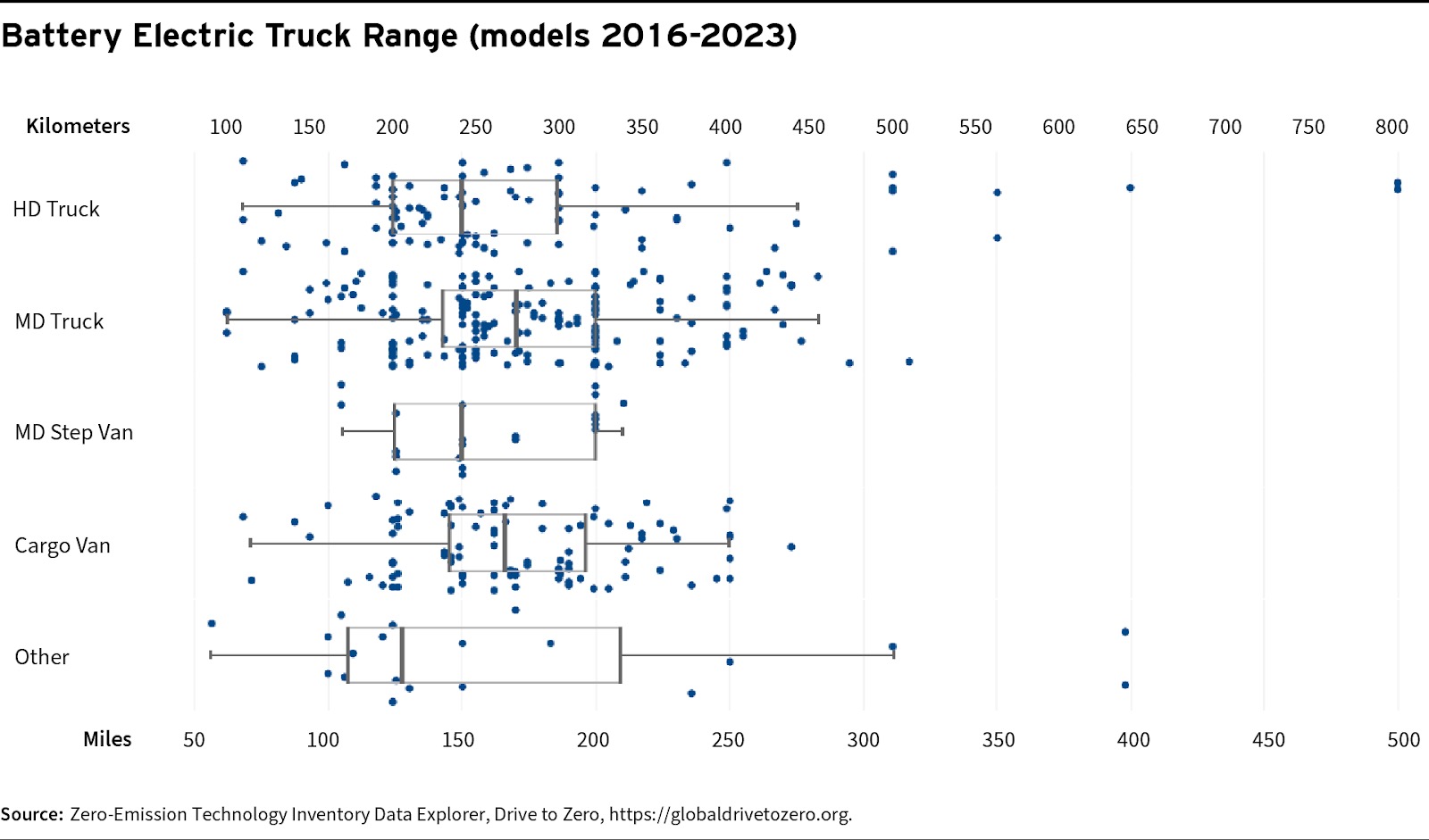
on Less Electric results, the Zero-Emissions Technology Inventory has cataloged the range of
all electric truck models today and has found that the majority of trucks have a
range of 100 to 200 miles, with newer models exceeding 300 miles on a single
charge.

The Impact of the Advanced Clean Trucks Rule

California has been a leader in advancing clean transportation technology,
including the state’s efforts to transition to clean trucks. California’s
influence has spread beyond its borders, shaping clean transportation policies
across the nation.

In 2020, California passed the ACT rule, the world’s first zero-emissions commercial truck
requirement. This groundbreaking legislation requires original equipment
manufacturers of medium- and heavy-duty vehicles to sell an increasing percentage
of zero-emissions vehicles (ZEVs) annually from 2024 to 2035.

Since ACT was adopted, 18 states and the District of Columbia have formed the
largest-ever national partnership to address truck pollution. These states have
committed to achieve 30 percent ZEV truck sales by 2030 and 100 percent by 2050.
Some states have already fully embraced the ACT rule, while others are in the
process or have signed the rule’s memorandum of understanding, marking a decisive
step toward a cleaner future for American truck fleets.

Frequently Asked Questions

In this dashboard, we define “electrifiable” vehicles as those returning to a depot after driving fewer than 300 miles on 95 percent of their journeys.

These criteria — limited travel distance and return to a fixed base — capture the two primary constraints on real-world e-truck operations: limited mileage range and lack of public and/or shared charging infrastructure.

This definition of electrifiable trucks aims to capture the segment of the trucking market that can be easily electrified in the next one to three years. These are the trucks that should be electrified based on ACT regulations.

This dashboard contains data for the first 15 states that signed a memorandum of understanding stating their intent to follow California’s ACT regulation.

Truck Data: Geotab ITS Telematics

The dashboard data comes from Geotab ITS, a global company that is building one of the world’s largest and fastest growing transportation analytics platforms, securely connecting millions of vehicles worldwide. Its trucking telematics data is collected by placing physical tracking devices in trucks to collect truck operations behavior, which provides information on when, where, and how trucks drive and stop.

We use this data to understand which trucks are the easiest to electrify, how much energy those trucks will need when they electrify, and when those electrified trucks will be able to recharge. Due to privacy requirements maintained by Geotab ITS, summary statistics from groups of vehicles rather than data from individual vehicles are provided.

The US Environmental Protection Agency (EPA) maintains numerous data sets and models that track environmental factors that affect human health. The EPA’s CO–Benefits Risk Assessment (COBRA) screening model is a tool that explores how changes in air pollution can affect human health at county, state, regional, or national levels.

We use this data to understand how truck electrification can improve air quality and the resulting impacts on human health.


This report was prepared as an account of work sponsored by an agency of the United States Government. Neither the United States Government nor any agency thereof, nor any of their employees, makes any warranty, express or implied, or assumes any legal liability or responsibility for the accuracy, completeness, or usefulness of any information, apparatus, product, or process disclosed, or represents that its use would not infringe on privately owned rights. Reference herein to any specific commercial product, process, or service by trade name, trademark, manufacturer, or otherwise does not necessarily constitute or imply its endorsement, recommendation, or favoring by the United States Government or any agency thereof. The views and opinions of authors expressed herein do not necessarily state or reflect those of the United States Government or any agency thereof.

Help build the clean energy future. Donate today.

Independent research. Real-world solutions. Supported by donors.

RMI can pursue the highest-impact climate and energy solutions because we’re supported by people who believe change is possible. Every gift helps advance the work needed to make clean energy the default choice worldwide.

For other ways to give to RMI, including checks or gifts of stock, please visit Other Ways to Give.