

Learn how we are working to transform how we use and produce energy.
Zero-Carbon Targeted Integrated Energy Planning
An Innovative District-Level Pathway to Support Carbon Neutrality by 2060
Why we share this work for free
RMI is an independent nonprofit working to accelerate the clean energy transition. We publish research like this to inform decision-makers and drive real-world impact.
Our work is supported by philanthropy as well as partnerships, including fee-for-service engagements. This support makes it possible for us to share our independent insights for free.
If you find this work valuable, you can support it anytime.
Get more insights like this
Stay up to date with the latest research, analysis, and tools from RMI by opting in to receive occasional emails below. You’ll get new reports, event invitations, and practical insights to help us all accelerate the clean energy transition.
Loading form...
Your download should start automatically. If it doesn’t, click the download button below.
This work is made possible by philanthropy
RMI is a nonprofit supported by donors and partners. Philanthropy enables us to produce independent research and make resources like this freely available.
If you find this report valuable, please consider supporting our work. You can also explore how we partner with organizations to drive impact.
Jump to Section
During the 75th session of the UN general assembly, President Xi Jinping announced a strategic goal for China to “enhance its nationally determined contribution by adopting more powerful policies and measures, aiming to have CO2 emissions peak by 2030, and achieve carbon neutrality by 2060.”
China has experienced rapid urbanization in the past few decades and will continue to urbanize in the future. One key driver of urban growth is the more than 3,500 new urban development zones being planned or under construction in China. As such, exploring zero-carbon urban energy transformation pathways in new urban development zones is an important and innovative way to contribute to the national carbon-neutrality goal. Furthermore, integrated energy planning (IEP) for new urban development zones will be a key tool to achieve the zero-carbon goal in urban areas.
Compared with traditional energy planning, IEP shifts the focus from the supply side to the demand side, and focuses on three major energy-consuming urban sectors including buildings, transportation, and industry. It aims at building a clean, efficient, and reliable energy system in new urban development zones. It does this through optimizing the allocation of energy, improving energy efficiency, and utilizing renewable energy to avoid overlapping, misallocation, and excess allocation of energy resources, which could help reduce investment and operation costs of the system.
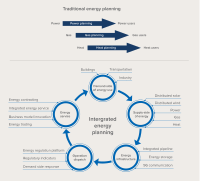
Employing zero-carbon targeted integrated energy planning in new urban development zones could unlock the full potential of carbon emissions mitigation, contributing to China’s goals of CO2 emissions peaking by 2030 and carbon neutrality by 2060. Analysis in this report shows that if all the new urban development zones in China adopt zero-carbon targeted IEP methodology, the contribution to the total emissions reduction of China’s carbon-neutrality goal could reach at least 15%.


Related Insights

Steel’s Transformation: China and Australia’s next horizon of clean steel
Efficiency Reimagined: The next phase of China’s industrial energy transition
Help build the clean energy future. Donate today.
Independent research. Real-world solutions. Supported by donors.
RMI can pursue the highest-impact climate and energy solutions because we’re supported by people who believe change is possible. Every gift helps advance the work needed to make clean energy the default choice worldwide.
For other ways to give to RMI, including checks or gifts of stock, please visit Other Ways to Give.