Learn how we are working to transform how we use and produce energy.
Unlocking Low-Carbon Semiconductor Wafers
An initial assessment of market-based mechanisms to support decarbonization
Why we share this work for free
RMI is an independent nonprofit working to accelerate the clean energy transition. We publish research like this to inform decision-makers and drive real-world impact.
Our work is supported by philanthropy as well as partnerships, including fee-for-service engagements. This support makes it possible for us to share our independent insights for free.
If you find this work valuable, you can support it anytime.
Get more insights like this
Stay up to date with the latest research, analysis, and tools from RMI by opting in to receive occasional emails below. You’ll get new reports, event invitations, and practical insights to help us all accelerate the clean energy transition.
Loading form...
Your download should start automatically. If it doesn’t, click the download button below.
This work is made possible by philanthropy
RMI is a nonprofit supported by donors and partners. Philanthropy enables us to produce independent research and make resources like this freely available.
If you find this report valuable, please consider supporting our work. You can also explore how we partner with organizations to drive impact.
Jump to Section
The rapid growth of artificial intelligence, cloud computing, electrification, and clean energy technologies is driving increasing demand for semiconductors, creating a growing need to reduce emissions across semiconductor supply chains. However, complex, multi-tier supply chains, limited emissions transparency, unresolved confidentiality concerns around sharing supplier-level production data, and a lack of mechanisms to connect low-emissions production with downstream willingness to pay make it difficult for suppliers to invest and buyers to procure low-emissions wafers.
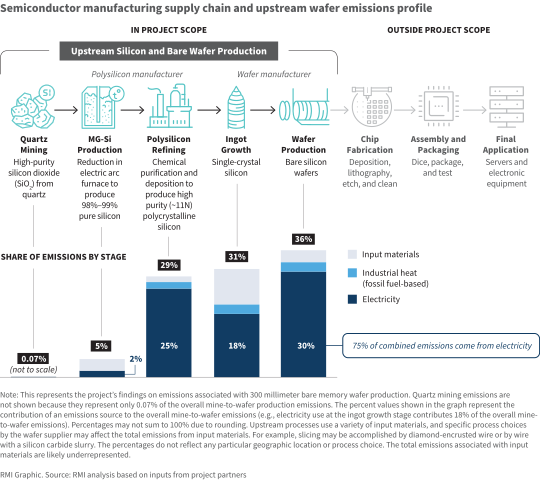
Wafer production is highly electricity-intensive, making carbon-free electricity the most impactful near-term opportunity to reduce production emissions, complemented by low-emissions metallurgical-grade silicon, energy efficiency, and process improvements. Together, these measures could significantly reduce mine-to-wafer emissions. However, accelerating their deployment will require stronger demand signals from downstream buyers and credible mechanisms that enable low-emissions wafers to be recognized and differentiated.
This industry briefing explores book and claim (B&C) as a transitional mechanism to bridge this gap before physical traceability is in place, with longer-term progress expected to move toward physical sourcing of low-emissions wafers as emissions transparency, traceability, supplier capabilities, and industry standards mature. Drawing on technical analysis and collaboration with Hemlock, Shin Etsu Handotai (SEH) America, Micron Technology and Microsoft across the semiconductor value chain, it proposes an initial B&C system design covering functional units, eligibility criteria, transaction, claims and inventory accounting. The report also identifies priorities for pilot implementation and the data, standards, market infrastructure, and demand signals needed to support broader market development.
The findings are relevant to semiconductor buyers, suppliers, industry associations, standards bodies, and policymakers seeking to strengthen demand signals, improve emissions data and standards, and build credible market infrastructure for scaling low-emissions wafer production.
Read the full report to explore the proposed B&C design approach, key recommendations, and pathways for advancing low-emissions semiconductor wafer markets. For more information or to explore collaboration, contact Hao Wu at hwu@rmi.org or Hylla Barbosa at hbarbosa@rmi.org.
Authors

Hylla Barbosa
Senior Associate
Sravan Chalasani
Senior Associate
TJ Conway
Principal
Wenjuan Liu
Manager
Hao Wu
Manager
Iris Wu
AssociateRelated Insights
Reality Check: For Power Plants, Changing the Fuel Doesn’t Fix the Economics

Beyond the First Frontier: What Comes Next for Carbon Removal
The Opportunity for Heat Pumps to Put Downward Pressure on Electricity Rates
Help build the clean energy future. Donate today.
Independent research. Real-world solutions. Supported by donors.
RMI can pursue the highest-impact climate and energy solutions because we’re supported by people who believe change is possible. Every gift helps advance the work needed to make clean energy the default choice worldwide.
For other ways to give to RMI, including checks or gifts of stock, please visit Other Ways to Give.