

Learn how we are working to transform how we use and produce energy.
Understanding How Carbon and Trade Policies can Impact the Steel Sector Transition
Why we share this work for free
RMI is an independent nonprofit working to accelerate the clean energy transition. We publish research like this to inform decision-makers and drive real-world impact.
Our work is supported by philanthropy as well as partnerships, including fee-for-service engagements. This support makes it possible for us to share our independent insights for free.
If you find this work valuable, you can support it anytime.
Get more insights like this
Stay up to date with the latest research, analysis, and tools from RMI by opting in to receive occasional emails below. You’ll get new reports, event invitations, and practical insights to help us all accelerate the clean energy transition.
Loading form...
Your download should start automatically. If it doesn’t, click the download button below.
This work is made possible by philanthropy
RMI is a nonprofit supported by donors and partners. Philanthropy enables us to produce independent research and make resources like this freely available.
If you find this report valuable, please consider supporting our work. You can also explore how we partner with organizations to drive impact.
Jump to Section
Global iron & steel industry trade and EU CBAM exposure
To complement the report, we have compiled and developed global data on steel trade and emissions, as well as overall costs as a result of CBAM. The data is available to download below.
European Union carbon regime: key insights and implications for the steel sector transition
Introduction to the European Union’s carbon regime
The European Union’s Emissions Trading System (ETS) is the bloc’s cap-and-trade system, a crucial component of its climate alignment strategy. It has yielded significant emissions reductions by utilizing a market-based carbon price, where carbon “allowances” can be purchased, traded, and surrendered to satisfy regulatory compliance. However, emissions reductions have been driven mainly by electricity installations — industry has historically received the bulk of its allowances for free. 2026 marks the first year that these free allowances begin phasing out. However, rising carbon costs for domestic producers pose a risk: will downstream consumers instead opt to import products from abroad, where there is no carbon cost? This concept is referred to as carbon leakage, which the free allowances had been used to prevent. Now, as free allowances phase out, a new mechanism will phase in to replace them: the Carbon Border Adjustment Mechanism (CBAM). CBAM is a system dedicated to charging a carbon tariff for industrial goods that would be the equivalent of the carbon price the producer would have paid if it were located within the EU and subject to ETS pricing. CBAM will phase in over the period of 2026 to 2034. With rising carbon costs for imported steel, we expect trade flows to shift in response, with a potential for cleaner steel to emerge as the favorable investment for a steel industry of the future.
Steel product imports and exposure to CBAM
A cursory glance at steel imports shows that the European Union’s imports of steel are heavily dominated by flat products, comprising over three-quarters of finished steel imports. Global averages indicate that flat products, more likely to be made in integrated blast furnace-basic oxygen furnace (BF-BOFs) and have additional downstream processing steps (e.g., coating, annealing, etc.), are higher in emissions intensity than long products such as rebar. Flat products and countries exporting flat products are consequently the most exposed to CBAM-related costs.
Hot-dip galvanized steel is of note here as it is the second-most imported product and requires product processing that adds an estimated 0.36 tons CO2e per ton of steel over hot rolled coil, according to global averages from World Steel. In Asian markets, this differential grows to an estimated 0.73 tons CO2e per ton of steel. Asian markets are key suppliers for hot-dipped steel as their price offerings are low, thanks to cost advantages like economies of scale, state ownership, subsidization, and low-cost labor. China, for instance, exports a relatively low amount of hot-rolled coil to the EU due to anti-dumping tariffs, but is the second-largest source of hot-dip galvanized coil, with the product being China’s main steel export to the EU. Thus, while flat products overall will experience a bump in prices due to CBAM, we can expect high-import, high-emissions products such as hot-dip galvanized steel to have increased exposure to CBAM costs. As such, downstream industries that rely on this input product, such as the automotive and construction sectors, are at risk of short- to medium-term inflationary impacts.
How carbon pricing impacts the cost of steel in Europe
As the EU’s CBAM and ETS systems are designed to reduce carbon leakage and equally price emissions, steel prices of both imported and domestic steel will likely increase in the coming years as carbon costs increase. In 2030, the differential between carbon costs for imported versus domestic steel is estimated to be between €43 and €77 per ton of steel, indicated by the gap between the black and colored lines. The associated CBAM costs for imported steel, especially from Asia, are generally higher than domestic carbon costs from ETS because the imported steel has higher emissions on average. A notable exception is Turkey, a significant steel trading partner with a large fleet of EAF mills that bring its average emissions down. This differential stays within that range mentioned above until 2034. After 2034, a full-strength CBAM paired with a projected rise in the price of carbon nearly doubles the differential between imported and domestic carbon costs by 2040, indicating that in the long term, without changes to emissions, the price of imported steel will grow much faster than domestic prices. In the short- to medium-term, this indicates the price of steel across Europe is likely to rise, but by only around 10% of the total cost. Post-2034, the cost is expected to increase substantially. Efficient producers (defined as those with the least emissions per unit of production) or those operating EAF mills, as shown by “EU domestic, efficient” and Turkey, will see lower carbon costs for longer, but will also be gradually subject to price increases, especially after free allocation ends in 2034. Without a cost-effective, clean iron and steel base to compensate for increasing carbon costs, Europe will likely see downstream inflationary impacts.
Synergistic effects of trade policy: how tariffs could work in tandem with CBAM
Many countries, particularly in Asia, offer steel at a price below global averages, begging the question if trade volume would increase to offset costs even with carbon pricing. To combat this, the EU uses protective, country-specific tariff rate quotas (TRQs). The European Union’s revised TRQ1 for steel products reduces the total allowable duty-free import volume of steel by nearly half (down to 18.3 million tons) and doubles the out-of-quota rate to 50%. Previous European TRQs have been effective at constraining steel imports, with actual imported volumes maxing out at around the quota volume, demonstrating the efficacy of protective trade policies for steel.
Assuming the new tariff regime continues to deter out-of-quota imports, the reduced quota will create an effective reduction in demand for imported steel, which will in part increase the EU’s domestic utilization (which has been dropping for decades) and in part put downward pressure on the price of imported steel. At the same time, CBAM costs add to the cost of imported steel, creating upward pressure on prices. The ensuing price squeeze will vary by producer: heavy carbon emitters will have greater CBAM costs and firmer upward pressure on prices, whereas more efficient steel installations will experience less pressure. Conversely, the downward pressure on imported steel prices created by increased competition from less demand will not be discriminatory on the basis of emissions, since the TRQ does not account for emissions. In the short- to medium-run, this will create a market where energy efficient or lower carbon steel, made conventionally, will have a slight edge (e.g., increasing pellet and decreasing sinter burden or offsetting some coal use with natural gas). By utilizing conventional production to keep base costs at low prices but incorporating efficiency to shield from the highest CBAM costs, these producers will be able to outcompete those who produce more emissions. The alternative, deep decarbonization option of investment into green hydrogen-based DRI, is currently still more expensive on a production cost basis. These dynamics lead us to conclude that producers targeting exports of steel to the EU will favor investing in low-cost efficiency improvements for existing steel assets over the new construction of clean steel plants in the near term. While efficiency improvements are a short-term solution for mitigating carbon prices, this is unlikely to yield deep decarbonization and will eventually become a stranded asset as carbon prices increase in the long-term.
Can the EU’s carbon pricing regime drive deep sector transformation: which pathways will emerge?
Domestically, green DRI-based steel, using green hydrogen to produce iron, has some near-term cost advantages as it can take advantage of the excess free allowances offered to domestic installations (which are not provided under CBAM). Due to its clean production, green DRI-based steel would receive more allowances than it needs to cover its emissions and would be able to sell the excess allowances into the markets as a quasi-subsidy to bring down the cost of steel, in the €100–150/t HRC range in the next 5 years. However, as free allowances are phasing out, this benefit does as well, which is why we see the H2 DRI low-cost estimate below BF-BOF only through 2031.
We find that most green DRI-based steel, even when assuming full monetization of excess free allowances and carbon costs, will not be able to compete with BF-BOF steel without additional incentives (e.g., government support, green procurement requirements, voluntary demand, etc.) until 2036 or later. An extreme edge case requiring ideal investment and operating cost conditions and a high percentage of scrap use (referred to in the chart as H2 DRI 50% scrap, low) is the only case where green DRI-based steel is competitive with BF-BOF steel in the near term and will require higher scrap and siting in locations with ideal renewable energy costs, such as Sweden and Spain. Still, this steel is only competitive with the average BF-BOF installation; efficient BF-BOF producers in the EU will be able to hold off carbon costs until 2035, outcompeting the best case for green DRI-based steel in the near-term. As such, green DRI-based steel produced in Europe is unlikely to break into the market at scale in the next decade without additional incentives.
Alongside these options, an EAF producing steel using 100% scrap outcompetes all options where carbon costs are considered, indicating that if producers can secure enough scrap supply, EAF steel production is likely to increase in Europe. With the EU currently at an industry-wide scrap rate of around 52%, there is room to increase scrap use without compromising industry competitiveness: as a comparison point, the U.S. and Turkey are closer to 70% industry-wide scrap rates, which means that the EU could offset about 17 Mt of its current pig iron production with scrap to reach the same scrap utilization as these trading partners. As the EU is currently the world’s largest scrap exporter (at 15 Mt in 2024, about 20% of the scrap it generates), some of this scrap supply could come from current exports, although it is unlikely that all exports would be used domestically without disrupting larger trade dynamics (for example the EU and Turkey have a near circular scrap-to-steel relationship with the EU exporting 10 Mt scrap and in turn importing 8 Mt steel from Turkey). To this end, new policy instruments that target higher domestic generation of high-quality scrap in the EU are needed (e.g., recycled content requirements in final goods) to enable EAF expansion without increasing scrap net imports, which will be important to avoid equity issues given the rising demand for scrap in emerging markets.
Another option showing promise for cost-competitive clean steel production in the EU is by building out the EAF fleet and sourcing green DRI from projects in regions with ideal resources, such as Brazil or Australia. Cost-wise, these options would line up similarly to the low estimates for EU domestic H2 DRI production, albeit without the excess free allowances those EU plants would receive until 2034. Taken together with the cost-competitiveness of 100% scrap EAF under ETS in the near term, there is a strategic incentive for EU steel producers to invest in new EAFs for both near and long-term competitiveness.
Gaps in CBAM and ETS: what is in and out of different regime boundaries
Alignment of emissions boundaries is emerging as a critical need for suppliers and buyers to understand risks, assess costs, and finalize offtake agreements. The leading globally recognized voluntary emissions reporting methodology by ResponsibleSteel is comprehensive, including close to 100% of emissions through crude steel. But with most purchasing agreements in terms of commercially traded finished products like hot-rolled coil, suppliers and buyers are responsible for tracing emissions through the supply chain to understand compliance with ResponsibleSteel. It will also be critical to align the newly emerging regulatory standards for different regions (e.g., CISA standard in China and LESS standard in the EU) with the already established ResponsibleSteel standard as much as possible to reduce the additional emissions accounting burdens on first movers with ongoing deals. Progress on alignment is underway: in 2025, ResponsibleSteel announced partnerships with CISA and LESS to improve interoperability between the three standards.
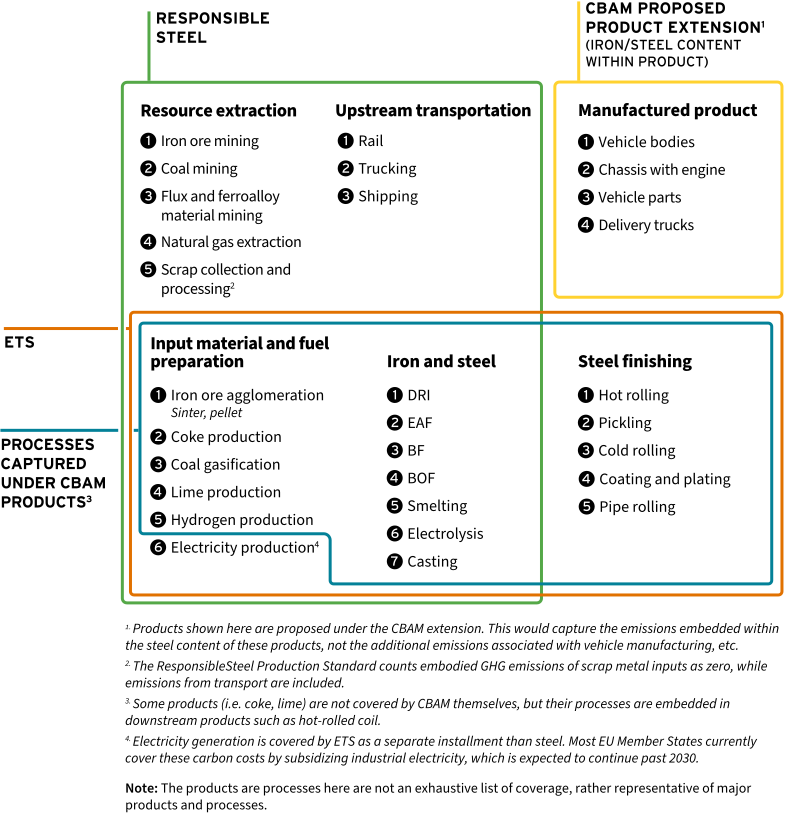
With ResponsibleSteel being a voluntary emissions reporting system, suppliers and buyers are first looking to align with the regulations that directly drive costs: CBAM and ETS. As the policy currently stands, CBAM does not cover electricity associated with producing iron, steel, and its precursors (except electricity associated with producing agglomerated iron). Because of this, electricity consumed within hydrogen production, iron ore beneficiation, DRI pre-heating, or EAF use does not experience carbon pricing, whereas it would within the EU since electricity installations are covered by ETS. While many Member States subsidize industrial electricity, this will not necessarily be even across different steel pathways. Emissions accounting along these pathways is therefore incomplete under EU CBAM.
Another route, steel made from natural gas-based DRI, promises around 50% reduced emissions compared to BF-BOF steel. With carbon costs applied, existing and new installations in the MENA regions could undercut European BF-BOF and H2 DRI-EAF costs by €100 and €60–270 per ton of steel by 2030, respectively. However, since methane leakage is not considered under CBAM (or ETS, for that matter), their emissions accounting is shown to be much less than the reality and could be missing up to 0.6 tons of CO2 per ton of steel, which would add around €70 per ton of steel in CBAM costs in 2030.
With CBAM as it is currently legislated, NG-based steel from the MENA region could still be over €200 per ton of steel cheaper than H2-based steel made fully with renewables in 2040. Inclusion of electricity and methane leakage emissions is critical to narrowing the gap. Including electricity and methane leakage also critically ensures that grid-connected electrolyzers in any regions with fossil-dominated grids (like the MENA region, where grid electricity is cheap but powered by natural gas) fully account for those emissions and are also more expensive than renewables-based systems. Inclusion of electricity and methane leakage emissions in both CBAM and ETS could also ensure that H2-based steel first movers in the EU are competitive with EU BF-BOFs as early as 2028 (by accounting for coal-based methane leakage), with NG-based steel from the MENA region by 2040, and always competitive with grid-connected H2-based steel from the MENA region.
The exclusion of electricity in CBAM scope for steel is partly due to the EU ETS State Aid Guidelines, which allow for sectors classified as “exposed to a genuine risk of carbon leakage due to indirect emission costs” to be eligible for Indirect Cost Compensation (ICC). Inclusion of electricity in CBAM coverage for steel would require changing the way ICC operates to ensure the sector is not protected twice, through both CBAM and ICC, and thus CBAM is not incompatible with international trade rules.
Another gap in CBAM comes in the form of downstream products. While there is a revision to CBAM working its way through the legislative train that would cover the embedded iron and steel emissions in hundreds of downstream products, such as transport vehicles and components, it does not include passenger cars, a significant source of steel representing approximately 6 million tons of CO2 per year based on current trade volumes. Exclusion of passenger cars also puts automotive manufacturing in Europe at risk of offshoring to avoid accounting for the iron and steel emissions because of the increase in input steel costs.
International carbon policies: key insights and implications for steel
ETS and CBAM policies outside the EU
An important component of CBAM is the inclusion of adjustment — products that have incurred an equivalent carbon penalty to the one they would have if manufactured within the EU are exempt from paying CBAM costs. This reinforces CBAM’s primary position as an equalization policy that attempts to put all products on the same playing field, rather than an explicit source of revenue. It also provides an opportunity for EU trading partners to enact their own ETS or similar regulations to retain that revenue within their borders, which theoretically could be used as public support for industrial decarbonization efforts domestically, like the EU’s Innovation Fund. However, adding carbon costs to the production cost provides an equalization only when trading with the European Union or with other partners with CBAM; countries with significant exports elsewhere may not see a benefit from steel firms losing competitiveness in those markets, and each country’s entire CBAM exposure of products beyond steel would need to be considered. Additionally, it should be noted that CBAM acts in the same way as a tariff: the importer bears legal responsibility for paying CBAM costs, so any payment does not represent an immediate outflow of funds from the exporting country, but rather a gradual shift in trade patterns via decreased demand or lowering of prices to cover CBAM’s costs.
ETS systems are developing worldwide, with many important steel trading partners already having or planning to enact their own systems. However, many of these systems do not bear the same strength in carbon pricing or emissions accounting as the EU ETS and CBAM systems, leading to uncertainty about the quantity of CBAM costs they would avoid.
Countries highly exposed to the EU’s CBAM
Countries with large volumes and a high dependence on the EU for steel exports tend to be the most exposed to CBAM (i.e., Turkey, India, Ukraine, United Kingdom). Additionally, countries that have lower dependence but significant volumes of trade are also exposed; however, that exposure carries less of a burden on the entire steel industry within that country given the diversification of their exports beyond the EU (i.e., South Korea, Vietnam, China, Japan).
Ultimately, exposed countries and their steel firms face several high-level options in response to EU CBAM. At the firm level:
- Seek alternative markets, e.g. shifting trade to other partners or selling steel to domestic markets.
- Adjust prices down to account for carbon costs and retain competitiveness, at the expense of profit margins.
Firms’ abilities to seek alternative markets will heavily depend on current exports to EU, domestic demand, and the growth in demand from current trade partners. For countries like Turkey, South Korea, Japan, Ukraine, and the United Kingdom, it is unlikely that current exports to the EU could be entirely absorbed by expected demand increases, either domestically or from existing trade partners. These countries export more steel to the EU than the volume their primary steel trade partners are expected to grow. Additionally, domestic consumption is expected to grow marginally or decrease. For these countries, looking at volumes alone, current exports to the EU could be shifted to meet growing domestic demand (i.e. India and Vietnam) or growing demand from existing trade partners (i.e. China, although overcapacity complicates this potential), but these trade shifts may come with lower profit margins or require downstream processing adjustments to provide products for these new markets.
At the government level, trade and industrial policies can be shifted to support steel sector decarbonization and maintain global competitiveness. Enacting a domestic ETS, as mentioned previously, is a regulatory method that could theoretically be used to drive both decarbonization by incentivizing efficiency improvements in the short-term to reduce exposure to EU CBAM, while reinvesting ETS revenues into deeply decarbonized options domestically to increase global competitiveness. All the identified exposed countries have either established or are planning to enact their own ETS, indicating that the future of steel trade could potentially be pushed toward climate-aligned options. However, the pace and strength of implementation matters for alignment — the majority either do not cover steel or employ some kind of free allocation method (with varying allocation thresholds for steel) and have low carbon prices that are together preventing these ETS systems from stimulating and accelerating full-scale deep decarbonization of industry.
United Kingdom
The UK and EU already use similar approaches to ETS and CBAM, with the UK’s CBAM going into effect in 2027 and both regions transitioning away from free allocations for the steel industry. Although there are currently some minor differences in the allocation phase-out timeline and carbon price points, it is generally expected that both the EU and UK are committed to aligning their ETS and CBAM systems, with reporting and carbon prices converging in the coming years. This process will help to set a precedent and act as a reference case for other highly exposed countries considering the process and implications of aligning domestic ETS and CBAM policies with the EU’s CBAM.
Turkey
Turkey is a unique steel trade partner of the European Union, providing a plurality of flat and long finished steel products to the bloc, with a lower-than-average emission intensity of steel due to Turkey’s vast EAF fleet2 and high scrap use. Over half of Turkey’s scrap imports originate from the EU, creating a circular steel value chain in which scrap steel is exported to Turkey and re-imported into the EU as finished steel.
Turkey’s developing ETS is designed to cover the same sectors as the EU’s CBAM, indicating a desire to align carbon pricing coverage with its trading partner. Furthermore, its ETS system will follow similar benchmarking for free allocation, and a phase-in through 2035 that nearly lines up with CBAM’s phase-in through 2034. With low emissions and the establishment of an ETS system, Turkey appears positioned to continue steel trade with the EU regardless of CBAM costs. While there are many factors that have likely gone into the decision to establish an Emissions Trading System, the timing of the decision (2 years after the passage of CBAM) in conjunction with Turkey’s high dependence on EU steel purchases and high volumes suggests the EU’s CBAM was a contributing factor. Furthermore, this suggests that a Carbon Border Adjustment Mechanism, with the provision to deduct already-paid carbon penalties, can incentivize countries with a high dependence on exports to develop carbon pricing schemes, granted they have appropriate state capacity to accomplish this policy goal.
South Korea
At 3.1 Mt in 2024, South Korea is the second-highest exporter of steel to the EU, but it has a low overall trade exposure since those exports only make up approximately 17% of South Korea’s total steel exports. Looking at current trade partners outside the EU and excluding other highly exposed countries (like India) or countries with negative or modest growth expectations (like Japan, China, and the U.S.), one option for South Korean steel firms could be to increase exports to other current trade partners with high steel demand growth expectations (like Thailand and Malaysia). However, we estimate that these trade shifts would only cover up to 1 Mt of steel by 2030 (if South Korea maintains the same proportion of exports to these countries), still leaving 2 Mt exposed to EU CBAM that are also unlikely to be absorbed domestically, considering South Korea’s own declining demand expectations. This translates to approximately €1.5–2 billion in carbon costs through CBAM paid to the EU through 2030, roughly the investment size of a new DRI-EAF steel plant. Layering this on top of the Korea Iron and Steel Association’s targets of producing 2.5 Mt of commercial-scale hydrogen-based steelmaking by 2035 and reaching 95% emissions reduction by 2050, there could be a strategic incentive to strengthen domestic carbon pricing and reinvest ETS (and possibly CBAM) revenues into domestic decarbonization efforts.
South Korea’s ETS system is already functioning, but with less coverage than the EU’s CBAM through lower carbon prices and higher free allocations for steel. As of June 2026, there is no set timeline for the 100% free allocation phase-out for the steel sector, and in 2025, K-ETS carbon prices fluctuated around €6/t CO2e, roughly 92% lower than average EU ETS prices (€73/t CO2e). Ending the full free allocations for steel, decreasing benchmarks to gradually cover all product emissions (including Scope 2 and 3 emissions), and increasing the cost of carbon will be critical to align with EU CBAM, retain carbon revenues for reinvestment, and accelerate domestic decarbonization within South Korea.
India
India is the third highest exporter to the EU, just under 3.1 Mt, but with one of the highest exposures, since EU trade comprises roughly 75% of all steel exports. Looking at existing trade partners outside the EU, it is unlikely that Indian steel firms could easily shift EU exports to another growing market alone. However, with India’s domestic demand expected to significantly grow in the coming decades (estimated additional demand of 40–60 Mt by 2030) there may be the option to shift to meeting domestic demand, albeit with potential price impacts by selling into the domestic market rather than EU markets. India’s ambitious public procurement targets will also create additional pressure for domestic steel buyers to source lower emissions steel. Still, India has formally opposed EU CBAM, citing it as a trade barrier and has worked to structure CBAM exemptions and an EU-India Free Trade Agreement. However, some critics within India are also advocating for this diplomatic energy to focus less on the trade grievances and more on the market design opportunity to strengthen India’s Carbon Credit Trading Scheme (CCTS) system.
India’s CCTS is an intensity-based baseline-and-credit system, rather than a cap-and-trade system like the EU’s ETS, meaning that each steel plant is assigned an emission intensity target and plants below their target earn credits, while plants above must purchase carbon credits. With CCTS moving from development to implementation in 2026 and draft emission intensity targets for 255 steel facilities recently published for compliance in 2026–2027, India is well on its way to formally including the steel sector in its ETS. The currently designed CCTS system avoids putting an absolute emissions cap on an expanding economy with a growing industrial base, but it puts Indian producers at risk of paying both CCTS and CBAM costs. The recent draft covers 150 Mt of iron and steel production and targets feasible near-term emission abatements, ranging from 2.1% to 9.3% reduction. The baseline-and-credit system essentially functions as free allocations — but with each plant having a different benchmark — and with the recently published modest emissions reduction targets, most of the Indian production will still be well above the CBAM benchmarks. There is also the price gap dimension: although they are still in price-discovery phase, recent carbon credit prices are estimated in the €9–13/t CO2e range, roughly 85% lower than average EU ETS prices (€73/t CO2e).
Increasing the cost of carbon and setting both absolute (i.e. across all plants) and decreasing (i.e., gradually over time) emission targets across the industry to be more stringent and in line with India’s objective of net zero by 2070 is ultimately a more effective way to use the carbon market to transform the steel industry, bring India’s ETS in alignment with EU CBAM, and retain carbon revenues for reinvestment domestically.
Conclusions and recommendations: the design of carbon pricing
Unsurprisingly, there is no one-size-fits-all approach to external responses to EU’s CBAM. We find that while EU’s CBAM may have a moderate impact on influencing trade partners to adopt carbon pricing schemes, this is highly dependent on total trade dependence (beyond just steel), the trade dependence of the steel industry, and the possibility of shifting markets. At the time of writing, the EU has just revised its steel TRQs: reducing them to nearly half their previous volume. This massive shift in trade policy is likely to become the primary concern for steelmakers in the short-term, as the out-of-quota duty rate of 50% (approximately €300/t HRC) dwarfs any short- to mid-term carbon costs (approximately €10–200/t HRC by 2030). We can expect the immediate response to the new TRQs to be an increase in capacity utilization within EU and a reduction in imports into the EU as a response to CBAM costs. Ultimately, this blunts the pressure of CBAM on trade partners to enact equivalent carbon pricing and reinforces the protective aspect of CBAM as a complement to increasingly stronger domestic climate policy.
Based on our analysis, we find that without additional incentives the European Union’s ETS and CBAM policies will likely push the steel industry to adopt marginal efficiency improvements on existing assets and increased scrap use rather than investing into deep decarbonization options of primary steel production such as renewable hydrogen DRI. This may come in the form of improvements to BF-BOF facilities or the expansion of EAF deployment. Already, we have seen the partial cancellation or delay of green DRI part of steel projects, while the EAF component moves forward, demonstrating this trend. Due to the lack of green-DRI based steel, the price of steel across Europe is likely to rise due to carbon pricing if EU Allowance projections are confirmed and their prices rise.
CBAM should be revised to preserve its climate credibility, prevent carbon leakage, and support global decarbonization. We propose the following revisions:
- Inclusion of electricity to produce steel within CBAM and changing the way ICC operates to close potential loopholes and reflect true cost of carbon.
- Expansion of ETS and CBAM to include methane leakage to accelerate the breakeven point of H2-DRI and BF-BOF as well as reflect the full emissions associated with alternatives such as natural gas DRI.
- Expansion of CBAM to all vehicles to reduce carbon leakage and protect domestic manufacturing.
Additionally, the following is needed to promote deep decarbonization of the steel sector in the EU in the next decade:
- Increased scrap recycling and utilization to help satisfy demand through lower carbon means. Reducing exports of steel scrap through restrictions in tandem with incentives for scrap use can be a solution; however, this will reduce scrap availability for emerging economies that rely on scrap imports, potentially creating an equity issue.
- Increased government support for green DRI-based steel to make near-term investment viable, including tools such as grant funding and Carbon Contracts for Difference (CCfDs) for domestic projects and partnerships with international suppliers of green DRI. This is critical to promote deep decarbonization of the steel sector outside of modest efficiency improvements.
Data appendix
Mid case used for carbon pricing in this report, based on projections from Enerdata and BNEF. Projections were made by creating curve-fit piecewise-defined functions for both sets of data and then creating composite curves using the minimum and maximum of each curve at a given year. The mid value was found as the average of the values found for a given year including the original data points.
Endnotes
- The new TRQ has just come into effect at the time of writing; data on imports is not readily available yet. ↩
- Turkey’s EAF fleet accounts for 70% of its crude steel production, as opposed to 30% for BF-BOF, according to World Steel. ↩
Contributors and reviewers: Nick Yavorsky, Julia Kate Bradley, Thanh Ha, Kaitlyn Ramirez, Oleksiy Tatarenko


Related Insights

How Better Policy Can Support South Korea’s Green Steel Opportunity
Help build the clean energy future. Donate today.
Independent research. Real-world solutions. Supported by donors.
RMI can pursue the highest-impact climate and energy solutions because we’re supported by people who believe change is possible. Every gift helps advance the work needed to make clean energy the default choice worldwide.
For other ways to give to RMI, including checks or gifts of stock, please visit Other Ways to Give.