

Learn how we are working to transform how we use and produce energy.
Understanding Contrail Management: Opportunities, Challenges, and Insights
A Comprehensive Overview Report
Why we share this work for free
RMI is an independent nonprofit working to accelerate the clean energy transition. We publish research like this to inform decision-makers and drive real-world impact.
Our work is supported by philanthropy as well as partnerships, including fee-for-service engagements. This support makes it possible for us to share our independent insights for free.
If you find this work valuable, you can support it anytime.
Get more insights like this
Stay up to date with the latest research, analysis, and tools from RMI by opting in to receive occasional emails below. You’ll get new reports, event invitations, and practical insights to help us all accelerate the clean energy transition.
Loading form...
Your download should start automatically. If it doesn’t, click the download button below.
This work is made possible by philanthropy
RMI is a nonprofit supported by donors and partners. Philanthropy enables us to produce independent research and make resources like this freely available.
If you find this report valuable, please consider supporting our work. You can also explore how we partner with organizations to drive impact.
Jump to Section
The following report examines the state of science and mitigation of contrails — the linear clouds created by aircraft in cold and humid air — including an overview of the current approaches and efforts to better understand and address their significant climate impact. Contrail management, including contrail avoidance by rerouting flights, presents an opportunity for stakeholders across the aviation sector to engage in radical collaboration to reduce non-CO2 climate impacts alongside ongoing aviation decarbonization efforts.
This report was created in collaboration with participants of the RMI-convened Contrail Impact Task Force, which comprises stakeholders across the aviation sector, including industry organizations, airlines, academic institutions, non-governmental organizations, private companies, and government entities. It provides a comprehensive overview of the current understanding of the climate impact of contrails as well as research and implementation efforts that support the following key points:
- The climate impact of contrails is significant but solvable. Contrail-induced warming is a concentrated problem with targeted, promising solutions.
- While contrail formation is driven by complex and dynamic atmospheric conditions, forecasting models are being developed to predict persistent contrails. To ensure model accuracy, reliable input data is critical and validation efforts must be scaled up. The most significant source of continued uncertainty is a lack of accurate humidity data at cruising altitude.
- Ongoing flight trials are testing the operational implications of contrail avoidance and providing crucial insights for contrail prediction improvements. Continued collaboration on research and participation in large-scale flight trials can increase the collective understanding of the climate impact of contrails and support the improvement of prediction models.
- Measuring the climate impact of contrails is critical to evaluating the full climate impact of aviation.
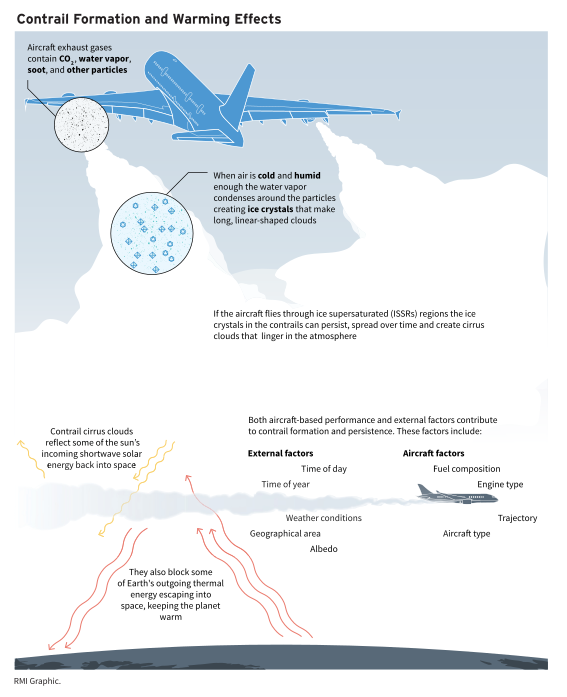
This report aims to provide a detailed technical overview for decision makers and stakeholders, including researchers, commercial air carrier operators, international aviation industry organizations, civil society, and policymakers. With this collective understanding, it is our hope that these sector actors further support research efforts and work toward potential non-CO2 industry standards and policies for the global aviation system.
Recommendations in the report include:
- Stakeholders must continue to invest in — and policymakers should incentivize — atmospheric science research and improving the collection and measurement of meteorological data to narrow the uncertainty of how much contrails affect climate warming. Investment should prioritize better weather models, retrofitted humidity sensors on aircraft, and enhanced satellite imaging coverage.
- Continued and deepened collaboration among stakeholders is needed in the form of flight trials, both simulated and in real life, to demonstrate and assess the feasibility of contrail avoidance solutions. Trials are crucial to improve prediction models, obtain operational know-how, gather practical knowledge on integrating contrail management into airline operations, study possible airspace implications, and further develop and automate the contrail management processes within flight planning tools.
- Air traffic management needs to be included and prioritized in research, simulations, and trials to prepare for possible future airspace challenges such as capacity constraints and congestion issues and to adapt systems and processes over time. To ensure contrail avoidance becomes a durable mitigation solution, coordinated implementation spearheaded by air traffic management authorities is likely essential.
This work would not have been possible without the engagement from participants of the Contrail Impact Task Force since its launch in November 2022. Addressing the climate impact of contrails presents challenges that can only be overcome through continued radical collaboration among stakeholders from across the aviation value chain.
Authors

Joey Cathcart
Senior Associate
Andrew Chen
Principal
Henri Cornec, Yale Center for Environmental Law Policy, Yale University
Supraja Kumar, International Council on Clean Transportation
Joachim Majholm, Blue Lines
Maxime Meijers, Estuaire
Nicolas Meijers, Estuaire
Reed Miller, University of Maine, Department of Civil Environmental Engineering / Yale Center for Environmental Law Policy, Yale University
Jayant Mukhopadhaya, International Council on Clean Transportation
Nikhil Sachdeva, Roland Berger
Marc Shapiro, Breakthrough Energy
Christopher Stern, Roland Berger
Zachary A. Wendling, Center on Global Energy Policy
Columbia University / Yale Center for Environmental Law Policy, Yale University
Siân Andrews, NATS
Related Insights


Moving Beyond Carbon: Advancing Aviation Contrail Accounting and Reporting


Chasing Contrails: RMI’s Joey Cathcart Takes Off to Cut Airlines’ Climate Toll
Help build the clean energy future. Donate today.
Independent research. Real-world solutions. Supported by donors.
RMI can pursue the highest-impact climate and energy solutions because we’re supported by people who believe change is possible. Every gift helps advance the work needed to make clean energy the default choice worldwide.
For other ways to give to RMI, including checks or gifts of stock, please visit Other Ways to Give.
