

Learn how we are working to transform how we use and produce energy.
The Easiest and Most Economical Way to Meet Growing Electricity Demand for the Electric Vehicle Revolution Is to Save It in Our Buildings
Why we share this work for free
RMI is an independent nonprofit working to accelerate the clean energy transition. We publish research like this to inform decision-makers and drive real-world impact.
Our work is supported by philanthropy as well as partnerships, including fee-for-service engagements. This support makes it possible for us to share our independent insights for free.
If you find this work valuable, you can support it anytime.
Get more insights like this
Stay up to date with the latest research, analysis, and tools from RMI by opting in to receive occasional emails below. You’ll get new reports, event invitations, and practical insights to help us all accelerate the clean energy transition.
Loading form...
Your download should start automatically. If it doesn’t, click the download button below.
This work is made possible by philanthropy
RMI is a nonprofit supported by donors and partners. Philanthropy enables us to produce independent research and make resources like this freely available.
If you find this report valuable, please consider supporting our work. You can also explore how we partner with organizations to drive impact.
Jump to Section
Policymakers far and wide, buckle up! The electric vehicle (EV) revolution is upon us: baseline forecasts project that EVs will comprise more than half of all annual car sales and one-third of all cars on the road (550 million in total) globally by 2040. Over the same time frame, electricity demand from buildings is already projected to grow nearly 70 percent worldwide. To put that into perspective, the United States alone may have to invest roughly $2.5 trillion into electricity infrastructure to accommodate that demand.
These statistics raise the question: where will all of this electricity come from? Surely there’s a better alternative to meet these capacity needs than the budget-bending build-out of new grid infrastructure across the world. RMI, in partnership with Signify, produced a new analysis and report suggesting that faster deployment of energy efficiency technologies in buildings represents the most cost-effective and beneficial path to supporting the growth in EV-driven electricity demand while also meeting global climate targets.
Shifting Energy Efficiency into Higher Gear
Why energy efficiency? Not only does it represent the lowest-cost energy supply resource, but it offers a number of other benefits that can be captured locally. These include the creation of 380 jobs per terawatt-hour (TWh) of electricity saved (versus 110 jobs per TWh of electricity generated by coal-fired power plants); the direct pocketing of energy cost savings by local consumers and businesses—spurring economic development, higher employee productivity, improved thermal comfort and indoor air quality; and increased resilience, energy security, and grid stability.
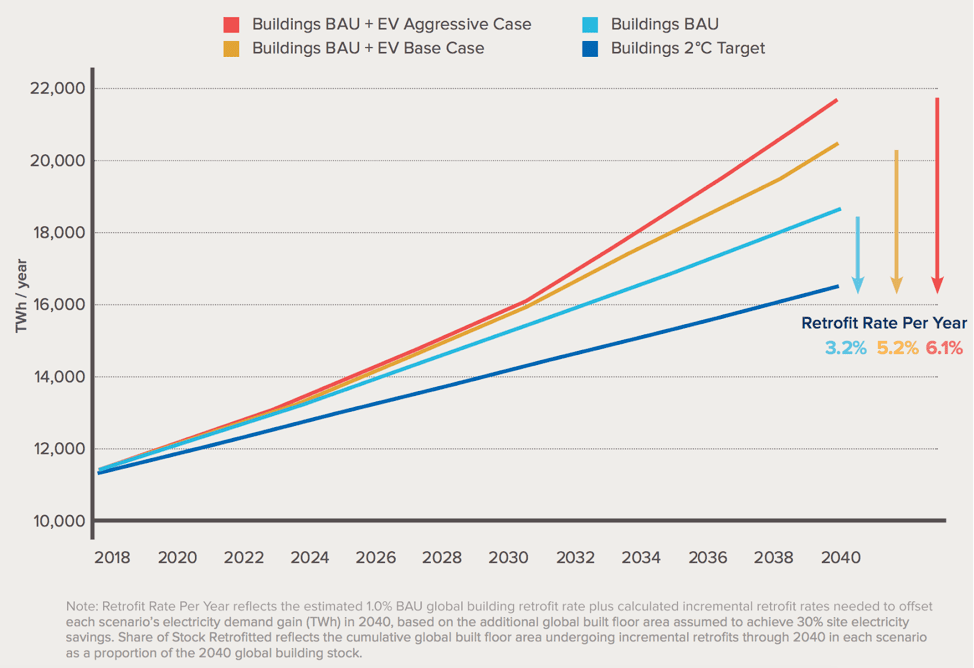
However, the global average retrofit rate remains very low, estimated at only 1 percent of the building stock each year. This can be increased dramatically and cost-effectively based on existing, widely available, and noninvasive energy efficiency technologies. Our analysis finds that by increasing the retrofit rate to just over 5 percent per year (a fraction of its cost-effective potential), we can welcome all expected EVs through 2040 with minimal added grid infrastructure and meet the 2°C target set by the Paris Agreement. But driving up the retrofit rate and capturing the associated benefits will require a step change in policy approaches that integrate building energy and EV planning.
Building Retrofit Rates Required to Offset EV Demand and Meet 2°C Targets
Policymakers Must Take the Steering Wheel
RMI’s report, Energy Efficiency and Electric Vehicles: How Buildings Can Pave the Way for the Global EV Revolution, highlights a number of tools and technologies that local, regional, and national policymakers have in their arsenal to accelerate the deployment of energy efficiency to more ambitious levels and to thoughtfully plan ahead for a growing wave of EVs within their jurisdictions (including references to successful real-world precedents).
On the buildings side, policymakers should push for benchmarking and disclosure policies, performance-based building ordinances, mandatory building energy codes, and minimum energy performance standards for appliances and equipment, to name a few. When it comes to EVs, time-of-use pricing signals, well-planned smart EV charging infrastructure, data collection mechanisms, and appropriate trigger events (such as requiring EV integration as part of broader building renovation efforts) can go a long way to ensuring a strong foundation.
Above all, considering building and EV policies in tandem can lower the costs associated with both, and together they can support a high-penetration renewable future by allowing demand to respond dynamically to supply.
Avoiding U-Turns
Ignoring these issues or delaying solution development presents major risks. EV charging will have a sizeable impact on increasingly strained power grids, especially at certain times and locations, with consequences for power reliability and quality, and possible cost increases for consumers. And given the very slow pace at which the building stock turns over, poor planning or a lack of policy action to curb building energy waste will lock in inefficient technologies and the associated costs and emissions for decades to come.
In this report, we hope to convey the urgent need to economically address growing electricity loads worldwide and to equip policymakers with the context and insights they need to implement policies that tie together two sectors essential to achieving climate goals. Although EVs and their regulatory implications are relatively new and untested, they offer forward-thinking policymakers a unique opportunity to get it right from the outset. When it comes to building energy policies, on the other hand, policymakers do not have to reinvent the wheel—best practices and lessons learned must be borrowed and shared internationally given the vast technical and practical experience accumulated to date.
Concerted policy action is required to make our building stock more efficient and to welcome all EVs expected in the decades ahead in ways that minimize cost outlays and carbon emissions while maximizing economic benefits and quality of life improvements for citizens across the globe.
Download Energy Efficiency and Electric Vehicles: How Buildings Can Pave the Way for the Global EV Revolution. And contact us and tell us what you’re doing—help inspire others who are looking to tackle building efficiency and EV integration more effectively and holistically.


Related Insights

The Opportunity for Heat Pumps to Put Downward Pressure on Electricity Rates
Building Smarter, More Efficient Air Conditioners for Real World Conditions

How Heat Pumps Reduce Energy Bills and Air Pollution in the San Francisco Bay Area
Delivered Fuel Customers in Maryland See Strong Energy Bill Savings in a Switch to Heat Pumps
Help build the clean energy future. Donate today.
Independent research. Real-world solutions. Supported by donors.
RMI can pursue the highest-impact climate and energy solutions because we’re supported by people who believe change is possible. Every gift helps advance the work needed to make clean energy the default choice worldwide.
For other ways to give to RMI, including checks or gifts of stock, please visit Other Ways to Give.
