

Learn how we are working to transform how we use and produce energy.
Road to Viksit Bharat
Five Building Blocks to Power India’s Transition to Zero Emission Trucking
Why we share this work for free
RMI is an independent nonprofit working to accelerate the clean energy transition. We publish research like this to inform decision-makers and drive real-world impact.
Our work is supported by philanthropy as well as partnerships, including fee-for-service engagements. This support makes it possible for us to share our independent insights for free.
If you find this work valuable, you can support it anytime.
Get more insights like this
Stay up to date with the latest research, analysis, and tools from RMI by opting in to receive occasional emails below. You’ll get new reports, event invitations, and practical insights to help us all accelerate the clean energy transition.
Loading form...
Your download should start automatically. If it doesn’t, click the download button below.
This work is made possible by philanthropy
RMI is a nonprofit supported by donors and partners. Philanthropy enables us to produce independent research and make resources like this freely available.
If you find this report valuable, please consider supporting our work. You can also explore how we partner with organizations to drive impact.
Jump to Section
India’s zero-emission trucking (ZET) journey is gaining pace. Over just the past three years, efforts by government ministries, state agencies, and industry leaders have laid the groundwork for transforming one of the country’s most critical and dominant transport segments. From national policy roadmaps and state-led accelerators to targeted incentive schemes, the ambition is clear: making ZETs a mainstream and competitive choice for India’s road freight.
Why Zero-Emission Trucking Matters for India
Trucks produce over 40 percent of India’s road transport CO₂ emissions despite being a fraction of total vehicles. Achieving 85 percent zero-emission truck sales by 2050 could abate 2.8 gigatons of CO₂, cut particulate matter and NOₓ pollution by ~40 percent, displace 993 billion liters of diesel (saving ₹116 lakh crore [US$1.4 trillion]), and reduce logistics costs by17 percent. It would also generate 4,000 GWh of battery demand, spurring jobs and innovation in India’s clean energy economy.
Five Building Blocks to Power India’s ZET Transition
India stands at the cusp of a freight transformation. It must reimagine trucking, not just as a cleaner mode of transport, but as a driver of economic growth, manufacturing strength, and energy security. These five building blocks can power that shift:
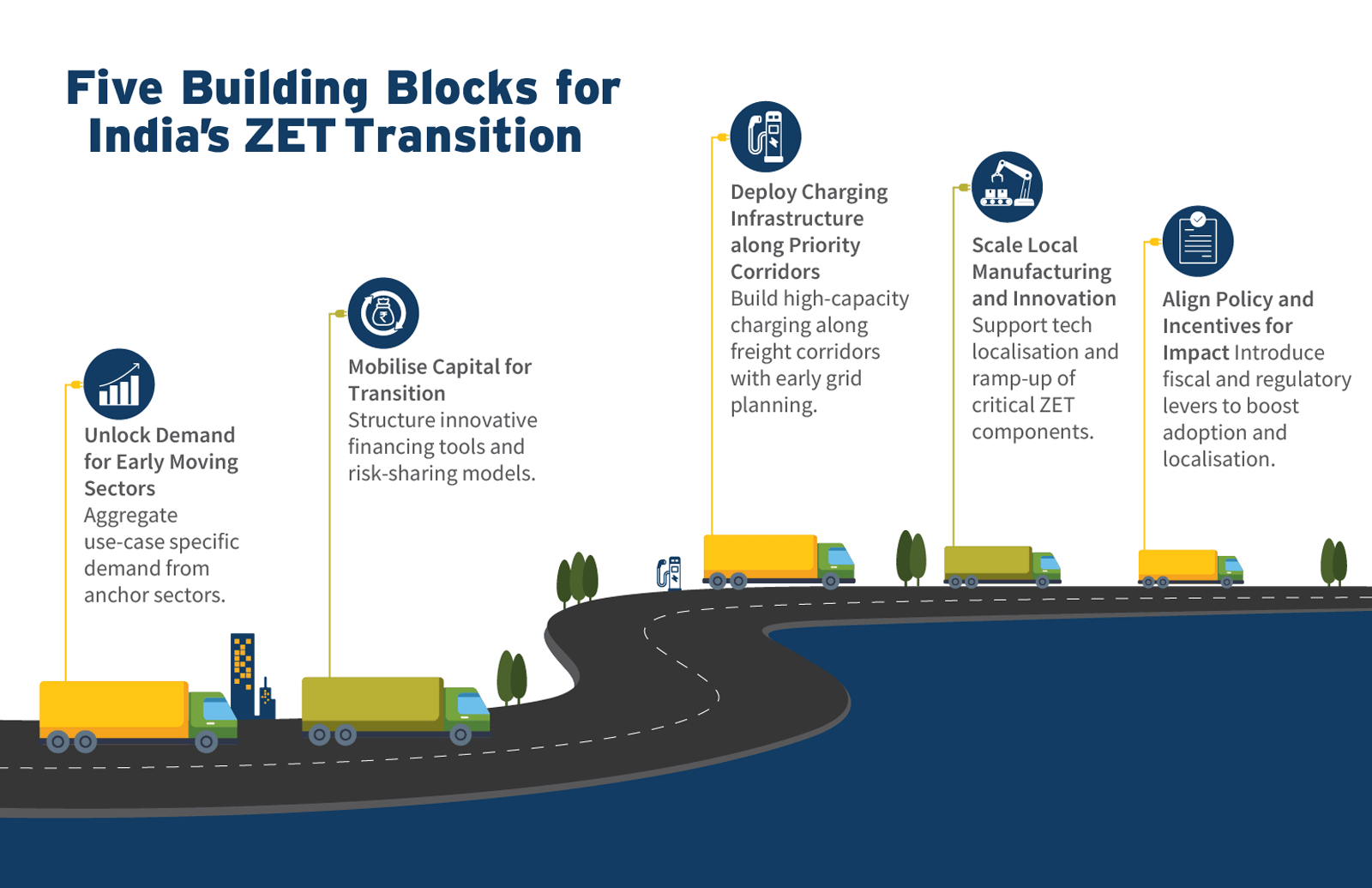
The road to scaling ZET deployment runs through these five building blocks. The graphic above maps the journey; here’s how each step can drive India’s shift to zero-emission trucks:
- Unlock demand in early-moving sectors: Aggregate procurement in sectors such as cement, steel, ports, mining, and e-commerce to send clear production signals to OEMs, guide product design, and achieve economies of scale.
- Mobilize capital for the transition: Deploy blended finance, concessional debt and risk-sharing models to make ZET fleets viable and investment-ready, with proven pilots and innovative contracts to build lender confidence and scale adoption.
- Deploy charging infrastructure along priority corridors: Target high-traffic freight routes for early infrastructure rollout, with coordinated action among stakeholders to plan timely grid upgrades, optimize site selection, manage charging costs, and ensure high infrastructure utilization.
- Scale local manufacturing and innovation: Expand domestic production of trucks, batteries, fuel cells, and components, and develop battery recycling systems to lower costs, reduce import dependency, and create skilled jobs.
- Align policy and incentives for impact: Align national and state policies through purchase subsidies, localization incentives, sales-credit programs, and regulatory levers to accelerate adoption and strengthen domestic supply chains.
This decade will determine whether India leads or follows in the global transition to clean freight. With a global target of 30 percent zero-emissions medium- and heavy-duty vehicle sales by 2030, India’s manufacturing strength, policy momentum, and early deployments put it in a prime position to lead.
By acting decisively on these five building blocks — aggregating demand, finance, infrastructure, manufacturing, and policy alignment, India can power clean freight, drive industrial growth, enhance energy security, and pave the Road to Viksit Bharat.
Authors

Marie McNamara
Manager
Zhinan Chen
Senior Associate
Akshima Ghate
Chetna Nagpal

Pranav Lakhina
ManagerRelated Insights

India’s Used EV Battery Market Needs Trust. Battery Aadhaar Can Help.
Help build the clean energy future. Donate today.
Independent research. Real-world solutions. Supported by donors.
RMI can pursue the highest-impact climate and energy solutions because we’re supported by people who believe change is possible. Every gift helps advance the work needed to make clean energy the default choice worldwide.
For other ways to give to RMI, including checks or gifts of stock, please visit Other Ways to Give.
