

Learn how we are working to transform how we use and produce energy.
Why we share this work for free
RMI is an independent nonprofit working to accelerate the clean energy transition. We publish research like this to inform decision-makers and drive real-world impact.
Our work is supported by philanthropy as well as partnerships, including fee-for-service engagements. This support makes it possible for us to share our independent insights for free.
If you find this work valuable, you can support it anytime.
Get more insights like this
Stay up to date with the latest research, analysis, and tools from RMI by opting in to receive occasional emails below. You’ll get new reports, event invitations, and practical insights to help us all accelerate the clean energy transition.
Loading form...
Your download should start automatically. If it doesn’t, click the download button below.
This work is made possible by philanthropy
RMI is a nonprofit supported by donors and partners. Philanthropy enables us to produce independent research and make resources like this freely available.
If you find this report valuable, please consider supporting our work. You can also explore how we partner with organizations to drive impact.
Jump to Section
This report provides new analysis that shows the Global South is in fact adopting cleantech faster than the Global North. In Powering Up the Global South, RMI illustrates that Global South countries are deploying cleantech rapidly and will continue to do so as their path to growth.
The research shows that three-quarters of the Global South’s energy demand is in the “sweet spot” of change based on their level of fossil fuel imports, income, energy demand, and available renewable resources. The research finds:
- With 60 percent of the global population, the Global South has only 20 percent of fossil fuel production and reserves, and oil and gas production are in decline. As a result, it is already a net importer of fossil fuels. In contrast, the Global South is rich in renewables, with 70 percent of global renewable potential.
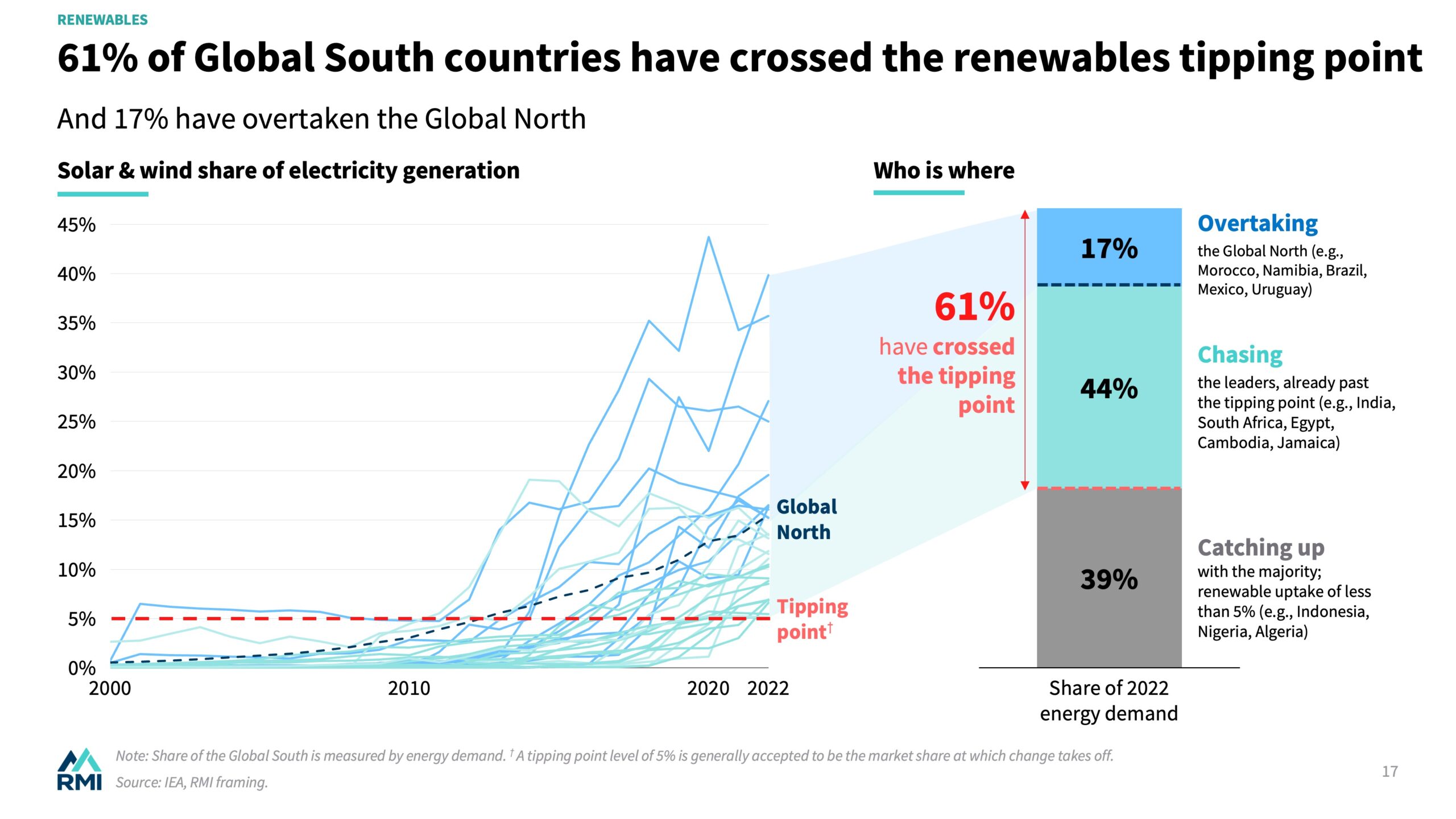
- In 2024, 87 percent of capital expenditures on electricity generation will go into clean energy. Over the past five years, solar and wind generation in the Global South has grown on average at 23 percent annually, now supplying 9 percent of its electricity. Global South solar and wind adoption is only five years behind the Global North.
- One-fifth of the Global South, from Brazil to Morocco and Namibia, from Bangladesh to Egypt and Vietnam, has already overtaken the Global North in terms of the share of solar and wind in electricity generation, or the share of electricity in final energy.
While there are grounds for optimism, more action is needed to speed up change. Solutions include domestic policy, reform of development banks, catalytic and concessional finance directed especially to poor and vulnerable countries, and technology transfer. As COP29 approaches, now is the time for countries’ policies to reflect the new economic reality of cleantech.
Authors

Vikram Singh
Senior DirectorRelated Insights
For Clean Energy Projects, How Community Benefits Are Delivered Matters

Tracking WestTEC: Where 100+ Transmission Projects Stand and What Comes Next

Help build the clean energy future. Donate today.
Independent research. Real-world solutions. Supported by donors.
RMI can pursue the highest-impact climate and energy solutions because we’re supported by people who believe change is possible. Every gift helps advance the work needed to make clean energy the default choice worldwide.
For other ways to give to RMI, including checks or gifts of stock, please visit Other Ways to Give.
