

Learn how we are working to transform how we use and produce energy.
Policy Framework for Zero-Emission Trucks Adoption at Major Ports in India
Driving decarbonization at Indian ports through enabling policy measures
Why we share this work for free
RMI is an independent nonprofit working to accelerate the clean energy transition. We publish research like this to inform decision-makers and drive real-world impact.
Our work is supported by philanthropy as well as partnerships, including fee-for-service engagements. This support makes it possible for us to share our independent insights for free.
If you find this work valuable, you can support it anytime.
Get more insights like this
Stay up to date with the latest research, analysis, and tools from RMI by opting in to receive occasional emails below. You’ll get new reports, event invitations, and practical insights to help us all accelerate the clean energy transition.
Loading form...
Your download should start automatically. If it doesn’t, click the download button below.
This work is made possible by philanthropy
RMI is a nonprofit supported by donors and partners. Philanthropy enables us to produce independent research and make resources like this freely available.
If you find this report valuable, please consider supporting our work. You can also explore how we partner with organizations to drive impact.
Jump to Section
India’s Ministry of Ports, Shipping and Waterways (MoPSW) has introduced the Harit Sagar — Green Port Guidelines, setting a target for 50 percent of port equipment and vehicles to be electric across the 12 Major Ports by 2030. Building on these targets, there is an urgent need to transition to zero emission trucks (ZETs) at these ports. This report outlines a phased policy framework to drive that transition through strategic planning and market development, fiscal and non-fiscal measures, infrastructure development, and capacity-building that can help reshape goods movement at Major Ports into cleaner, more efficient systems.
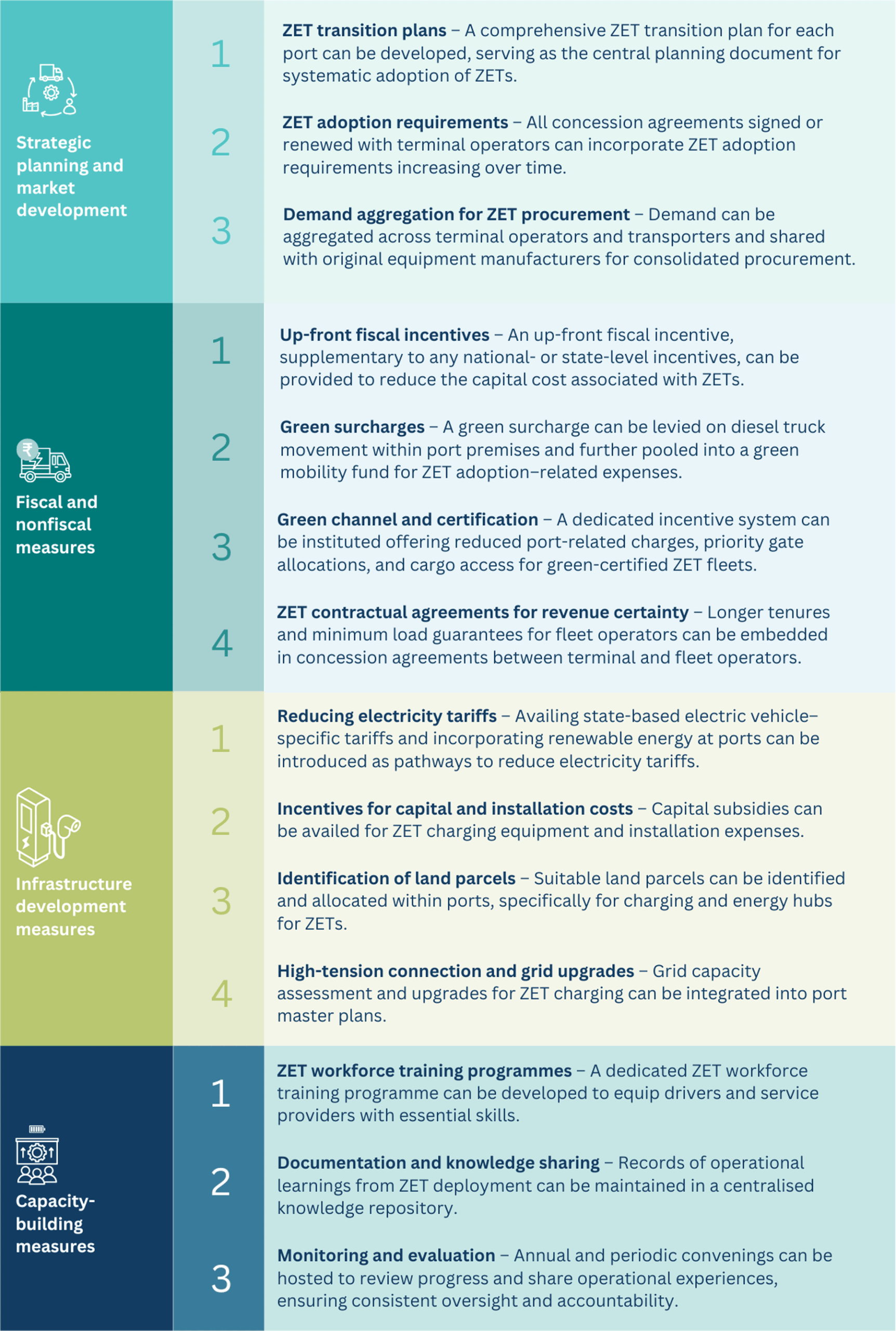
The report proposes a phased approach to implementation of the above measures. Near-term priorities suggest a focus on foundational actions such as aggregating demand, deploying targeted incentives, facilitating access to favorable electricity rates, and building technical expertise among operators. In the medium and long term, the emphasis shifts toward institutionalizing ZET requirements within contracts and strengthening the underlying power infrastructure to support scaled deployment. This phased pathway builds confidence in the near term and ensures accelerated, large-scale ZET adoption in the medium term.
Authors

Vaibhav Sabharwal
Associate
Samhita Shiledar
Principal
Akshima Ghate

Pranav Lakhina
Manager
Avni Mehta
Related Insights


Reality Check: For Power Plants, Changing the Fuel Doesn’t Fix the Economics


Beyond the First Frontier: What Comes Next for Carbon Removal
Help build the clean energy future. Donate today.
Independent research. Real-world solutions. Supported by donors.
RMI can pursue the highest-impact climate and energy solutions because we’re supported by people who believe change is possible. Every gift helps advance the work needed to make clean energy the default choice worldwide.
For other ways to give to RMI, including checks or gifts of stock, please visit Other Ways to Give.