

Learn how we are working to transform how we use and produce energy.
Why we share this work for free
RMI is an independent nonprofit working to accelerate the clean energy transition. We publish research like this to inform decision-makers and drive real-world impact.
Our work is supported by philanthropy as well as partnerships, including fee-for-service engagements. This support makes it possible for us to share our independent insights for free.
If you find this work valuable, you can support it anytime.
Get more insights like this
Stay up to date with the latest research, analysis, and tools from RMI by opting in to receive occasional emails below. You’ll get new reports, event invitations, and practical insights to help us all accelerate the clean energy transition.
Loading form...
Your download should start automatically. If it doesn’t, click the download button below.
This work is made possible by philanthropy
RMI is a nonprofit supported by donors and partners. Philanthropy enables us to produce independent research and make resources like this freely available.
If you find this report valuable, please consider supporting our work. You can also explore how we partner with organizations to drive impact.
Jump to Section
India’s electric vehicle (EV) sector is growing rapidly; however, there is currently insufficient infrastructure to support that growth. Distribution companies (DISCOMs), as the link between the electricity grid and the EV infrastructure market, are uniquely positioned to address that challenge. This brief identifies roles and priority actions for DISCOMs in enabling India’s EV infrastructure to keep pace with its mobility and energy transition goals.
To meet India’s goals of 30 percent EV penetration by 2030, RMI estimates the country will need over 1.9 million public chargers and 275,000 battery swapping stations by 2040. DISCOMs can serve in various roles, from enablers of private sector charging to charge point operators (CPOs), to help meet this infrastructure need.
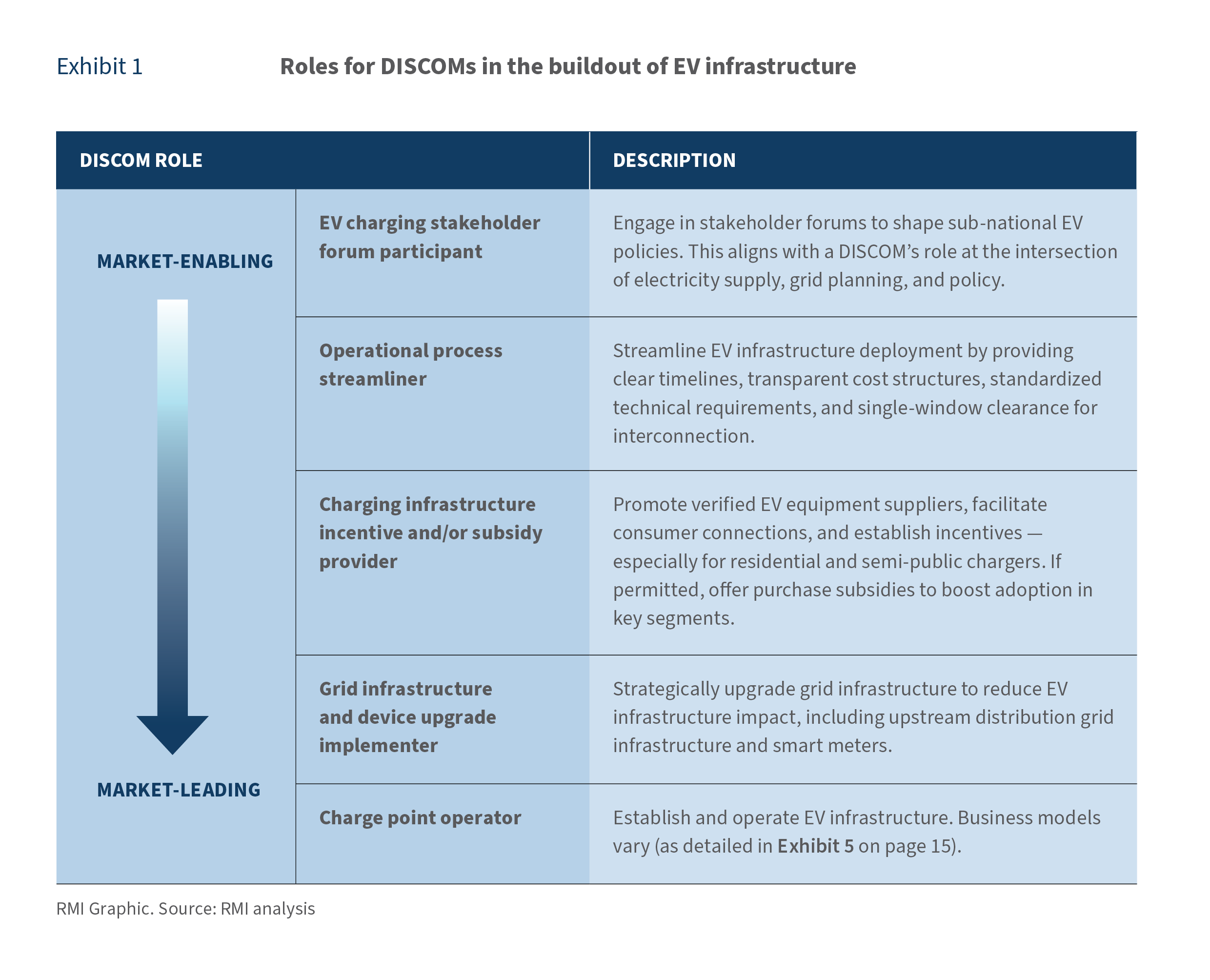
DISCOMs must evaluate their financial capacity, regulatory environment, and technical readiness when choosing their role. Those with limited resources may focus on enabling private investment, while other DISCOMs can take on more active roles as CPOs.
To drive the scale-up of EV infrastructure, DISCOMs should consider the following priority actions:
- Conducting long-term EV load planning to upgrade grid infrastructure strategically
- Streamlining processes to reduce barriers to entry for CPOs
- Providing infrastructure and pilots to support future load mitigation
- Assessing innovative business models to become CPOs
Despite challenges around grid upgrades, load forecasting, and viability, international examples showcase that DISCOM leadership can catalyze the market and accelerate the deployment of necessary infrastructure. With focused action and stronger coordination, DISCOMs can help build a robust, scalable, and inclusive EV infrastructure ecosystem.


Related Insights


Help build the clean energy future. Donate today.
Independent research. Real-world solutions. Supported by donors.
RMI can pursue the highest-impact climate and energy solutions because we’re supported by people who believe change is possible. Every gift helps advance the work needed to make clean energy the default choice worldwide.
For other ways to give to RMI, including checks or gifts of stock, please visit Other Ways to Give.
