

Learn how we are working to transform how we use and produce energy.
Why we share this work for free
RMI is an independent nonprofit working to accelerate the clean energy transition. We publish research like this to inform decision-makers and drive real-world impact.
Our work is supported by philanthropy as well as partnerships, including fee-for-service engagements. This support makes it possible for us to share our independent insights for free.
If you find this work valuable, you can support it anytime.
Get more insights like this
Stay up to date with the latest research, analysis, and tools from RMI by opting in to receive occasional emails below. You’ll get new reports, event invitations, and practical insights to help us all accelerate the clean energy transition.
Loading form...
Your download should start automatically. If it doesn’t, click the download button below.
This work is made possible by philanthropy
RMI is a nonprofit supported by donors and partners. Philanthropy enables us to produce independent research and make resources like this freely available.
If you find this report valuable, please consider supporting our work. You can also explore how we partner with organizations to drive impact.
Jump to Section
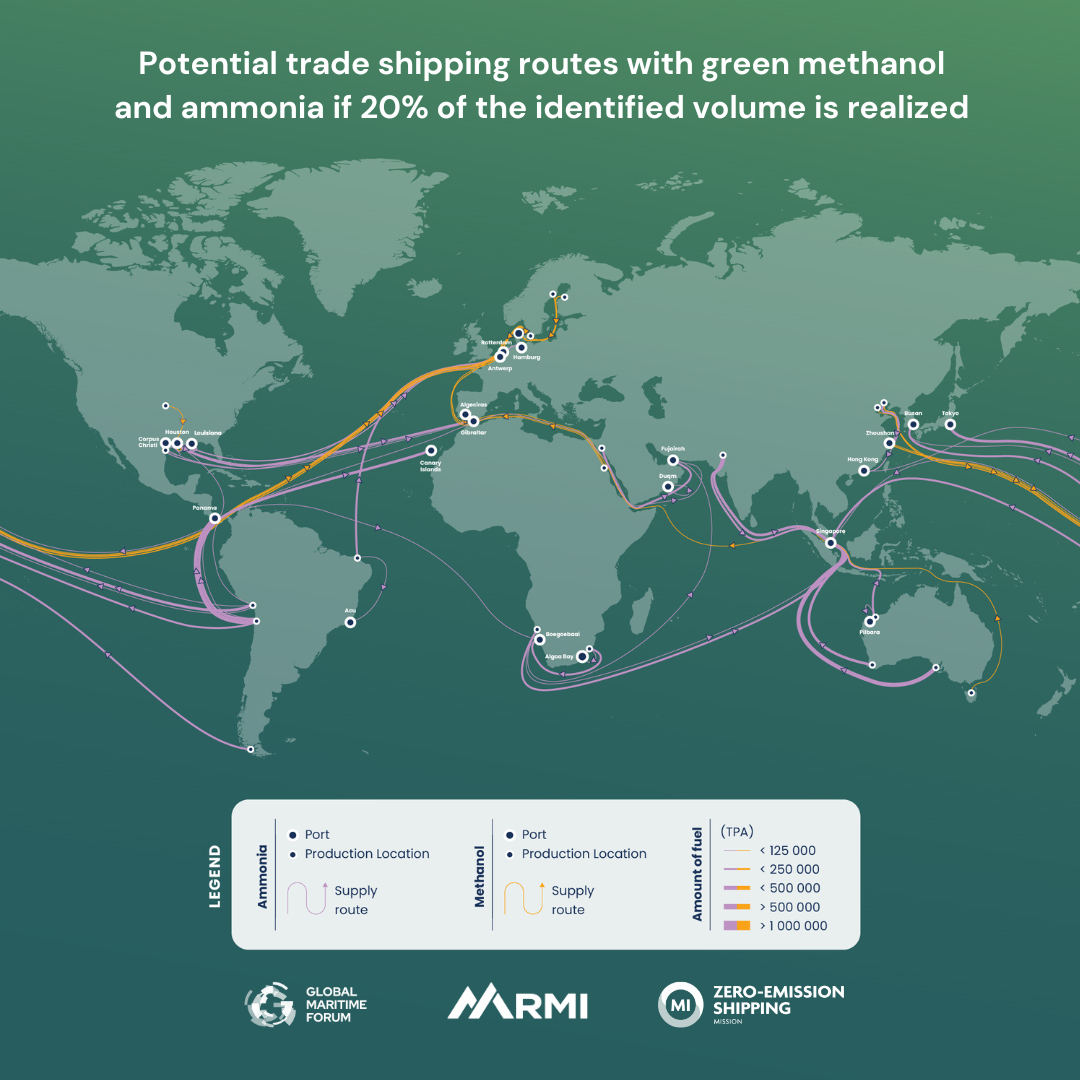
The maritime sector plays a pivotal role in enabling global trade and accelerating the transition to a low-carbon economy. Responsible for 3 percent of global greenhouse gas (GHG) emissions, ocean transport needs to transition to low-and zero-emissions fuels. As the maritime industry decarbonizes, significant shifts in fuel procurement and distribution are anticipated. Gaining insights into the availability and sourcing of green methanol and ammonia for the shipping sector will be crucial to meeting the International Maritime Organization’s (IMO) target of achieving at least 5% utilization of zero-emission fuels by 2030.
This report, by the Global Maritime Forum and RMI, under Mission Innovation’s umbrella, outlines strategies for ports to become first movers in providing green methanol and ammonia bunkering. The report highlights key findings on the cost-effectiveness of transporting green methanol and ammonia, both derived from green hydrogen, which is expected to foster extensive trade networks between production centers and major ports. Moreover, it underscores the pivotal role of policy in shaping a country or region’s position within the evolving hydrogen economy.
Analyzing green ammonia and methanol production, the report shows potential supply patterns, with methanol likely concentrated in major bunkering hubs and European ports, and green ammonia facilitated by long-distance transport from low-cost production sites across regions like the United States, South America, Australia, and Sub-Saharan Africa.
As ports strategize to meet the IMO’s emission targets, the study identifies four archetypes of ports, each with specific opportunities, challenges, and requisite actions for developing green methanol or ammonia bunkering facilities. Drawing insights from ports like Singapore, Algeciras, Corpus Christi, Seattle & Tacoma, and Rotterdam, the report offers tailored recommendations to guide ports in pioneering the decarbonization efforts of the maritime industry.
Authors

Cato Koole
Manager
Abby Martin
Associate
Aparajit Pandey
Principal
Joe Boyland (Report writing engagement support Global Maritime Forum)
Bianca Garvin (Research engagement support Global Maritime Forum)
Jesse Fahnestock (Global Maritime Forum)
Related Insights
The Opportunity for Heat Pumps to Put Downward Pressure on Electricity Rates
Gas Utility Depreciation: Recommendations for an Uncertain Future
Help build the clean energy future. Donate today.
Independent research. Real-world solutions. Supported by donors.
RMI can pursue the highest-impact climate and energy solutions because we’re supported by people who believe change is possible. Every gift helps advance the work needed to make clean energy the default choice worldwide.
For other ways to give to RMI, including checks or gifts of stock, please visit Other Ways to Give.
