

Learn how we are working to transform how we use and produce energy.
New York Set to Pioneer a Move to New All-Electric Buildings
Why we share this work for free
RMI is an independent nonprofit working to accelerate the clean energy transition. We publish research like this to inform decision-makers and drive real-world impact.
Our work is supported by philanthropy as well as partnerships, including fee-for-service engagements. This support makes it possible for us to share our independent insights for free.
If you find this work valuable, you can support it anytime.
Get more insights like this
Stay up to date with the latest research, analysis, and tools from RMI by opting in to receive occasional emails below. You’ll get new reports, event invitations, and practical insights to help us all accelerate the clean energy transition.
Loading form...
Your download should start automatically. If it doesn’t, click the download button below.
This work is made possible by philanthropy
RMI is a nonprofit supported by donors and partners. Philanthropy enables us to produce independent research and make resources like this freely available.
If you find this report valuable, please consider supporting our work. You can also explore how we partner with organizations to drive impact.
Jump to Section
The New York State Legislature is poised to take a leadership role nationwide by requiring all-electric new construction across the state. This comes on the heels of local all-electric legislation in New York City, which passed in December 2021.
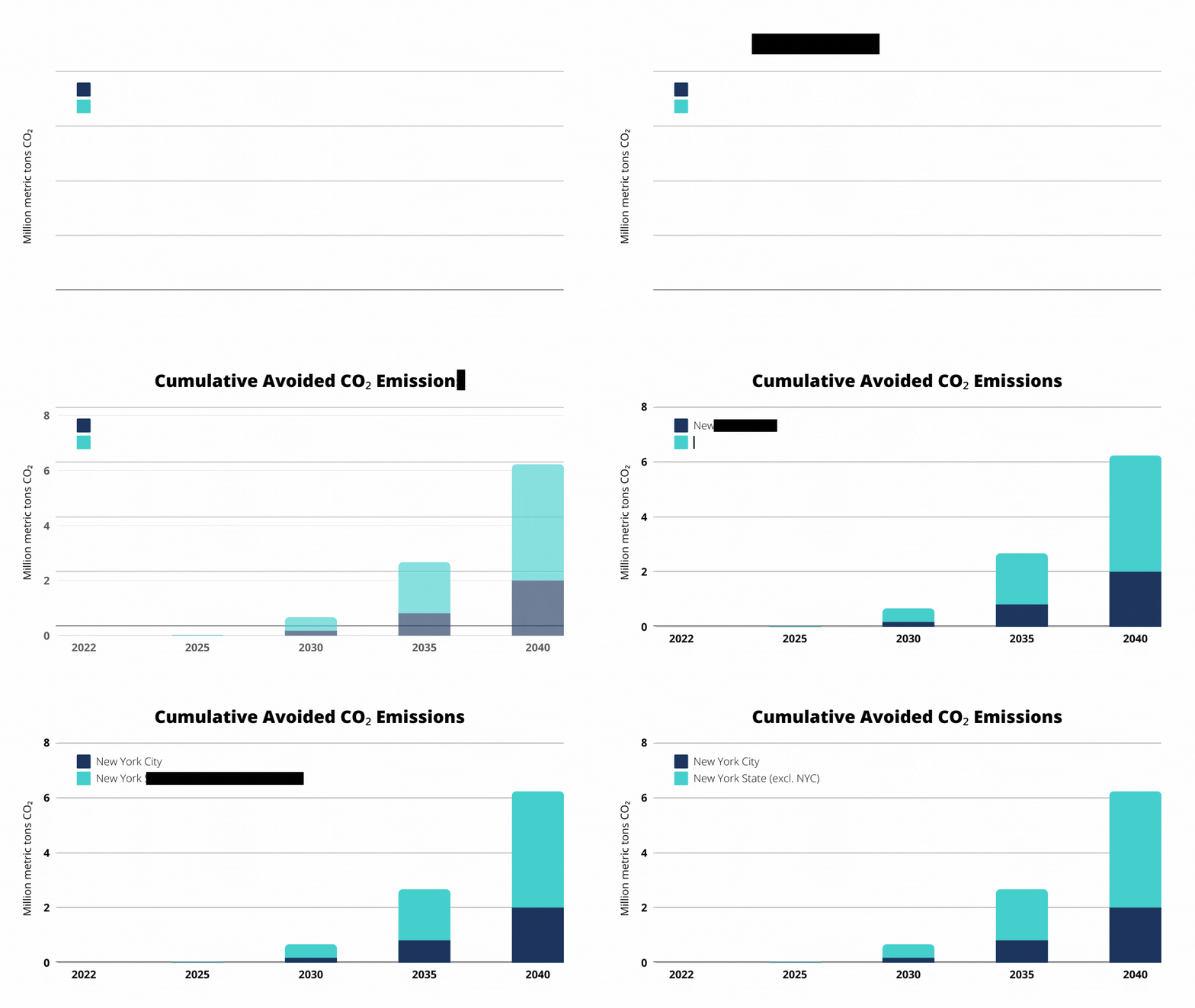
RMI analyzed the impacts of all-electric new construction in New York State on a timeline comparable to New York City’s law.* We found that the statewide policy would save an additional 4 million metric tons of CO2 by 2040 beyond the reductions already expected from NYC — the equivalent of keeping 870,000 cars off the road for one year.
Setting the Stage at the City and State Level
In December, New York City passed Local Law 154, phasing out on-site fossil fuel use in new construction starting in 2024 for small buildings and 2027 for buildings of seven-plus stories. A few weeks later, the State’s Climate Action Council released its Draft Scoping Plan, laying out a roadmap to achieve New York’s climate targets. The plan highlighted a similar measure statewide — all-electric new construction, also starting in 2024 for small buildings.
Tripling the Climate Impact of NYC’s Law
The statewide policy would triple the impact of the NYC law, saving an additional 4 million metric tons of CO2 beyond NYC’s 2 million metric tons. Why the outsized impact? First, there is significant new construction outside of New York City, accounting for nearly two-thirds of the state’s residential construction in the past decade. Second, all-electric new construction beyond NYC includes more single-family homes, and an all-electric single-family home displaces more than three times the gas consumption of a unit in a large multifamily building.

All-Electric New Construction: A Win for Climate, Health, and the Economy
All-electric new construction policies offer a range of benefits for New Yorkers. All-electric new construction is cost-effective today compared to new, mixed-fuel homes. Clean, electric heating will help New York State address its worst-in-the-nation ranking for premature mortality from building-related air pollution. And last but not least, these policies reduce ratepayer subsidy costs for expanding the gas distribution system, which will lie fallow when the state turns off its gas taps.
All-electric buildings are the future in New York State — and with this policy, the Empire State can pioneer their adoption across the country as well.
* Methodology: RMI modeled a statewide policy based on New York City’s Local Law 154, varying implementation scope and dates for single-family homes (2024 for space and water heating), multifamily and commercial buildings less than seven stories (2024 for space heating), and all remaining buildings and end uses (2028). RMI used historical data on new residential and commercial construction from the American Community Survey and NREL’s City and County Commercial Building Inventories, respectively. Natural gas consumption data was derived from NREL’s End Use Load Profiles for the US Building Stock. Lastly, RMI used forward-looking electric grid CO2 emissions factors from NREL’s Cambium dataset, specifically the scenario modeling 95 percent decarbonization of electricity generation by 2050.
Authors

Amar Shah
Talor Gruenwald
Yu Ann Tan
Related Insights

Help build the clean energy future. Donate today.
Independent research. Real-world solutions. Supported by donors.
RMI can pursue the highest-impact climate and energy solutions because we’re supported by people who believe change is possible. Every gift helps advance the work needed to make clean energy the default choice worldwide.
For other ways to give to RMI, including checks or gifts of stock, please visit Other Ways to Give.
