

Learn how we are working to transform how we use and produce energy.
Guidelines for Financing a Credible Coal Transition
A Framework for Assessing the Climate and Social Outcomes of Coal Transition Mechanisms
Why we share this work for free
RMI is an independent nonprofit working to accelerate the clean energy transition. We publish research like this to inform decision-makers and drive real-world impact.
Our work is supported by philanthropy as well as partnerships, including fee-for-service engagements. This support makes it possible for us to share our independent insights for free.
If you find this work valuable, you can support it anytime.
Get more insights like this
Stay up to date with the latest research, analysis, and tools from RMI by opting in to receive occasional emails below. You’ll get new reports, event invitations, and practical insights to help us all accelerate the clean energy transition.
Loading form...
Your download should start automatically. If it doesn’t, click the download button below.
This work is made possible by philanthropy
RMI is a nonprofit supported by donors and partners. Philanthropy enables us to produce independent research and make resources like this freely available.
If you find this report valuable, please consider supporting our work. You can also explore how we partner with organizations to drive impact.
Jump to Section
Today, more than 95 percent of coal consumptions occurs in countries that have pledged to phase out coal or achieve net zero emissions. Despite these positive commitments, coal emissions have plateaued at a high level, with existing coal plants expected to draw down two-thirds of our remaining 1.5°C carbon budget unless action is taken to transition the current coal fleet. Many of these coal plants operate in markets where regulation or contractual structures insulate them from competition, allowing them to remain profitable despite the rapidly declining cost of renewables.
In this context, coal transition mechanisms (CTMs), or financial mechanisms that support an accelerated, managed transition from coal to clean energy, can be critical tools for turning coal phaseout commitments into action. CTMs are gaining significant interest worldwide, from ratepayer-backed bond securitization in the United States to multilateral development bank programs, such as the Asian Development Bank’s Energy Transition Mechanism (ETM) and the Climate Investment Fund’s Accelerating Coal Transition (ACT) Investment Program. Yet these mechanisms also carry risks that could undermine their ability to deliver on their intended outcomes.
In this working paper, Guidelines for Financing a Credible Coal Transition, Climate Bonds Initiative, Climate Policy Initiative, and RMI introduce a framework to help funders and coal plant owners address these risks, including:
- Risks that the CTM transaction does not deliver positive climate outcomes
- Social, environmental, and economic risks to coal workers, communities, and regional governments
- Reputational risks attached to the optics of providing financing to coal plant owners
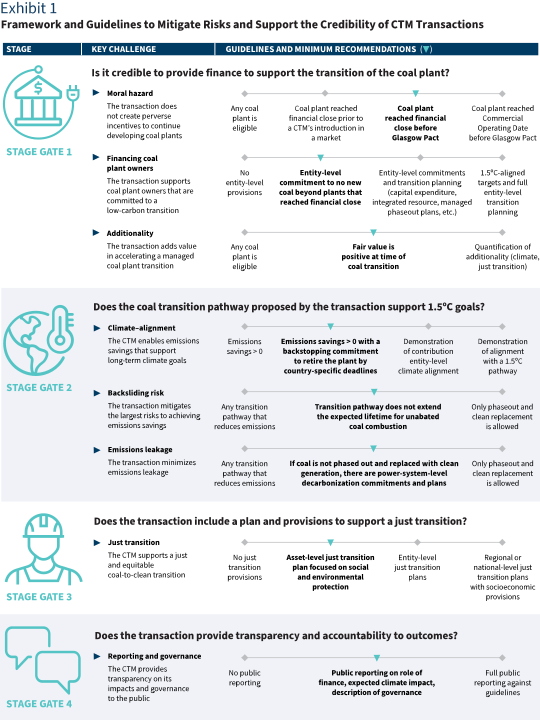
This framework is organized into four stage gates that assess coal plant eligibility, coal transition pathways, social protection, and accountability associated with a CTM and puts forward recommended guidelines within each gate (see below).
These guidelines were developed through a consultative process with experts and stakeholders from public, private, and civil society institutions. We expect them to further evolve with both CTM experience and stakeholder needs.
We look forward to hearing your feedback on the guidelines. Please feel free to reach out to the contacts listed in the report to provide any inputs.
Authors

Tyeler Matsuo
Principal
Barbara Buchner (CPI)
Koben Calhoun
Jonathan First (CPI)
Sean Kidney (CBI)
Chiagozie Obuekwe
Vivek Sen (CPI)
Emma Slater
Zofia Wetmańska (CBI)
Vikram Widge (CPI)
Related Insights

For Clean Energy Projects, How Community Benefits Are Delivered Matters

Tracking WestTEC: Where 100+ Transmission Projects Stand and What Comes Next


Help build the clean energy future. Donate today.
Independent research. Real-world solutions. Supported by donors.
RMI can pursue the highest-impact climate and energy solutions because we’re supported by people who believe change is possible. Every gift helps advance the work needed to make clean energy the default choice worldwide.
For other ways to give to RMI, including checks or gifts of stock, please visit Other Ways to Give.
