

Learn how we are working to transform how we use and produce energy.
Fast Tracking Freight in India: A Roadmap for Clean and Cost-effective Goods Transport
Why we share this work for free
RMI is an independent nonprofit working to accelerate the clean energy transition. We publish research like this to inform decision-makers and drive real-world impact.
Our work is supported by philanthropy as well as partnerships, including fee-for-service engagements. This support makes it possible for us to share our independent insights for free.
If you find this work valuable, you can support it anytime.
Get more insights like this
Stay up to date with the latest research, analysis, and tools from RMI by opting in to receive occasional emails below. You’ll get new reports, event invitations, and practical insights to help us all accelerate the clean energy transition.
Loading form...
Your download should start automatically. If it doesn’t, click the download button below.
This work is made possible by philanthropy
RMI is a nonprofit supported by donors and partners. Philanthropy enables us to produce independent research and make resources like this freely available.
If you find this report valuable, please consider supporting our work. You can also explore how we partner with organizations to drive impact.
Jump to Section
Freight transportation plays a crucial role in supporting the economic development of a nation, boosting its logistics and industrial competitiveness, and satisfying the daily needs of its citizens. Due to the rising demand for goods and services, India’s freight transport demand has been growing at 5 percent since 2015 and is expected to grow rapidly over the next three decades. Although freight transport is an important pillar of the Indian economy, it can also have negative consequences such as high logistics costs, rising CO2 emissions, and worsening air quality leading to poor public health.
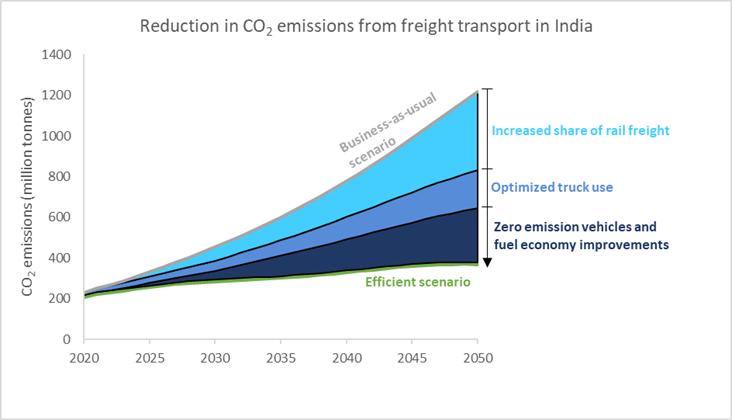
India can address these negative impacts through three main opportunity areas:
- Improve share of rail freight transport
- Optimize truck use
- Increase the uptake of zero-emissions vehicles and fuel economy improvement technologies
In this report, NITI Aayog and RMI outline solutions for the opportunity areas mentioned above. These solutions can enable the freight transport ecosystem in India to become more cost-effective, optimized, and cleaner.
Together, these opportunities can unlock 10 gigatons of cumulative CO2 emission savings between 2020 and 2050. This can help India achieve its goal of reducing the logistics costs from 14 percent of GDP to 10 percent, and will reduce nitrogen oxide and particulate matter emissions by 35 percent and 28 percent respectively until 2050.


Related Insights
India’s Used EV Battery Market Needs Trust. Battery Aadhaar Can Help.
Help build the clean energy future. Donate today.
Independent research. Real-world solutions. Supported by donors.
RMI can pursue the highest-impact climate and energy solutions because we’re supported by people who believe change is possible. Every gift helps advance the work needed to make clean energy the default choice worldwide.
For other ways to give to RMI, including checks or gifts of stock, please visit Other Ways to Give.
