

Learn how we are working to transform how we use and produce energy.
Equity and Climate: A Solution for Home Rentals
Why we share this work for free
RMI is an independent nonprofit working to accelerate the clean energy transition. We publish research like this to inform decision-makers and drive real-world impact.
Our work is supported by philanthropy as well as partnerships, including fee-for-service engagements. This support makes it possible for us to share our independent insights for free.
If you find this work valuable, you can support it anytime.
Get more insights like this
Stay up to date with the latest research, analysis, and tools from RMI by opting in to receive occasional emails below. You’ll get new reports, event invitations, and practical insights to help us all accelerate the clean energy transition.
Loading form...
Your download should start automatically. If it doesn’t, click the download button below.
This work is made possible by philanthropy
RMI is a nonprofit supported by donors and partners. Philanthropy enables us to produce independent research and make resources like this freely available.
If you find this report valuable, please consider supporting our work. You can also explore how we partner with organizations to drive impact.
Jump to Section
Lack of affordable housing and energy burdens plague many people and communities. Cities throughout the United States are looking for solutions to create greater equity. Many of these cities are part of the over 3,600 US cities, states, and businesses that have pledged support for the goals established in the Paris Agreement in 2015. Improving efficiency and comfort in homes is a key part of meeting these goals because the residential sector accounts for 20 percent of US carbon emissions. But as housing prices continue to rise, cities might struggle to make housing more affordable while reducing emissions.
RMI has been working with over two dozen cities to create a way forward on both of these challenges. One way to reach both sustainability and housing affordability goals is by establishing minimum efficiency standards for rental housing. RMI recently developed an action guide website for cities interested in doing exactly that.
What Are Minimum Efficiency Standards for Rentals?
Let’s dig a bit deeper into the policy. Efficiency standards for rentals ensure that landlords upgrade the efficiency of their residential properties as a prerequisite for renting a property. This avoids running a rental business that uses substandard housing and helps reduce energy burdens on renters. This policy was successfully passed by the City of Boulder in 2010, with rentals fully compliant by the end of 2018.
Almost 70 percent of residential properties were built before an energy code was in place, and as a result, existing residential properties, on average, are 30 percent less efficient than newly constructed residential properties. This means that tenants are burdened with living in less efficient and less comfortable homes while paying higher utility bills. Low-income customers in particular are burdened with higher energy costs and live in disproportionately less energy efficient buildings. The Department of Energy estimates that 44 percent of US households are defined as low income. These households have an energy burden three times higher than that of non-low-income households. In 2015, about 20 percent of households reported needing to sacrifice essentials such as food and medicine to pay energy bills and 11 percent reported that they kept their home at an unhealthy temperature to avoid high energy bills.
Cities Taking Action
Already, two cities have passed the policy and three other cities have publicly announced their progress on passing the policy as shown by the map below.
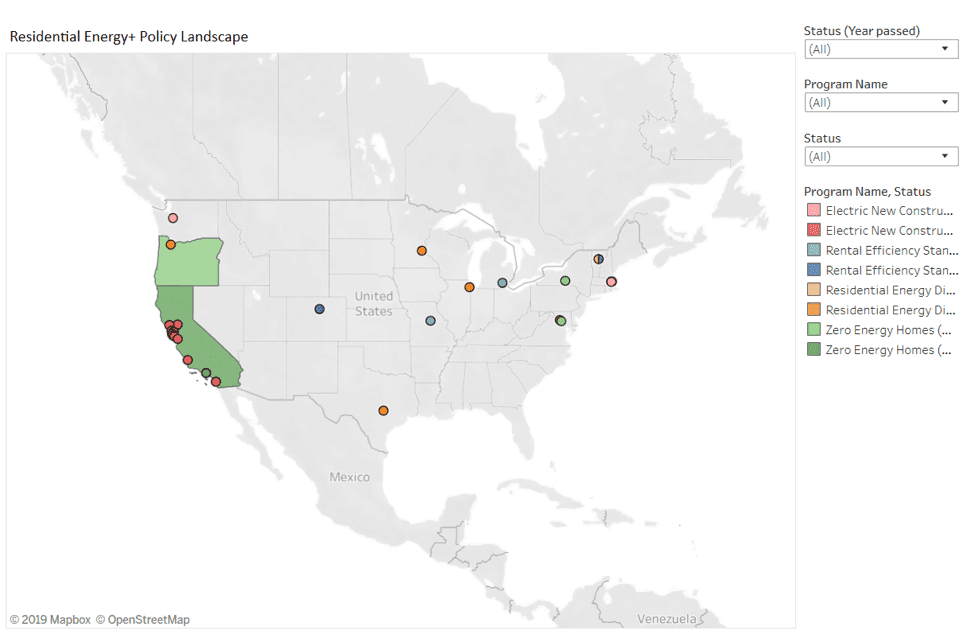
In 2018, RMI’s Residential Energy Plus team organized a cohort of 27 cities that are also exploring this policy, representing a total of over 1 million rental units. We estimate that all 27 cities implementing rental efficiency standards could yield up to $560 million in annual energy cost savings.
While this is an impressive start, there are several other cities that could build upon existing rental licensing policies. It would be possible to integrate minimum efficiency standards into an existing rental licensing program by requiring licensing inspectors to confirm that rental properties meet a minimum efficiency standard before issuing their rental licenses. The map below shows the status of rental licensing policy status of the over 80 of the most populous US cities.
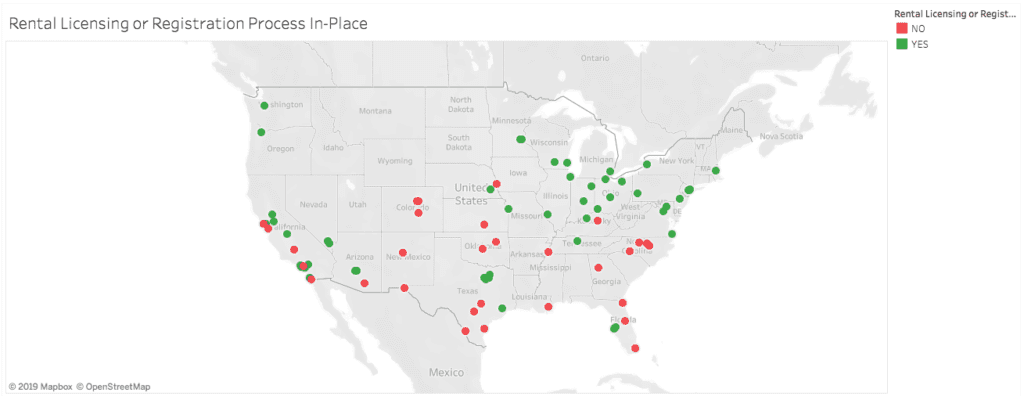
Note: This is based on preliminary research. Please reach out with any suggested updates.
Announcing an Action Guide for Cities
RMI recently developed an action guide website for cities interested in passing rental efficiency standards. This website walks city officials through filling out a policy blueprint that can guide action and drive impact. The goal of this action guide is to equip policymakers with the resources needed to understand, design, implement, and administer efficiency standards for residential rental properties in their jurisdiction.

Please let us know about any additional resources that would be helpful to your city as you explore this policy. This resource will likely evolve over time as more cities explore and implement rental efficiency standards.
To learn more about the outcomes of RMI’s past working groups or to receive technical assistance as your city explores this policy, please reach out to Sneha Ayyagari at sayyagari@rmi.org.
Authors

Sneha Ayyagari
Related Insights


Help build the clean energy future. Donate today.
Independent research. Real-world solutions. Supported by donors.
RMI can pursue the highest-impact climate and energy solutions because we’re supported by people who believe change is possible. Every gift helps advance the work needed to make clean energy the default choice worldwide.
For other ways to give to RMI, including checks or gifts of stock, please visit Other Ways to Give.