

Learn how we are working to transform how we use and produce energy.
Emergence Strategy: A Systems Approach to Corporate Climate Action
How leading companies can move beyond incremental emission-reduction steps to seize business opportunities that entail transformative changes.
Why we share this work for free
RMI is an independent nonprofit working to accelerate the clean energy transition. We publish research like this to inform decision-makers and drive real-world impact.
Our work is supported by philanthropy as well as partnerships, including fee-for-service engagements. This support makes it possible for us to share our independent insights for free.
If you find this work valuable, you can support it anytime.
Get more insights like this
Stay up to date with the latest research, analysis, and tools from RMI by opting in to receive occasional emails below. You’ll get new reports, event invitations, and practical insights to help us all accelerate the clean energy transition.
Loading form...
Your download should start automatically. If it doesn’t, click the download button below.
This work is made possible by philanthropy
RMI is a nonprofit supported by donors and partners. Philanthropy enables us to produce independent research and make resources like this freely available.
If you find this report valuable, please consider supporting our work. You can also explore how we partner with organizations to drive impact.
Jump to Section
How can companies take advantage of the exponential changes unfolding in energy technologies and systems as they develop strategies to achieve net-zero emissions in their own businesses and value chains? This series of emergence strategy case studies provides examples of how leading companies are moving beyond incremental emission-reduction steps to seize business opportunities that entail transformative changes. Here, we provide a brief introduction to emergence strategy and its implications.
What?
Emergence strategy applies systems thinking tools to identify new business opportunities, overcome obstacles to system transitions, and pinpoint the roles a company can play as a leader, catalyst, advocate, or collaborator in relation to other key actors in a system. This process is different from traditional strategy approaches that focus primarily on competition, but the two may be used in complementary ways. In addition, emergence strategy leverages corporate climate action building blocks such as science-based net-zero commitments and scope-based emissions disclosures where these have already been developed.
Why?
Turning climate action from a bolt-on set of requirements for existing business activities into a strategic priority can unlock new avenues for innovation and value creation for many companies. Because the changes needed to address the climate crisis will require transitions across many key industries and value chains, companies looking for strategic opportunities must focus on how they can participate in accelerating and influencing systems change to deliver new solutions. Emergence strategy is a way of searching for and capitalizing on fundamental changes that are emerging in a business ecosystem, sector, or value chain in connection with corporate climate action.
Who?
Companies most likely to deploy emergence strategies are those looking to widen the aperture of their search for new value-creation opportunities aligned with their climate and sustainability goals. The systems approach helps companies develop focused strategies for engaging other stakeholders, including companies up and down value chains, governments, and civil society organizations to advance new technologies, introduce new products or services, or evolve market structures.
How?
The emergence strategy process entails three functions that are applied iteratively:
- System sensing to identify opportunities for profitably delivering sustainable solutions,
- System solutions to overcome barriers based on understanding the s-curve dynamics and patterns
- System roles to describe how a particular organization is best suited to act and mobilize others to drive and shape systemic change.
Together, these allow a company to assess the strategic landscape using systems thinking tools and choose where and how to collaborate and compete.
When?
Companies use emergence strategy when they want to look beyond incremental steps to reduce emissions and explore new business opportunities that are linked to transformative change in products and services, business models, or supply chain relationships.
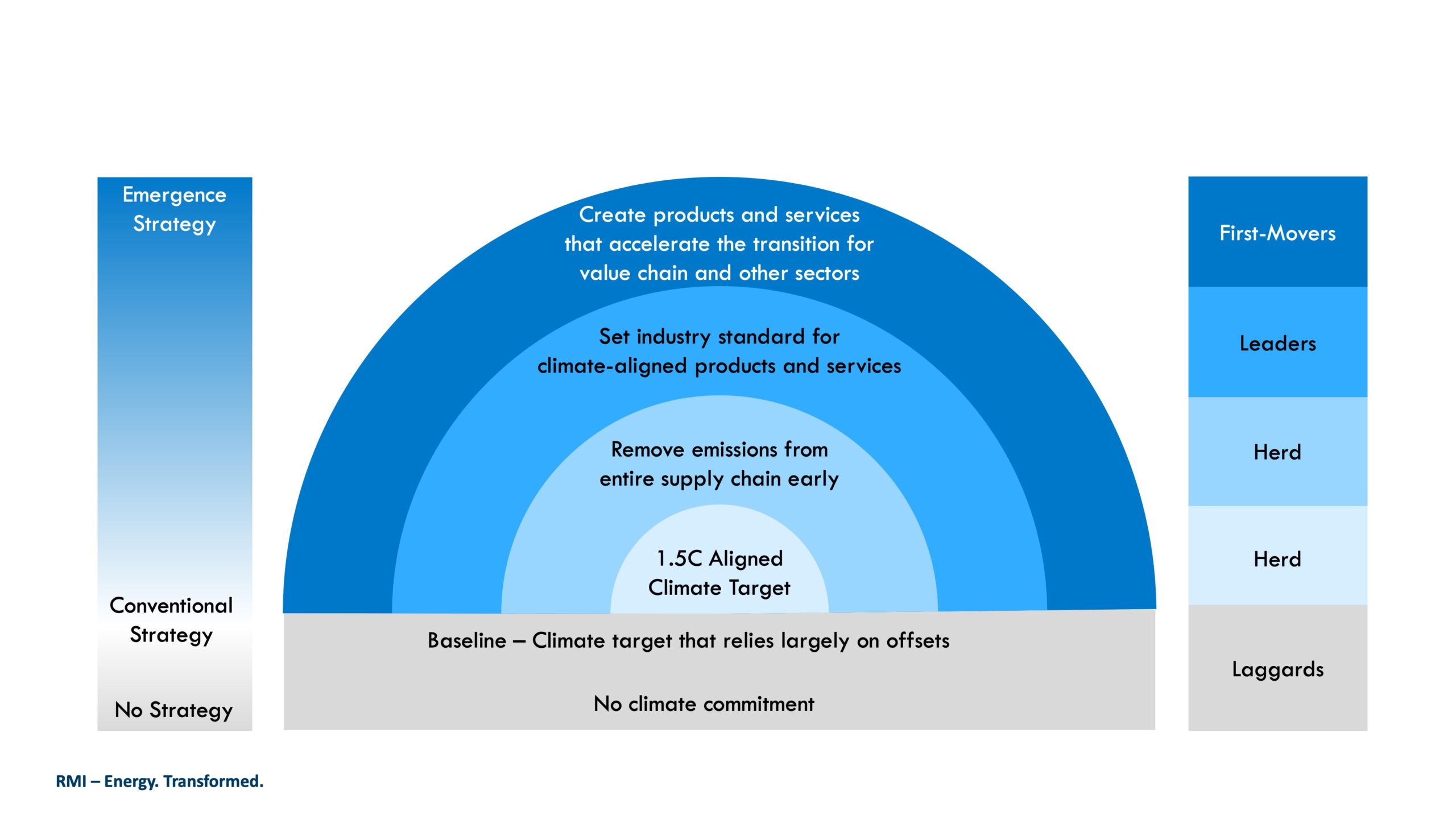
Read all of our related emergence strategy work at the links below:
Authors

James Newcomb
Senior Expert
Laurens Speelman
Principal
Yuki Numata
Senior Associate
Adefunke Sonaike
Data Scientist
Marissa Gantman
Strategic Communications Director- Strategy and PlanningRelated Insights

For Clean Energy Projects, How Community Benefits Are Delivered Matters


Tracking WestTEC: Where 100+ Transmission Projects Stand and What Comes Next

Help build the clean energy future. Donate today.
Independent research. Real-world solutions. Supported by donors.
RMI can pursue the highest-impact climate and energy solutions because we’re supported by people who believe change is possible. Every gift helps advance the work needed to make clean energy the default choice worldwide.
For other ways to give to RMI, including checks or gifts of stock, please visit Other Ways to Give.
