

Learn how we are working to transform how we use and produce energy.
Climate Change Is Ravaging California. It’s Time to Electrify.
Why we share this work for free
RMI is an independent nonprofit working to accelerate the clean energy transition. We publish research like this to inform decision-makers and drive real-world impact.
Our work is supported by philanthropy as well as partnerships, including fee-for-service engagements. This support makes it possible for us to share our independent insights for free.
If you find this work valuable, you can support it anytime.
Get more insights like this
Stay up to date with the latest research, analysis, and tools from RMI by opting in to receive occasional emails below. You’ll get new reports, event invitations, and practical insights to help us all accelerate the clean energy transition.
Loading form...
Your download should start automatically. If it doesn’t, click the download button below.
This work is made possible by philanthropy
RMI is a nonprofit supported by donors and partners. Philanthropy enables us to produce independent research and make resources like this freely available.
If you find this report valuable, please consider supporting our work. You can also explore how we partner with organizations to drive impact.
Jump to Section
COVID-19 isn’t the only crisis taking a toll on California this summer. Record-breaking heat has helped fuel the largest wildfire season on record, with more than two million acres already burned. Smoke from the fires has blanketed much of the state, causing some of the worst air quality in the world.
It’s clear that the climate crisis is here and that we need to act fast to slash emissions across every sector of the economy. California has already made progress toward this goal with an executive order mandating that the state achieve carbon neutrality no later than 2045. But determining how exactly the state will eliminate carbon emissions in that timeframe is still an open-ended question, particularly in stubborn sectors like buildings.
Researchers at Energy and Environment Economics (E3) mapped out several paths for the California Air Resources Board in their recent report Achieving Carbon Neutrality in California. In this report, E3 evaluates three different scenarios to achieve carbon neutrality by 2045: “Zero Carbon Energy,” “Balanced,” and “High Carbon Dioxide Removal.” Each varied in how much it relies on directly cutting fossil fuel emissions (such as electrifying buildings) versus relying upon carbon dioxide removal strategies (such as direct air capture and land-based carbon sinks).
This report adds to a growing body of work that makes clear that aggressive building electrification is required to truly tackle climate change.
The Imperative to Electrify
One of the key takeaways from the E3 report is that aggressive building electrification is considered a “least-regret” strategy to get to carbon neutrality by 2045, meaning it’s required for the state to reach its carbon goals in a cost-effective manner. In all three paths to carbon neutrality that E3 evaluated, the retail natural gas distribution system will need to undergo “a significant reduction in use,” and one of the scenarios recommends the complete decommissioning of the system by 2045.
This report builds on E3’s past work showing that carbon reduction scenarios with high building electrification have lower economy-wide costs than scenarios in which there is no building electrification.
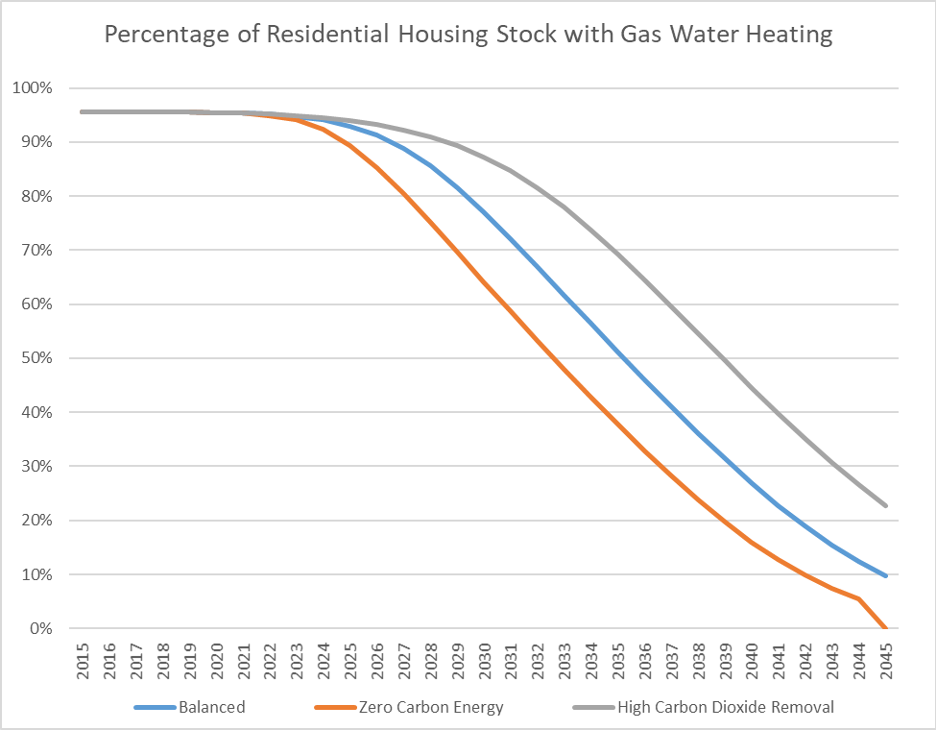
Regardless of the precise approach taken, California will require substantial fuel switching of its gas appliance stock to reach carbon neutrality. Even in the least aggressive electrification scenario, gas water heaters are reduced from 95 percent of the residential housing stock today to 23 percent by 2045. Space heaters also see a similar reduction, from 82 percent to 27 percent. Reductions of this magnitude will require a massive market shift in the annual sales of space and water heating appliances.
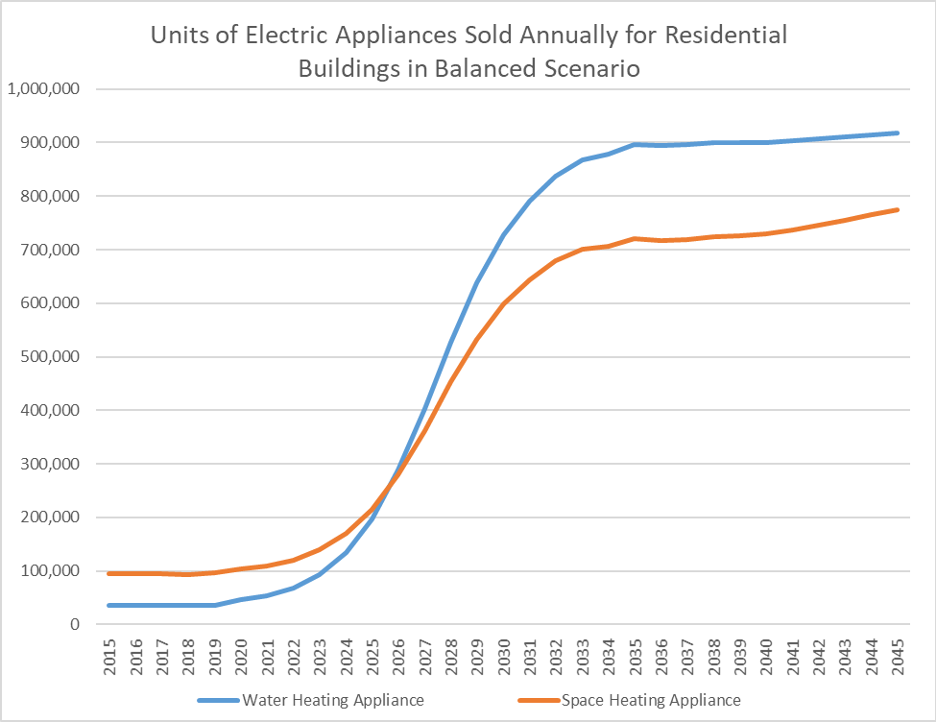
According to E3’s data, California sells around 36,000 electric residential water heaters annually. This would need to increase to around 134,000 electric water heaters in residential homes being sold per year by 2024 if we are to keep on track for the balanced “middle ground” scenario.
Given there were roughly 114,000 new residential units built in 2018, one strategy to reach this market growth would be for the California Energy Commission to require all new construction to be all-electric in the 2022 code cycle. All-electric new construction has the benefit of lower upfront costs compared with mixed-fueled buildings, while also eliminating the danger of expanding the gas system that will inevitably become a stranded asset.
Aggressive Electrification for Air Quality and Health
Though the E3 study does not perform a detailed air quality analysis, it uses statewide fuel combustion as a proxy for potential air quality and health impacts. Combustion in our homes contributes to harmful levels of toxic pollutants that cause respiratory illnesses, including asthma.
The scenario that assumes high levels of carbon capture relies most heavily on fuel combustion, resulting in higher levels of pollution and negative health impacts. In contrast, the aggressive electrification scenario avoids or mitigates the most fossil fuel emissions and creates the greatest opportunity for co-benefits, such as improved health and air quality.
UCLA researchers found that replacing all of California’s gas appliances with electric appliances would prevent 900 cases of respiratory illnesses, lower healthcare costs by $3.5 billion, and save 350 lives every year. These co-benefits make building electrification a highly compelling strategy for emissions reductions, especially compared with alternatives that rely on higher levels of combustion.
We Need Low-Carbon Fuels, but Not in Buildings
Alternative fuels, such as biofuels, hydrogen, and synthetic gas, still have a role to play in a low-carbon future. However, that role is not in the buildings sector. All three of E3’s carbon reduction scenarios assume California will utilize the state’s full population-weighted share of US waste biomass, plus 5 percent hydrogen blend in our pipelines. Two scenarios assume additional low-carbon fuel use on top of that. These alternative fuels are largely used in industry applications and heavy-duty trucks.
In fact, the scenario with the most aggressive building electrification also assumes the highest demand for low-carbon fuel by 2045. In other words, building electrification does not equal the end of gas altogether. It’s time gas utilities understand this fact. Rather than continuing to push for alternative fuel use in buildings, they ought to find a proactive set of climate-aligned business solutions, such as transforming the gas utility business model to provide heat as a service and supporting the transition to heat pumps.
National and international studies reach the same conclusions: we need aggressive building electrification to meet climate change goals and alternative fuels will play a role in other sectors. The reality is that alternative fuels are expensive and supply constrained. Their limited supply should be used in hard-to-electrify sectors, not the building sector where affordable, efficient, and clean electric technologies exist on the market today.
Prioritizing Building Electrification
Among E3’s pathways to carbon neutrality, the aggressive electrification scenario presents the lowest risk for inadvertently exceeding carbon reduction goals and for causing harmful health impacts associated with fuel combustion. The greatest risk for the aggressive electrification scenario is that consumers may not adopt electric technologies as quickly as needed to meet climate goals. Policymakers should take this to heart by understanding that to minimize statewide health and climate change impacts, they must accelerate adoption of clean electric technologies, especially in buildings.
As climate change-fueled disasters worsen, California cannot afford to wait. Slow action may be as detrimental as inaction when human lives are on the line.


Related Insights
The Opportunity for Heat Pumps to Put Downward Pressure on Electricity Rates
Building Smarter, More Efficient Air Conditioners for Real World Conditions

How Heat Pumps Reduce Energy Bills and Air Pollution in the San Francisco Bay Area
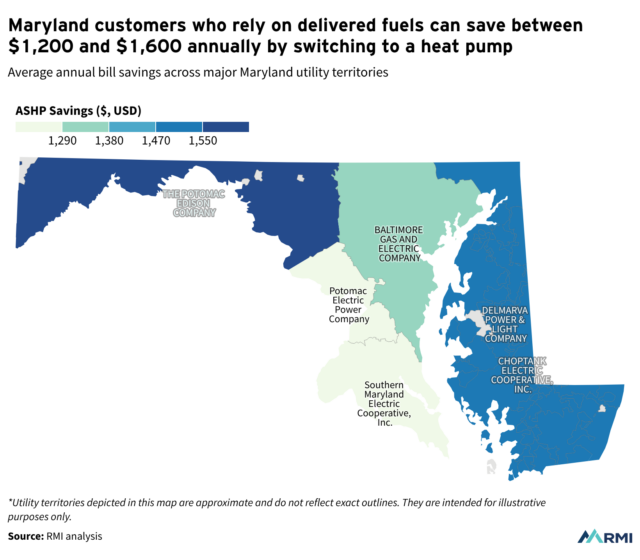
Delivered Fuel Customers in Maryland See Strong Energy Bill Savings in a Switch to Heat Pumps
Help build the clean energy future. Donate today.
Independent research. Real-world solutions. Supported by donors.
RMI can pursue the highest-impact climate and energy solutions because we’re supported by people who believe change is possible. Every gift helps advance the work needed to make clean energy the default choice worldwide.
For other ways to give to RMI, including checks or gifts of stock, please visit Other Ways to Give.
