

Learn how we are working to transform how we use and produce energy.
Why we share this work for free
RMI is an independent nonprofit working to accelerate the clean energy transition. We publish research like this to inform decision-makers and drive real-world impact.
Our work is supported by philanthropy as well as partnerships, including fee-for-service engagements. This support makes it possible for us to share our independent insights for free.
If you find this work valuable, you can support it anytime.
Get more insights like this
Stay up to date with the latest research, analysis, and tools from RMI by opting in to receive occasional emails below. You’ll get new reports, event invitations, and practical insights to help us all accelerate the clean energy transition.
Loading form...
Your download should start automatically. If it doesn’t, click the download button below.
This work is made possible by philanthropy
RMI is a nonprofit supported by donors and partners. Philanthropy enables us to produce independent research and make resources like this freely available.
If you find this report valuable, please consider supporting our work. You can also explore how we partner with organizations to drive impact.
Jump to Section
Hydrogen, especially green hydrogen, will be a key element in China’s energy transition for achieving the goal of carbon neutrality and building a more sustainable economy. The strategic role of green hydrogen has been emphasized in China’s recent “Hydrogen Industry Medium- and Long-Term Development Plan (2021–2035)” as a long-term development direction.
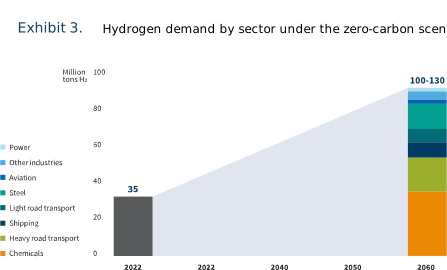
China has become the largest hydrogen producer and consumer in the world, with more than 33 million tons of annual demand. Under the driving force of China’s carbon-neutrality goal, the chemicals, steel, and heavy transportation sectors will require large volumes of green hydrogen to carry out the zero-carbon transition. By 2060, the annual hydrogen demand could increase to 100 million to 130 million tons, including 80 million to 100 million tons of green hydrogen.
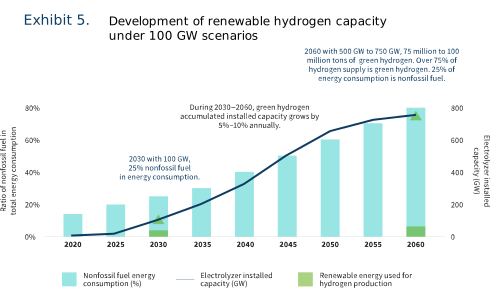
In alignment with both the green hydrogen target and trends in technology and cost advancement, it is necessary to first realize a 100 GW green hydrogen target by 2030. Meeting this target would both scale up production and utilization of green hydrogen and establish a mature supply chain to accelerate long-term development.
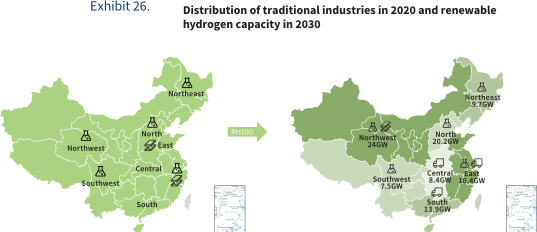
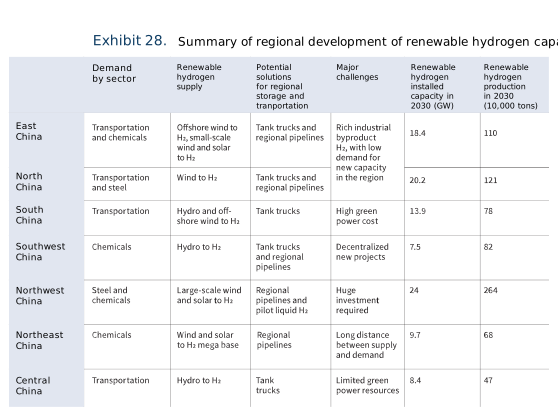
The Opening China’s Green Hydrogen New Era report provides a deep dive on China’s roadmap to reach 100 GW green hydrogen development by 2030, with a focus on utilization in the chemicals, steel, and heavy-duty transportation sectors. It also considers 2030 renewable hydrogen capacity by seven regions, considering sectoral demand, local resources, and potential industrial capacity upgrades. According to the analysis, the Northwest China region is expected to become the largest green hydrogen producer (24 GW) due to its abundant renewable energy resources and decarbonization demands from traditionally coal-based industry.
To support the 100 GW by 2030 target, the report also lands on several actionable recommendations from both policy and market perspectives that could accelerate green hydrogen adoption and long-term utilization across sectors.



Related Insights

Steel’s Transformation: China and Australia’s next horizon of clean steel

Efficiency Reimagined: The next phase of China’s industrial energy transition

Help build the clean energy future. Donate today.
Independent research. Real-world solutions. Supported by donors.
RMI can pursue the highest-impact climate and energy solutions because we’re supported by people who believe change is possible. Every gift helps advance the work needed to make clean energy the default choice worldwide.
For other ways to give to RMI, including checks or gifts of stock, please visit Other Ways to Give.
