

Learn how we are working to transform how we use and produce energy.
China 2050 A Fully Developed Rich Zero-Carbon Economy
Why we share this work for free
RMI is an independent nonprofit working to accelerate the clean energy transition. We publish research like this to inform decision-makers and drive real-world impact.
Our work is supported by philanthropy as well as partnerships, including fee-for-service engagements. This support makes it possible for us to share our independent insights for free.
If you find this work valuable, you can support it anytime.
Get more insights like this
Stay up to date with the latest research, analysis, and tools from RMI by opting in to receive occasional emails below. You’ll get new reports, event invitations, and practical insights to help us all accelerate the clean energy transition.
Loading form...
Your download should start automatically. If it doesn’t, click the download button below.
This work is made possible by philanthropy
RMI is a nonprofit supported by donors and partners. Philanthropy enables us to produce independent research and make resources like this freely available.
If you find this report valuable, please consider supporting our work. You can also explore how we partner with organizations to drive impact.
Jump to Section
The Paris Agreement committed the world to limit global warming to well below 2°C and to keep it as close as possible to 1.5°C above preindustrial levels. The latest IPCC report has warned the world of the major negative impacts on humanity and the planet of a rise in global temperatures of 1.5°C, and the even more dramatic consequences of 2°C global warming. It therefore urges the world to aim for 1.5°C and recommends achieving net zero CO2 emissions globally by 2050.
The Energy Transitions Commission (ETC)—a coalition of business, finance and civil society leaders from across the spectrum of energy producing and using industries—supports the ideal objective of limiting global warming to 1.5°C and, at the very least, well below 2°C.
To reach this target, it is essential for the world’s energy and industrial systems to achieve net-zero CO2 emissions within themselves. China, as one of the world’s major CO2 emitters, has a strategic role to reduce and eventually eliminate emissions from all sectors by mid-century, given its scale of economy and its crucial role in the global value chain.
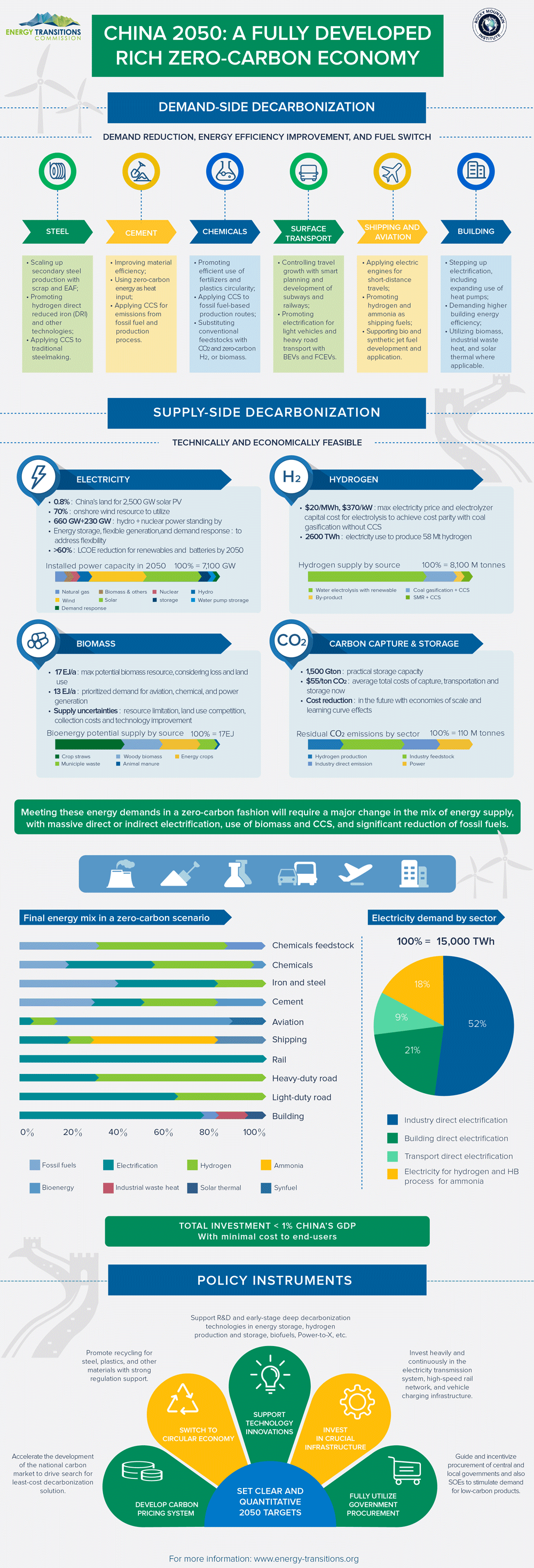
Following the ETC’s Mission Possible global report, the ETC launched a new report, China 2050: A Fully Developed Rich Zero-Carbon Economy, together with Rocky Mountain Institute’s (RMI’s) China team. It sets out an optimistic but realistic message—it is technically possible to decarbonize the harder-to-abate sectors of the Chinese economy by mid-century, when China is well placed to become a developed economy. The transition would cost less than 1 percent of GDP, with only a minor impact on consumer prices. The technologies required to achieve this already exist, although several still need to reach commercial viability and localization in China. Also, the feasibility of the transition does not rely on the assumption that there will be fundamental and currently unknown research breakthroughs. Furthermore, China is well placed to gain technological competitive advantage from the transition to net zero emissions.


Related Insights

Steel’s Transformation: China and Australia’s next horizon of clean steel

Efficiency Reimagined: The next phase of China’s industrial energy transition

Help build the clean energy future. Donate today.
Independent research. Real-world solutions. Supported by donors.
RMI can pursue the highest-impact climate and energy solutions because we’re supported by people who believe change is possible. Every gift helps advance the work needed to make clean energy the default choice worldwide.
For other ways to give to RMI, including checks or gifts of stock, please visit Other Ways to Give.
