

Learn how we are working to transform how we use and produce energy.
India’s Used EV Battery Market Needs Trust. Battery Aadhaar Can Help.
A unique digital identity that tracks a battery throughout its life cycle can help convert battery data into trusted battery health evidence
Why we share this work for free
RMI is an independent nonprofit working to accelerate the clean energy transition. We publish research like this to inform decision-makers and drive real-world impact.
Our work is supported by philanthropy as well as partnerships, including fee-for-service engagements. This support makes it possible for us to share our independent insights for free.
If you find this work valuable, you can support it anytime.
Get more insights like this
Stay up to date with the latest research, analysis, and tools from RMI by opting in to receive occasional emails below. You’ll get new reports, event invitations, and practical insights to help us all accelerate the clean energy transition.
Loading form...
Your download should start automatically. If it doesn’t, click the download button below.
This work is made possible by philanthropy
RMI is a nonprofit supported by donors and partners. Philanthropy enables us to produce independent research and make resources like this freely available.
If you find this report valuable, please consider supporting our work. You can also explore how we partner with organizations to drive impact.
Jump to Section
As India’s electric vehicle ecosystem matures, a key question is becoming more urgent: how can stakeholders accurately assess the value and remaining useful life of a used EV and its battery? The battery is the most valuable component of an EV, yet buyers, financiers, repurposers, insurers, and recyclers often lack credible visibility into its condition, performance, and history. This increases residual value risk, the risk that a used battery will command a lower resale price than expected, and makes used EV and battery markets more difficult to scale.
The issue is growing quickly. In RMI’s energy independence scenario, annual EV battery demand in India would reach around 1,080 GWh by 2050, roughly 40 times 2025 levels. The same modeling indicates that used battery volumes will begin to surge from around 2030 onward, especially from commercial fleets. That is why it is important to build credible systems now to assess, value, reuse, repurpose, and recycle batteries before larger volumes begin moving through second-life and end-of-life pathways. Without credible visibility into battery condition and performance, financiers struggle to price risk, repurposers spend additional time testing and sorting batteries, and used EV and battery markets have limited liquidity.
Battery Aadhaar, a unique digital identity that tracks a battery throughout its life cycle, offers a potential foundation. By providing a common data framework and standardized identifier, it can strengthen implementation of policies such as India’s Battery Waste Management Rules, 2022, which establish an Extended Producer Responsibility (EPR) framework for used batteries and are administered through the Central Pollution Control Board’s battery waste management systems. Battery Aadhaar could improve oversight, accountability, and coordination across the battery ecosystem by making battery identity and life-cycle status easier to verify.
But traceability alone will not unlock the market. Battery Aadhaar’s greatest impact will come if it helps convert battery data into trusted battery health evidence. At the core of many commercial decisions is a simple question: What is the value of a used battery? The answer influences valuation, financing, insurance, repurposing, warranty management, and recycling. Battery Aadhaar can have an outsize impact if it establishes a practical framework for providing the market with transparent, comparable, and decision-useful battery performance information.
What is Battery Aadhaar?
Battery Aadhaar is India’s proposed battery traceability and digital identification system. Draft guidelines for the system have been released by the Ministry of Road Transport and Highways (MoRTH), with the Office of the Principal Scientific Adviser to the Government of India associated with the development of the framework. While the framework has not yet been formally notified, the draft guidelines signal the government’s intent to establish greater transparency and traceability across the battery value chain.
Under the proposed system, each battery pack manufactured or sold in India would be assigned a unique Battery Pack Aadhaar Number (BPAN). Producers would be required to upload relevant information to a centralized digital platform, creating a life-cycle record that follows the battery from manufacturing and use through servicing, repurposing, recycling, or dismantling.
The system is designed to capture both static and dynamic battery information. Static data includes characteristics established at the time of manufacture or assembly, such as manufacturer details, battery chemistry, and technical specifications. Dynamic data includes information generated throughout the battery’s operational life, providing insight into battery usage, performance, health, status, and circularity pathway. The framework also proposes tiered levels of data access to balance transparency with protection of commercially sensitive information.
Exhibit 1: Battery Aadhaar data collection
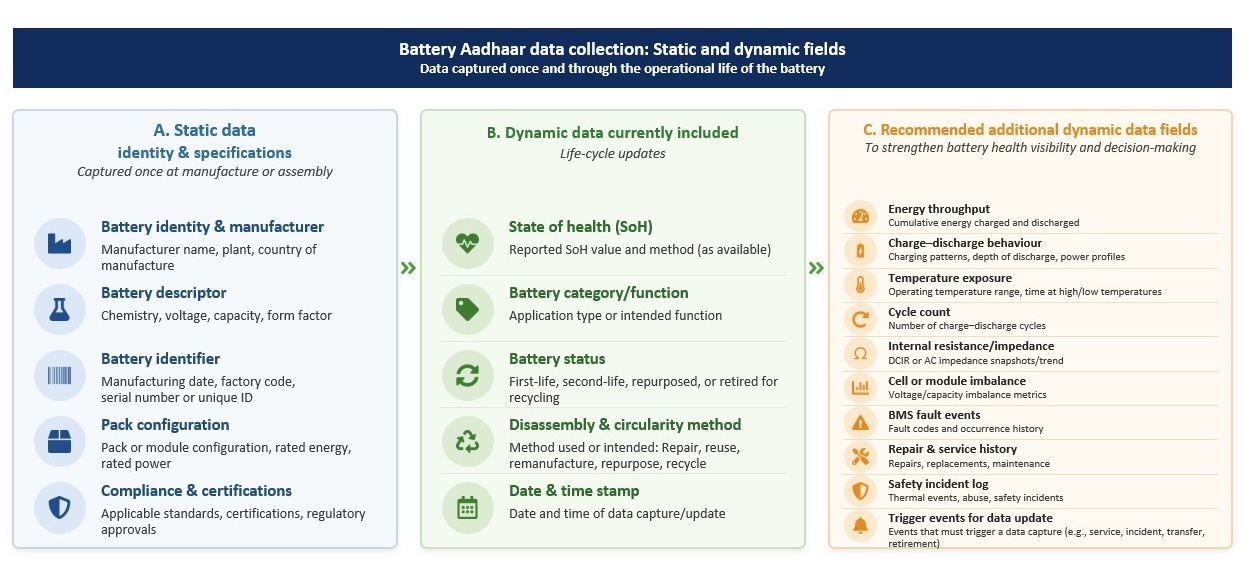
Note: Sections A and B are existing data fields outlined in the Battery Aadhaar guidelines, while Section C lists additional suggested dynamic data fields that could provide evidence of battery health to support second-life decisions.
From traceability to market confidence
Battery Aadhaar is a strong starting point because it creates a common digital record. The next step is to ensure that this digital identity supports market decisions, not only compliance reporting. In practice, that means clarifying what data Battery Aadhaar captures, where the current framework may need to expand, and how battery data should be translated into credible evidence for decisions on reuse, resale, financing, insurance, repurposing, and recycling.
India also has an opportunity to build on international experience while designing a system suited to its own market realities. The European Union’s Battery Regulation and Battery Passport establish requirements for life-cycle data reporting, including carbon footprint, recycled content, material sourcing, and ownership across the value chain. Yet globally, the treatment of technical data points such as state of health (SoH), reporting methods, and access rights remains under development. For India, this creates an opportunity to design Battery Aadhaar around interoperability, evolving battery technologies, and the needs of a market that includes OEM channels, fleet operators, repair networks, small operators, aggregators, second-life providers, and recyclers.
The variation in battery usage and battery owners makes robust battery health diagnostics essential. Stakeholders across the supply chain will need a shared understanding of the minimum technical data required to assess battery condition, including battery management system (BMS) data, voltage, current, temperature, and other core measurements. They will also need consistent methods to translate these inputs into battery health indicators such as SoH, remaining useful life, safety condition, and residual value. A harmonized approach would ensure that battery health metrics are transparent, comparable, and trusted.
Five priorities for strengthening Battery Aadhaar
If Battery Aadhaar is formally notified and implemented, five priorities could strengthen its capacity to support battery health assessment, second-life markets, and circular-economy objectives.
1. Define a minimum viable SoH reporting framework
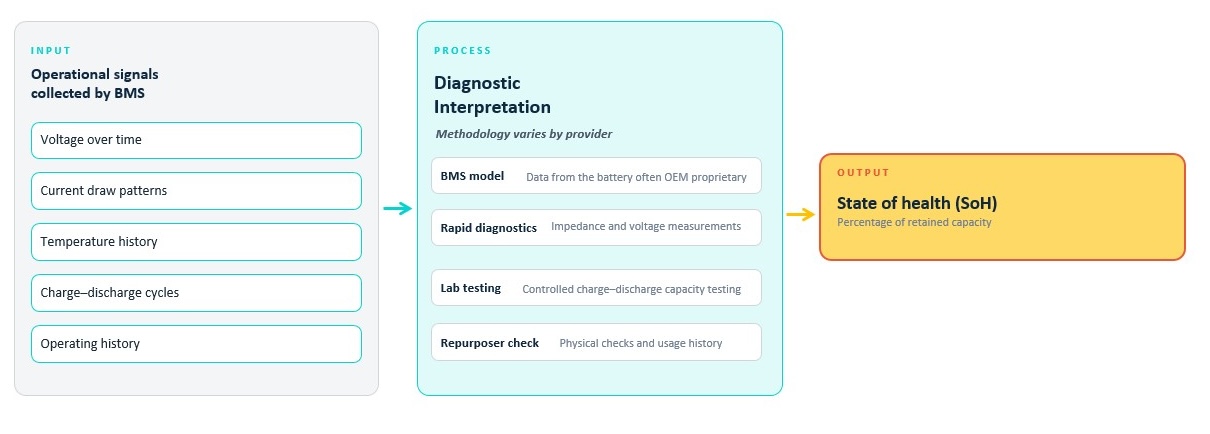
State of health is widely used as the primary shorthand for battery condition. It is typically expressed as the remaining capacity of a battery relative to its original or rated capacity. However, SoH is not a direct reading. It is an estimate derived from battery behavior over time, using inputs such as voltage, current, temperature, charging patterns, operating history, and diagnostic methods.
This distinction matters because two batteries with the same SoH can have very different market value. For example, two used batteries may both report 80% SoH, but one may have experienced repeated high-temperature events, cell imbalance, or BMS fault warnings, while the other may have degraded predictably under stable operating conditions. The same SoH number would not imply the same safety, remaining useful life, or second-life suitability.
Battery Aadhaar should therefore support a minimum viable SoH reporting framework rather than only recording a single SoH value. The framework could define minimum reporting requirements, acceptable estimation approaches, common terminology, uncertainty or confidence bands, and validation pathways. This would make reported values more transparent, comparable, and meaningful for OEMs, diagnostics providers, repurposers, recyclers, insurers, and financiers.
Exhibit 2: Depiction of SoH as a derived output, rather than a direct reading
2. Expand the dynamic data layer from reported values to battery health evidence
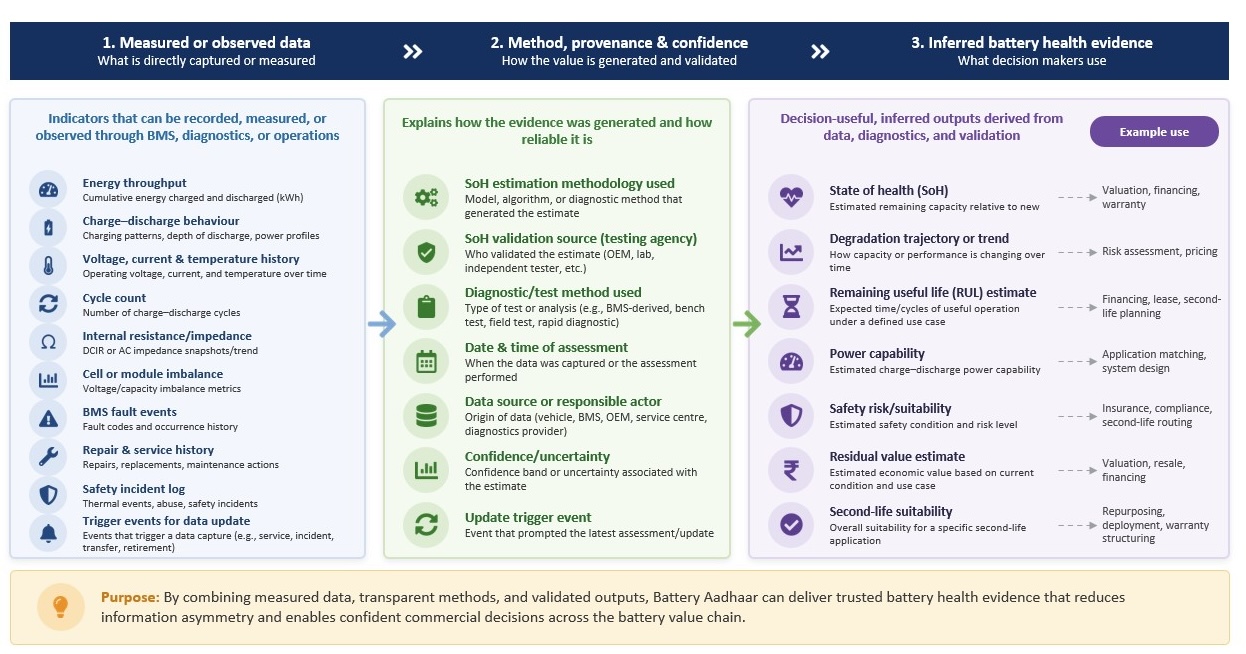
Battery Aadhaar’s dynamic data layer can be expanded to better support second life, financing, insurance, and EPR decisions by distinguishing between measured battery data and inferred battery health evidence. Measured or observed indicators could include energy throughput, cycle count, charge–discharge behavior, voltage, current, temperature exposure, internal resistance or impedance, cell or module imbalance, BMS fault events, repair history, and safety incident logs.
This data can then be interpreted through transparent diagnostic methods, validation sources, time stamps, and update triggers to generate decision-useful evidence, including SoH, degradation trajectory, remaining useful life, power capability, safety risk, second-life suitability, and residual value. Together, this would provide a more complete and trustworthy picture of battery condition and future performance.
Exhibit 3: From battery data to trusted battery health evidence
3. Maintain a single Battery Aadhaar record throughout the battery life cycle
Battery Aadhaar should function as a life-cycle record rather than a one-time identification label. The same BPAN should remain attached to the battery pack as it moves through ownership transfers, servicing, second-life deployment, change in application, repurposing, or recycling.
The guidelines should clearly define which life-cycle events trigger updates and which actors are responsible for making those updates. Without clear update requirements, records may become incomplete or inconsistent as batteries move across formal and informal channels, reducing their usefulness for regulatory oversight and commercial decision-making.
4. Design governance for a fragmented market
Battery Aadhaar will need to work for a market that includes large OEMs and fleets as well as smaller operators, service providers, aggregators, and recyclers. Reporting requirements should therefore be simple enough for broad participation while still producing credible data for market decisions.
Domestically, a harmonized governance framework with clear roles and data-sharing protocols across ministries, including the Ministry of Heavy Industries (MHI), MoRTH, the Ministry of New and Renewable Energy (MNRE), and the Ministry of Environment, Forest, and Climate Change (MoEFCC), can reduce fragmented reporting requirements and compliance burdens. Internationally, aligning core data structures with emerging battery passport frameworks can support cross-border traceability and trade while allowing implementation to reflect India’s market realities.
5. Use phased pilots to build field evidence before full-scale deployment
Pilots and phased implementation should be used to refine data requirements, governance arrangements, and reporting processes before full-scale deployment. Testing the framework across different battery use cases can help identify which data is most decision-useful, assess the practicality of reporting requirements, clarify update responsibilities, and evaluate data access arrangements.
Pilots should also test how Battery Aadhaar can enable practical market decisions, such as whether a battery should be reused in a vehicle, repurposed for stationary storage, insured, financed, or sent directly to recycling. This would allow the framework to evolve based on operational experience while reducing implementation risk and unnecessary compliance burden.
Moving to battery intelligence
A used battery’s remaining value depends on what it can still deliver, for how long, under which operating conditions, and with what level of confidence. While SoH is an important indicator, a single percentage cannot provide all the answers that OEMs, repurposers, buyers, financiers, insurers, and regulators need to make informed decisions.
Battery Aadhaar can help India move from battery traceability to battery intelligence. If designed well, it can link battery identity, operating history, diagnostic results, safety status, intended second-life application, and residual value in a trusted evidence framework. That would reduce information asymmetry, improve confidence in battery condition and value, and help unlock a scalable, efficient, and more liquid secondary battery market.



Related Insights



Help build the clean energy future. Donate today.
Independent research. Real-world solutions. Supported by donors.
RMI can pursue the highest-impact climate and energy solutions because we’re supported by people who believe change is possible. Every gift helps advance the work needed to make clean energy the default choice worldwide.
For other ways to give to RMI, including checks or gifts of stock, please visit Other Ways to Give.
