

Learn how we are working to transform how we use and produce energy.
Sizing and Seizing Economic Opportunity in New Energy Technology
Successfully building new energy technology clusters requires clarity on where to compete, what constrains potential investment, and how to coordinate the actors who can advance priority solutions.
Why we share this work for free
RMI is an independent nonprofit working to accelerate the clean energy transition. We publish research like this to inform decision-makers and drive real-world impact.
Our work is supported by philanthropy as well as partnerships, including fee-for-service engagements. This support makes it possible for us to share our independent insights for free.
If you find this work valuable, you can support it anytime.
Get more insights like this
Stay up to date with the latest research, analysis, and tools from RMI by opting in to receive occasional emails below. You’ll get new reports, event invitations, and practical insights to help us all accelerate the clean energy transition.
Loading form...
Your download should start automatically. If it doesn’t, click the download button below.
This work is made possible by philanthropy
RMI is a nonprofit supported by donors and partners. Philanthropy enables us to produce independent research and make resources like this freely available.
If you find this report valuable, please consider supporting our work. You can also explore how we partner with organizations to drive impact.
Jump to Section
Introduction
Economic opportunity in new energy technology is growing. Global investment in new energy systems surpassed $1 trillion in 2022 and hit $2.3 trillion in 2025. Modeling by BloombergNEF indicates that market forces alone could push cumulative investment worldwide to $188.6 trillion by 2050. How much of this opportunity the United States ultimately captures depends not just on national trends, but also on regional competitiveness. Technologies are not made and deployed in an abstract America; they are made and deployed in specific cities and towns across the country.
New energy technologies and supply chains are becoming increasingly integrated with fast-growing industries such as artificial intelligence and strategic industries such as drones. This is why several states in the Southeast have won investment not just in EV and battery production, but also in solar and grid-component manufacturing (Exhibit A1). It’s also why the scale and concentration of many of these supply chains overseas have complicated US manufacturers’ abilities to establish cost-competitive operations (Exhibit A2; Exhibit A3).
The integrated and traded nature of these industries lends well to clustering dynamics, which can help regions achieve sustained and shared prosperity. Clustering refers to geographic concentrations of related firms and workers, which enables greater knowledge-sharing, innovation, and productivity gains across an industrial activity. This is why the benefits of new energy investment often compound through cluster development (Exhibit 1). Early investments in manufacturing or infrastructure development, particularly large-scale early investments, can anchor later growth (Exhibit A4).
Exhibit 1
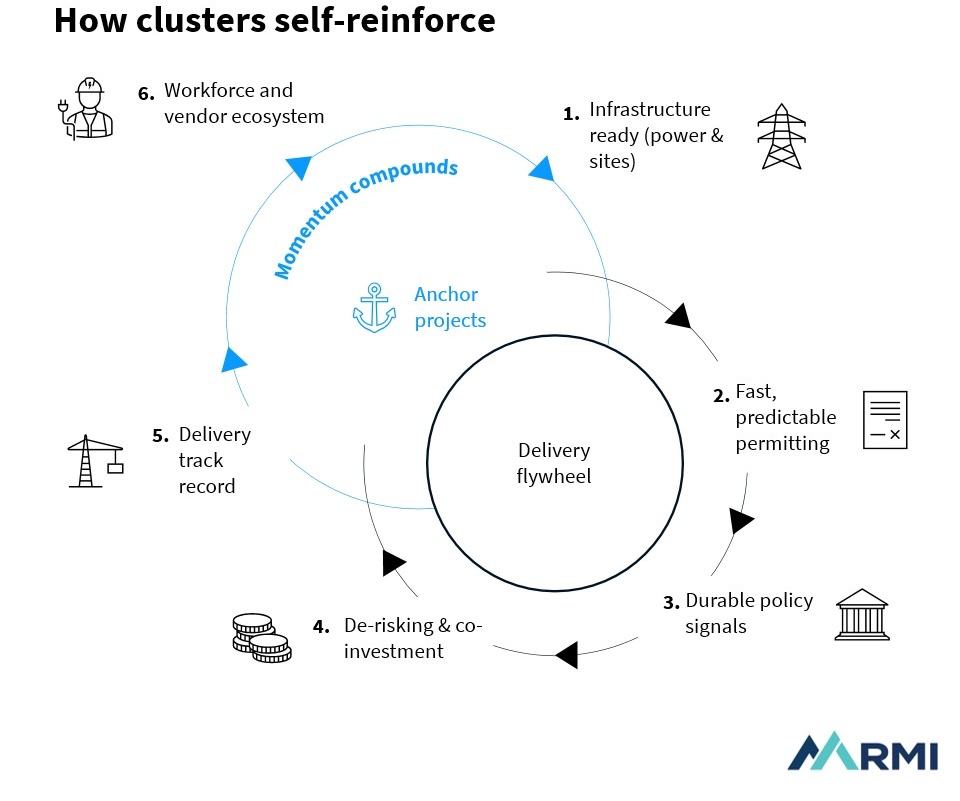
But clusters do not always form and hold. Large investments only sometimes attract new suppliers. Industrial land and electricity can only sometimes accommodate new entrants. Developers only sometimes hire locally. Anchor projects sometimes stall or shutter. To successfully gain an early lead in these industries and in cluster development, US policymakers and economic development leaders need renewed clarity on where to compete, what inhibits target investment, and who can advance priority solutions at the necessary scale.
Through engagements with economic development leaders and policymakers in 20-plus states since 2022, RMI has developed a framework for finding this clarity: Competitiveness, Constraints, Coordination (Exhibit 2). This framework enables regional leaders to more effectively navigate both traditional economic development challenges (scarce capital, staff time, and goodwill) as well as the distinctive new dynamics of the electro-industrial era.
Exhibit 2
Competitiveness: Pick a winnable race with a worthwhile prize
A winnable race requires relevant regional capabilities. A worthwhile prize requires a credible market opening.
The regional capabilities relevant to a new energy technology will vary not just by technology, but also by value-chain segment. In next-generation geothermal power, for instance, resource endowment is among the most critical factors in the location of new power plants, while regional manufacturing expertise will play a greater role in determining the geography of supply-chain build-out. In assessing regional fitness for a potential cluster development target, economic developers and policymakers can consider factors such as capital access, costs, industrial base and workforce, infrastructure and resource access, innovation ecosystem, institutions and policy, markets, and supply chains (Exhibit A5). It is important for regional leaders to assess these factors holistically, because sometimes several different factors can help to predict technology investment attraction (Exhibit 3).
Exhibit 3
Regional leaders can evaluate the credibility of a market opening and value-chain segment by assessing its expected size and durability, as well as the assumptions behind that market outlook, for example, the different sources of demand for a given technology. They should treat these factors as dynamic, not static. This is because regional action can shape the size, speed, and geography of market development, particularly when technologies are early in the commercialization process (Exhibit A6). But even when this is not the case, regional leaders should still plan around uncertainty. For example, while data-center electricity demand in the United States is set to soar in the next several years, it remains far from clear just how much that demand will rise (Exhibit A7). This uncertainty affects not just grid planning but also expected demand for a range of electrical technology systems and thus the size and timing of the opportunity for regions in the manufacture of relevant components.
Investments can bring both direct and catalytic value. Direct value refers to the jobs and revenue that a project might bring to a community or state. Catalytic value refers to the features of a project that might accelerate regional cluster development and the associated benefits. Developing a view on the distinct types of value a project can bring to an area will enable regional leaders to target anchor investments more effectively in the earlier stages of cluster formation.
Constraints: Identify barriers to cluster entry and growth
Once regional leaders have identified a target market and value-chain segment, the next question is: What might stand in the way of our winning desired new investment? Barriers to new energy technology are place-based and technology-based. Place-based investment barriers can arise from national, regional, or local market conditions; for instance, energy affordability, permitting challenges, site readiness, or workforce constraints. Technology-based investment barriers are shared across places and stem from technology characteristics or maturity; for instance, limited performance history, higher perceived technology risk, or uncertain demand.
Within a target technology or value-chain segment, it is important for regional leaders to identify which barriers to prioritize tackling given finite time, resources, and goodwill. When evaluating the priority of investment barriers, economic developers and policymakers can consider the severity of a barrier (i.e., whether it blocks investment outright, makes investment in a place less likely compared to rival locations, or represents a manageable friction); the scope of the barrier (whether it affects one project or firm, a class of project types, or a region’s entire investment climate); agency over that barrier (where leverage over this barrier exists or could exist, and how long it would take to exert that leverage); and the time it would take to meaningfully lower that barrier (including in relation to the timing of the market opportunity).
Some barriers, like the lack of ready industrial sites in many states, directly stymie new investment. Other constraints pertain to the infrastructure that enables innovation. For example, according to the Li-Bridge initiative, battery manufacturers in the United States often “find themselves at the end of a long line in waiting for delivery of machinery or access to new, innovative equipment” compared to their East Asian counterparts, where battery cell manufacturers often collaborate with nearby machinery providers. This is an example of how anchor investments like battery gigafactories — as crucial as these projects are for enabling the transfer of technology expertise — do not automatically catalyze every part of a globally competitive industrial ecosystem.
Where possible, economic developers and policymakers should adopt a cluster-oriented approach to investment-barrier reduction, even when working to attract individual projects. This is because the attributes of discrete projects, particularly workforce development (such as training local workers on how to get a facility installed and machinery operational for the first time), can still advance cluster development. Project-incentive negotiations present one opportunity to apply this approach. The delivery of development incentives as cluster-enabling specialized services, like workforce development and infrastructure upgrades, as opposed to cash, “improves the cost effectiveness of incentives by 50 percent,” according to the W.E. Upjohn Institute for Employment Research (Exhibit A8).
Coordination: Mobilize stakeholders for solution advancement at scale
Economic development organizations (EDOs) can catalyze investment attraction and address priority barriers through direct action and through engagement with regional stakeholders. EDOs directly shape the marketing of their region to the rest of the world. They also play a direct role in negotiations over project-level incentives.
What that influence looks like varies by region. In some places, a state-level EDO holds the most power. Elsewhere, this may be a county or metro-level group. Regardless of region, individual economic development leaders will not hold all the levers needed to address all priority investment constraints. Never, however, are they powerless.
Economic developers hold relationships and routinely engage with many of the groups that are most vital to addressing key barriers to new investment (Exhibit A9). Power availability depends on utilities, regulators, and infrastructure developers. Workforce readiness often requires the involvement of community college and training institutions.
Such networks enable economic development organizations (EDOs) to spearhead initiatives like Advanced Industrial Zones, a new approach to site readiness built around proactive planning and transparent community engagement. The convening and coordinating capacity of EDOs can strengthen the connective tissue of the American new energy economy.
The need for this role arises partly from the way place-based policy is organized. Federal and state programs often operate in separate domains for business attraction, electricity permitting, infrastructure upgrades, technology commercialization, and workforce development. Firms and investors do not see these domains separately; what they see instead is one big mess. Regional economic development therefore requires nimble leaders who can align people and priorities across different constituencies, mandates, and strategy cycles. Different opportunities and constraints require different types of partnerships.
Coordination is too often absent — but sorely needed — across jurisdictions. States and counties will continue to compete for some types of investment, and economic developers and governors will continue to see this dynamic as zero-sum, at least in part. But many of the activities that shape the size of a market opportunity take place upstream of final site selection. Here, coordination can serve as a force multiplier.
Consider for instance the battery supply chain in the Southeast. States including Alabama, Georgia, North Carolina, South Carolina, and Tennessee have won a substantial share of battery investment in the past several years, much of it in cell manufacturing and, relatedly, in electric-vehicle assembly. But each of these five states possesses distinct economic strengths, which can translate into different types of supply-chain investment. The key to unlocking this investment, according to Greenline Insights modeling, is coordinated state-level industrial policy. This unlocks the economies of scale that improve the business case for greater upstream and midstream investment in activities such as anode and cathode material production in states like Alabama and Tennessee. Because the Southeast battery supply chain spans state lines, each state would see economic growth attributable to out-of-state activity (Exhibit A10).
States with divergent politics and legislative calendars may not enact identical policies in parallel. But multistate coordination, even in a more targeted fashion, can shape new energy technology markets. In early 2026, Arizona, Colorado, New Mexico, and Utah launched the Mountain West Geothermal Consortium to accelerate geothermal development through coordinated procurement, financial-product development, and data sharing. Because the long-term prospects for next-generation geothermal in the United States are highly sensitive to sustained project-cost reductions and policy support achieved through the mid-2030s, efforts such as this consortium can unlock a larger opportunity pipeline for this region as well as for the rest of the nation.
Conclusion
The United States can capture much more of the economic benefit of the global energy transition if business attraction and retention leaders across the country — that is to say, economic developers — are better prepared to seize opportunities as they arise and better coordinated with their partners within and across states. Too often, these leaders lack the information they need to identify and act on opportunity in time to mobilize the stakeholders needed to make new projects possible.
RMI seeks to change that. By developing and socializing ambition-raising insights, convening conversations about scalable success stories, and directly supporting the state and regional leaders best positioned to drive cluster development, RMI is working to make the next new energy investment boom further-reaching and longer-lasting.
Acknowledgments
Appendix
Exhibit A1
Exhibit A2
Exhibit A3
Exhibit A4
Exhibit A5
Exhibit A6
Exhibit A7
Exhibit A8
Exhibit A9
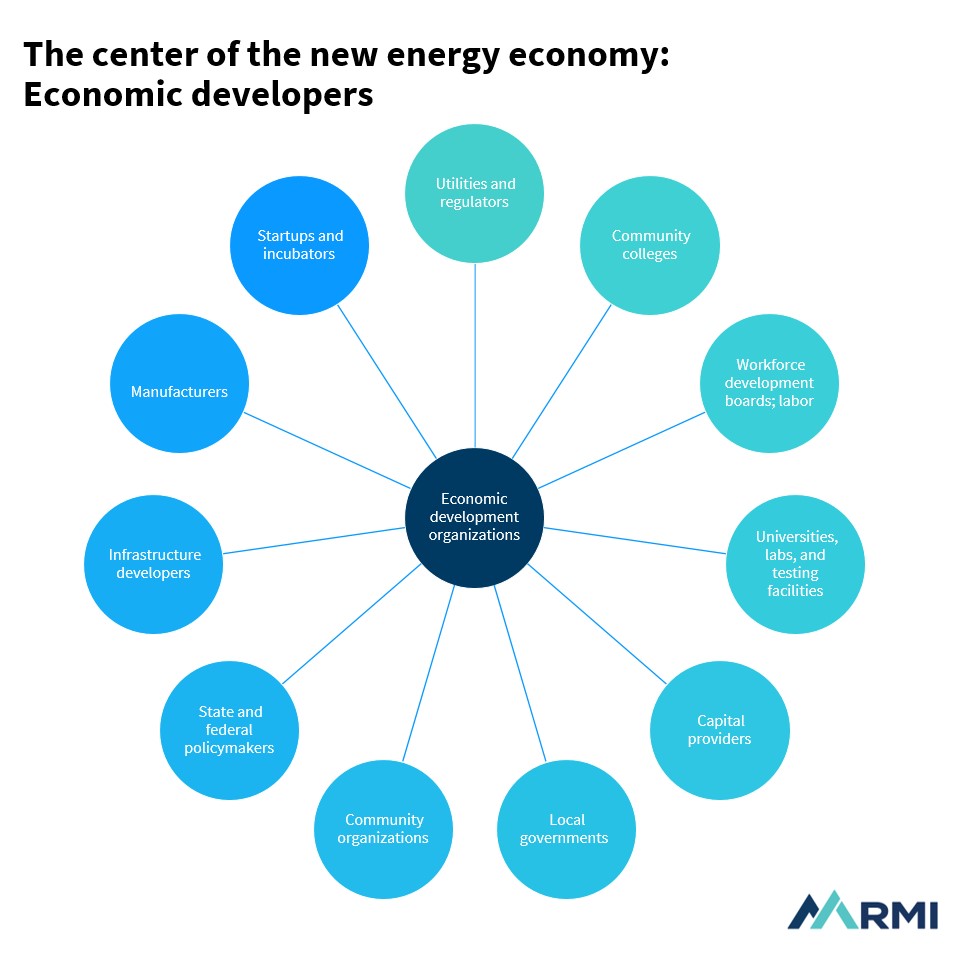
Exhibit A10
Authors

Aaron Brickman
Senior Principal
Adefunke Sonaike
Data Scientist
Ben Feshbach
Associate
Hannah Perkins
Strategic Communications Lead
Whitney Mann
ManagerRelated Insights
What’s Next for Advanced Energy Manufacturing in the United States?
Help build the clean energy future. Donate today.
Independent research. Real-world solutions. Supported by donors.
RMI can pursue the highest-impact climate and energy solutions because we’re supported by people who believe change is possible. Every gift helps advance the work needed to make clean energy the default choice worldwide.
For other ways to give to RMI, including checks or gifts of stock, please visit Other Ways to Give.
