

Learn how we are working to transform how we use and produce energy.
More Americans Are Heating Their Homes with Electricity than Ever Before
Electricity now heats 42% of US households, reflecting a decades-long shift away from coal, wood, and oil.
Why we share this work for free
RMI is an independent nonprofit working to accelerate the clean energy transition. We publish research like this to inform decision-makers and drive real-world impact.
Our work is supported by philanthropy as well as partnerships, including fee-for-service engagements. This support makes it possible for us to share our independent insights for free.
If you find this work valuable, you can support it anytime.
Get more insights like this
Stay up to date with the latest research, analysis, and tools from RMI by opting in to receive occasional emails below. You’ll get new reports, event invitations, and practical insights to help us all accelerate the clean energy transition.
Loading form...
Your download should start automatically. If it doesn’t, click the download button below.
This work is made possible by philanthropy
RMI is a nonprofit supported by donors and partners. Philanthropy enables us to produce independent research and make resources like this freely available.
If you find this report valuable, please consider supporting our work. You can also explore how we partner with organizations to drive impact.
Jump to Section
The share of homes using primarily electricity for space heating has steadily increased since 1950, replacing coal, wood and oil.
Americans have been steadily increasing their reliance on electricity for heating their homes over decades. Legacy fuels like coal, wood, and oil have largely subsided (though oil still serves many homes in the Northeast).
The growing popularity of electric heat creates opportunities for cleaner home energy, displacing dirtier fuels and making use of an electric system which is getting cleaner year over year.
Electricity can be a cleaner heating fuel than gas or oil, because it can be produced by low-carbon technologies. But its impact on buildings in the United States depends on adoption by millions of families in their own homes. These charts show that families are in fact choosing electricity more and more over time as their heating source. Sustaining this trend will be important for delivering a long-term decline in pollution from buildings.
Here’s what else we see in the Census home heating data:
- In 1940, the majority of American households heated with coal and over 20% with wood. Electricity use for heating was rare.
- By 1970, natural gas had become America’s primary home heating fuel and oil had surged to second place, while electricity was still below 10%.
- By 2024, electricity became the heating fuel of choice for 42% of American households, an all-time high. Natural gas provided heat for 47% of homes, down slightly from its peak decades earlier.
- The growth in electric heating has been steady across regions of the country. While electric heat is most prevalent in the South — where it serves two out of every three homes — the growth trend shows up everywhere, as electric heat is growing in popularity even in colder regions like the Midwest and Northeast.
- This trend includes both electric heat pumps and electric resistance heating, which is less efficient.


Related Insights
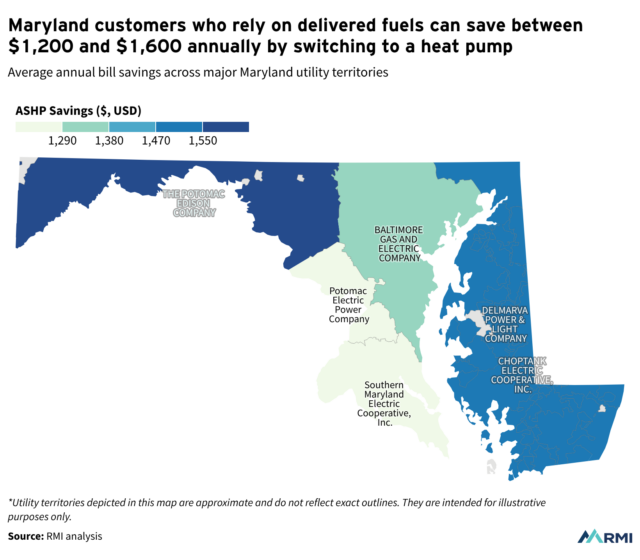
Delivered Fuel Customers in Maryland See Strong Energy Bill Savings in a Switch to Heat Pumps

Gas Utility Depreciation: Recommendations for an Uncertain Future

Help build the clean energy future. Donate today.
Independent research. Real-world solutions. Supported by donors.
RMI can pursue the highest-impact climate and energy solutions because we’re supported by people who believe change is possible. Every gift helps advance the work needed to make clean energy the default choice worldwide.
For other ways to give to RMI, including checks or gifts of stock, please visit Other Ways to Give.