

Learn how we are working to transform how we use and produce energy.
Low-Carbon Ammonia Technology: Blue, Green, and Beyond
Fertilizer production has a high climate cost. Here, we take a look at the most promising technologies to produce low-carbon ammonia — fertilizer’s building block.
Why we share this work for free
RMI is an independent nonprofit working to accelerate the clean energy transition. We publish research like this to inform decision-makers and drive real-world impact.
Our work is supported by philanthropy as well as partnerships, including fee-for-service engagements. This support makes it possible for us to share our independent insights for free.
If you find this work valuable, you can support it anytime.
Get more insights like this
Stay up to date with the latest research, analysis, and tools from RMI by opting in to receive occasional emails below. You’ll get new reports, event invitations, and practical insights to help us all accelerate the clean energy transition.
Loading form...
Your download should start automatically. If it doesn’t, click the download button below.
This work is made possible by philanthropy
RMI is a nonprofit supported by donors and partners. Philanthropy enables us to produce independent research and make resources like this freely available.
If you find this report valuable, please consider supporting our work. You can also explore how we partner with organizations to drive impact.
Jump to Section
As the world intensifies efforts to combat climate change, several industries are focusing on the development of sustainable manufacturing processes for high-impact products like ammonia. Primarily used as an agricultural fertilizer, ammonia and other ammonia-based fertilizers are essential for providing nitrogen to crops. Conventional ammonia production methods are carbon-intensive, relying heavily on fossil fuels, and thus, alternative low-carbon pathways to produce ammonia are under development, offering promising solutions to decarbonize ammonia production.
Ammonia production technologies generally fall under two categories: those that utilize the Haber-Bosch (HB) process, and those that are more novel. The Haber-Bosch process is the method by which hydrogen and nitrogen are converted into ammonia (NH₃) through the use of a high-pressure, high-temperature reactor and a chemical catalyst. Utilized in industry since the early 1900s, HB is already a mature technology. However, while nitrogen is sourced from the air, hydrogen is conventionally sourced from natural gas (methane) through a process called Steam-Methane Reforming (SMR) which releases significant amounts of carbon dioxide (CO₂), accounting for over 1 percent of global greenhouse gas (GHG) emissions. By capturing the carbon emitted or by sourcing the hydrogen from other feedstocks like water (H2O), the ammonia production process can become much less carbon intensive.
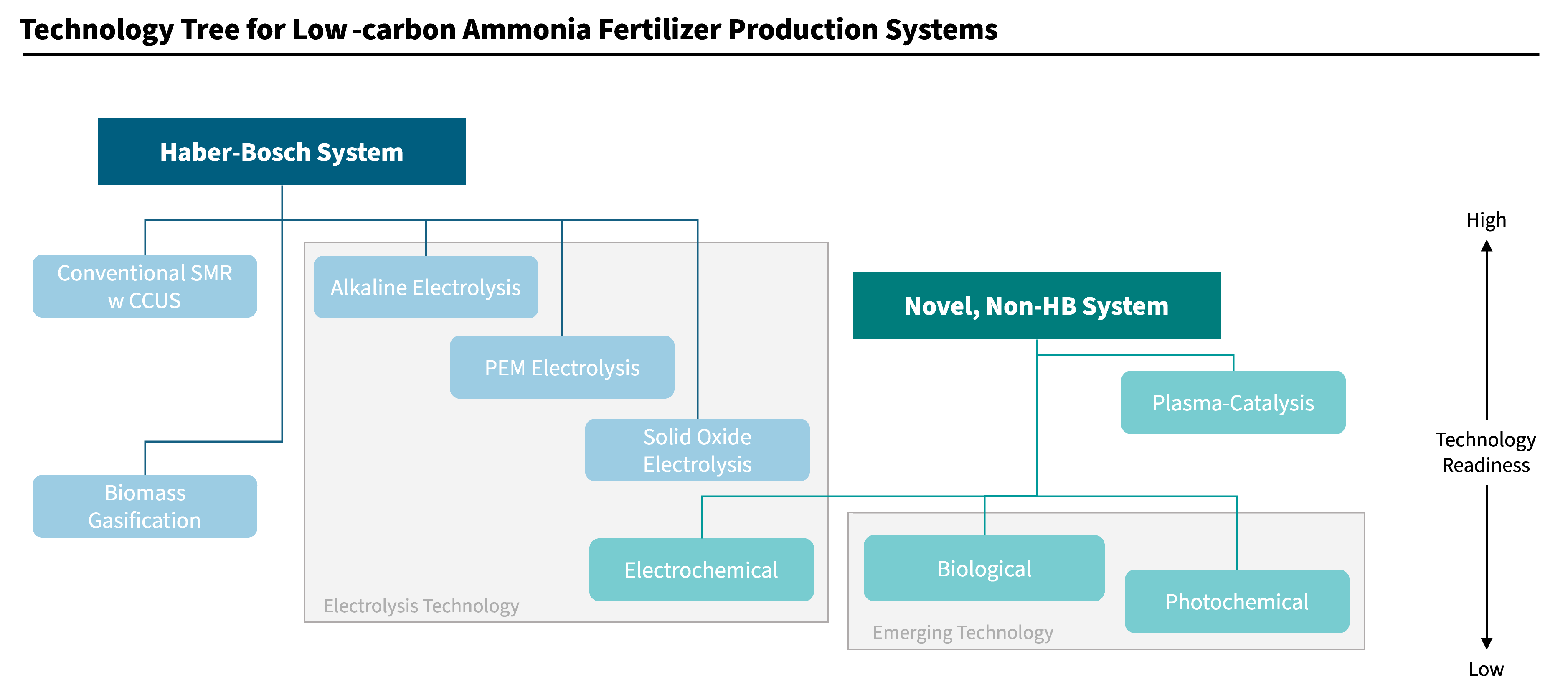
Promising low-carbon ammonia technologies
- Conventional Haber-Bosch with CCS, aka Blue Ammonia
Blue ammonia production captures and stores (or utilizes) the CO₂ emissions generated from natural gas-based hydrogen production. This approach combines the conventional SMR process with carbon capture and storage (CCS) technology and then utilizes the Haber-Bosch process to combine the “blue hydrogen” and nitrogen to create ammonia. Blue ammonia can significantly reduce emissions depending on the capture efficiency.- Hydrogen Feedstock: Natural gas/methane (CH4)
- Key Technologies: Steam methane reforming (SMR) or autothermal reforming (ATR) to produce hydrogen from natural gas, coupled with CCS
- Advantages: Utilizes established infrastructure; CCS reduces CO₂ emissions
- Challenges: High cost and energy requirements for CCS; concerns about CO₂ leakage over time; requires access to geologic sites for CO2 sequestration
- Commercial Readiness: Commercial-scale SMR+CCS plants have been demonstrated around the world; over 20 ammonia facilities with CCS integration are under development
- Electrolysis-Based Ammonia Production, aka Green Ammonia
Green ammonia is produced using renewable electricity (e.g., from wind or solar) to electrolyze water, producing hydrogen from water in a zero-carbon process. then combined with nitrogen to synthesize ammonia. Green ammonia is viewed as the most sustainable option, achieving near-zero emissions in production.- Hydrogen Feedstock: Water (H2O)
- Key Technologies: Electrolysis (alkaline, PEM, or solid-oxide electrolysis), Haber-Bosch synthesis powered by renewable energy
- Advantages: No CO₂ emissions; uses abundant renewable resources; decoupling from natural gas pricing and supply chain risks; suitable for small-scale/localized ammonia fertilizer production
- Challenges: High cost of renewable hydrogen; flexible system design required for intermittent renewable energy supply may impact scalability and costs
- Commercial Readiness: Electrolysis technology is well developed and demonstrated in commercial environments; one fully renewable electrolysis-based ammonia facility deployed in the US
- Electrochemical Ammonia
Electrochemical ammonia is a promising alternative to the Haber-Bosch process that can operate in a low-pressure environment. By running an electric current through an electrochemical cell containing a source of hydrogen and nitrogen, a single-step nitrogen reduction reaction (NRR) can occur.- Hydrogen Feedstock: Water (H2O)
- Key Technologies: Electrochemical cell
- Advantages: No CO₂ emissions; low-pressure ammonia synthesis; single-step process simplicity; suitable for small-scale/localized ammonia fertilizer production
- Challenges: low ammonia synthesis performance results at the research level; high energy requirements; reactor catalyst optimization
- Commercial Readiness: Lab-scale prototyping phase
- Plasma-Catalysis Ammonia Recent advancements in non-thermal plasma (NTP) ammonia have proven it to be a likely competitor of small-scale electrolysis systems as it can be used for on-farm ammonia fertilizer production. The low-temperature and low-pressure plasma reactors can produce nitrogen-based fertilizers such as nitric acid and ammonia, and this method does not require the Haber-Bosch process.
- Hydrogen Feedstock: Water (H2O)
- Key Technologies: NTP reactor
- Advantages: No CO₂ emissions; low-pressure, low-temperature ammonia synthesis; suitable for small-scale/localized ammonia fertilizer production
- Challenges: low energy efficiency; reactor catalyst optimization
- Commercial Readiness: Emerging from lab-scale to pilot-scale project phase
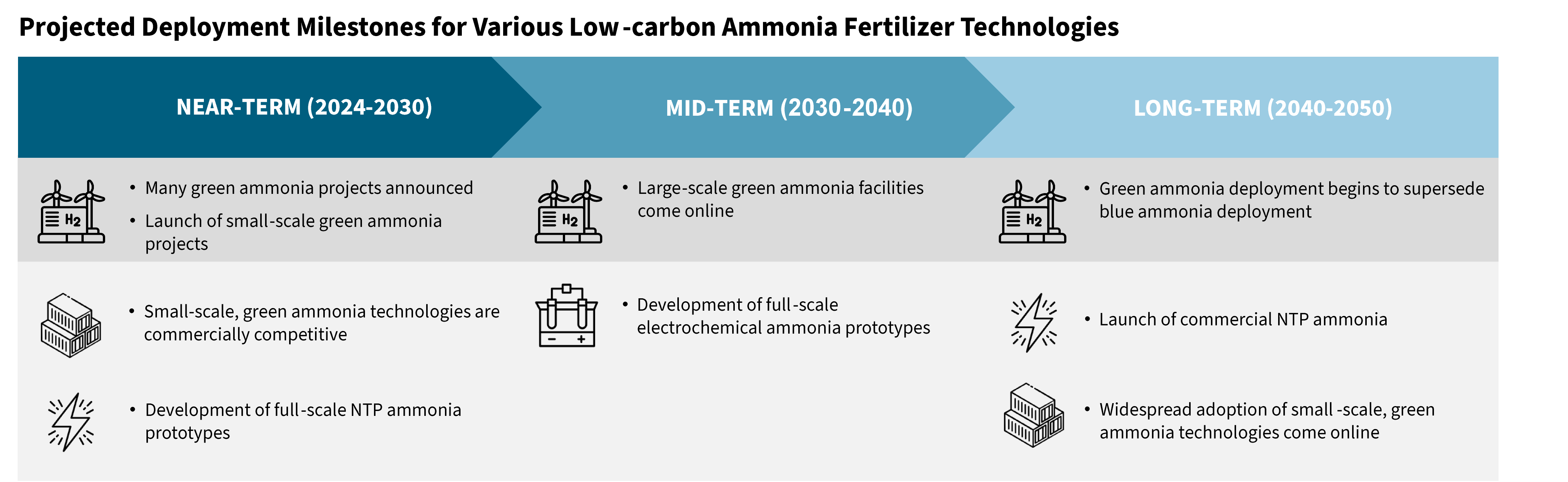
Recent innovations in ammonia technology have shown the potential for sustainable methods of ammonia production as well as alternatives to the Haber Bosh process altogether. As ammonia’s role in the energy transition continues to grow, reducing fossil fuel dependence and supporting technology innovation will become even more important in the near future. The path to a low-carbon ammonia industry will require multi-pronged investments in technology, infrastructure, and policy support. Collaborations across industries, governments, and academia are essential to advance these technologies, drive down costs, and scale production to meet global demand.
Within the next few decades, the convergence of renewable energy advancements, carbon capture improvements, and innovative reactor designs will create a portfolio of ammonia production technologies that not only meet the world’s fertilizer needs but also contribute to a low-carbon, sustainable future.
Authors

Elina Rodriguez
Related Insights

The Opportunity for Heat Pumps to Put Downward Pressure on Electricity Rates
Gas Utility Depreciation: Recommendations for an Uncertain Future
Help build the clean energy future. Donate today.
Independent research. Real-world solutions. Supported by donors.
RMI can pursue the highest-impact climate and energy solutions because we’re supported by people who believe change is possible. Every gift helps advance the work needed to make clean energy the default choice worldwide.
For other ways to give to RMI, including checks or gifts of stock, please visit Other Ways to Give.
