

Learn how we are working to transform how we use and produce energy.
Finding (Re)Purpose: How Planners Can Make Effective Coal Repurposing Decisions
In this third installment of the Finding (Re)Purpose series, we break down the steps that regulators and utilities can follow when planning for coal repurposing.
Why we share this work for free
RMI is an independent nonprofit working to accelerate the clean energy transition. We publish research like this to inform decision-makers and drive real-world impact.
Our work is supported by philanthropy as well as partnerships, including fee-for-service engagements. This support makes it possible for us to share our independent insights for free.
If you find this work valuable, you can support it anytime.
Get more insights like this
Stay up to date with the latest research, analysis, and tools from RMI by opting in to receive occasional emails below. You’ll get new reports, event invitations, and practical insights to help us all accelerate the clean energy transition.
Loading form...
Your download should start automatically. If it doesn’t, click the download button below.
This work is made possible by philanthropy
RMI is a nonprofit supported by donors and partners. Philanthropy enables us to produce independent research and make resources like this freely available.
If you find this report valuable, please consider supporting our work. You can also explore how we partner with organizations to drive impact.
Jump to Section
This year has seen growing political momentum behind phasing out coal, with Malaysia joining G7 countries in putting forward a coal phaseout commitment this spring. Despite forecasts for declining coal demand, emissions from coal power in emerging markets and developing economies remain at record highs. To advance climate commitments, power sector decision makers will need to devise innovative transition strategies into their electricity system planning. One such strategy is repurposing existing coal plants for new uses.
Thus far in this article series, we’ve broken down what repurposing is, various repurposing options, and how some coal plant owners are already exploring the practical options and financial implications of repurposing. While plant owners will be important for implementing repurposing strategies, their plant-level decisions need to be put into the context of the broader power sector transition. In this third installment, we dig into some of the questions regulators and utilities — key power sector planners — face, and propose guiding principles for effective decision-making on coal plant repurposing.
Repurposing is primarily an interim strategy, focused on enabling the long-term shift to carbon-free energy sources while maintaining grid reliability.
Selecting a repurposing approach
Planners can streamline their decisions by using a “screening” process to preselect repurposing approaches that are suitable for their electricity and policy contexts. Screening can save planners time and resources by identifying the most promising repurposing approaches (and discarding less attractive ones) early in the planning process, thus reducing the number of technology options that need to be studied in depth. This can help planners consider repurposing in two ways: (1) after screening the approaches, they can include plausible technology options into quantitative system analyses, such as in capacity expansion planning, and (2) the screening framework can help inform guidelines necessary to streamline approval processes for plant owners, making it easier for repurposing projects to move forward smoothly.
As covered in our first article on coal repurposing, our repurposing categories are centered around the coal plant’s role in the grid to maintain reliability. Each approach comprises technology options that could meet the same reliability goal, but some options rely more heavily on fossil fuels than others, and will be much more costly to replace for a zero-carbon alternative in the future. Therefore, to avoid falling in that trap, planners should aim to prioritize repurposing approaches based on their potential to enable clean energy integration, with the most promising approach starting from:

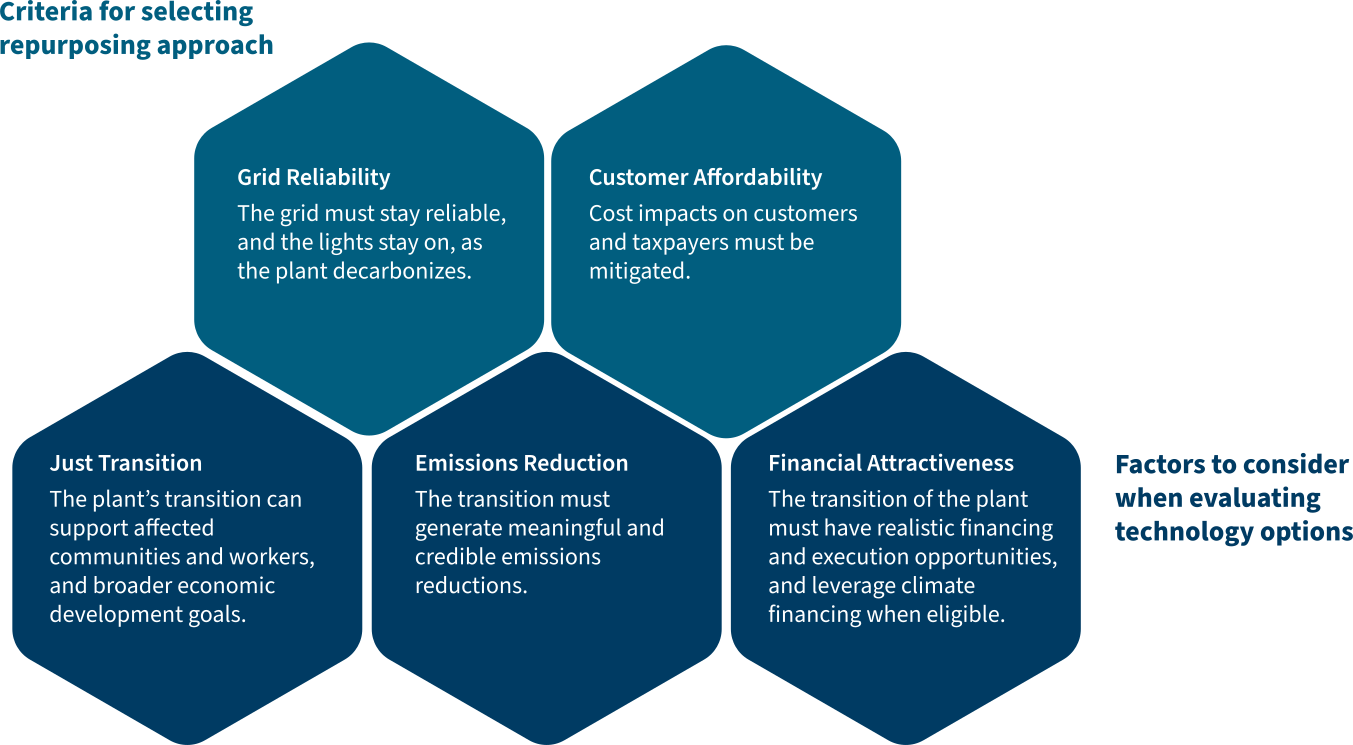
When assessing these approaches, reliability and affordability are the most crucial criteria. While a climate-aligned pathway is the ultimate goal, prioritizing reliability and affordability first helps mitigate the risks associated with a hasty transition, such as economic disruption or energy insecurity. Once these foundations are secured, planners can create a supportive environment in which emissions reduction and investment potential can be maximized effectively and sustainably.
Selecting a repurposing technology
Once a planner identifies the appropriate repurposing approach, they will need to assess which technological options they should consider. A wide range of technologies exists within each approach, so it’s important to narrow down options that are viable in context and technologically proven before quantitative analysis and modeling.
This assessment should evaluate: the potential to reduce overall fossil fuel utilization, just transition opportunities, and financial bankability or financial attractiveness of different technologies. These often involve trade-offs. For example, biomass cofiring may be more financially attractive in regions with extensive agricultural lands, but it risks prolonging the operation of coal plants. Alternatively, in regions with abundant variable renewable resources, utility-scale energy storage can augment integration but may conflict with financial viability if supportive market mechanisms are unavailable.
While technological readiness varies greatly depending on context and geography, RMI has conducted a general assessment of each technology based on what is currently prevalent worldwide.
RMI's Assessment of Repurposing Technologies
| Financial Attractiveness | Transition Outcomes | |||||||
|---|---|---|---|---|---|---|---|---|
| Repurposing Approach | Technology option | Technology Maturity | Commercial Deployment | Execution Time | Eligibility for Climate Finance | Capital Cost Savings | Just and Equitable Transition | Emissions Reduction |
| Post-retirement Reuse | Renewable energy replacement | |||||||
| Synchronous condensers | ||||||||
| Operational Flexibility | Flexible coal generation | |||||||
| Thermal energy storage | | |||||||
| Battery energy storage system (BESS) | | |||||||
| Lower Emissions Continuous Output | Co-firing with biomass or ammonia2 | |||||||
| Conversion to small modular reactors (SMR) | ||||||||
| Carbon capture, utilization, and storage (CCUS) | ||||||||
2. Technology outlook varies greatly on the type of fuel, i.e., biomass or ammonia, and co-firing ratio, i.e., low or high
After identifying these trade-offs and strategies to minimize them, quantitative modeling can help select the least-cost solution and define system impacts over different timescales within the broader context of the power sector plan.
To illustrate how planners can pursue coal plant repurposing, we are going to utilize two hypothetical examples. These examples illustrate two common high-level contexts in which coal plants currently exist. Then we will aim to fill in the details that would sway a decision toward one pathway versus another.
A Tale of Two Grids
Call to Action
By thoroughly understanding the three approaches to coal plant repurposing and the specific considerations for a coal plant’s context within the grid, regulators and utilities can confidently achieve policy priorities while ensuring reliability and significant emissions reductions. Additionally, evaluating the financial viability and execution feasibility of repurposing projects will enable regulators to establish robust guidelines and enforceable rules. This strategic approach helps ensure that only the most effective, efficient, and feasible repurposing projects are advanced, and that repurposing can credibly support energy transition strategies.
This is the third installment of the Finding (Re)Purpose article series. Explore the full series:



Related Insights


Help build the clean energy future. Donate today.
Independent research. Real-world solutions. Supported by donors.
RMI can pursue the highest-impact climate and energy solutions because we’re supported by people who believe change is possible. Every gift helps advance the work needed to make clean energy the default choice worldwide.
For other ways to give to RMI, including checks or gifts of stock, please visit Other Ways to Give.
