

Learn how we are working to transform how we use and produce energy.
The Energy Transition in Five Charts and Not Too Many Numbers
RMI experts Sam Butler-Sloss and Kingsmill Bond distill the energy transition down to five crucial concepts.
Why we share this work for free
RMI is an independent nonprofit working to accelerate the clean energy transition. We publish research like this to inform decision-makers and drive real-world impact.
Our work is supported by philanthropy as well as partnerships, including fee-for-service engagements. This support makes it possible for us to share our independent insights for free.
If you find this work valuable, you can support it anytime.
Get more insights like this
Stay up to date with the latest research, analysis, and tools from RMI by opting in to receive occasional emails below. You’ll get new reports, event invitations, and practical insights to help us all accelerate the clean energy transition.
Loading form...
Your download should start automatically. If it doesn’t, click the download button below.
This work is made possible by philanthropy
RMI is a nonprofit supported by donors and partners. Philanthropy enables us to produce independent research and make resources like this freely available.
If you find this report valuable, please consider supporting our work. You can also explore how we partner with organizations to drive impact.
Jump to Section
The energy transition is driven by the exponential growth of renewables, and the key changes will happen by 2030.
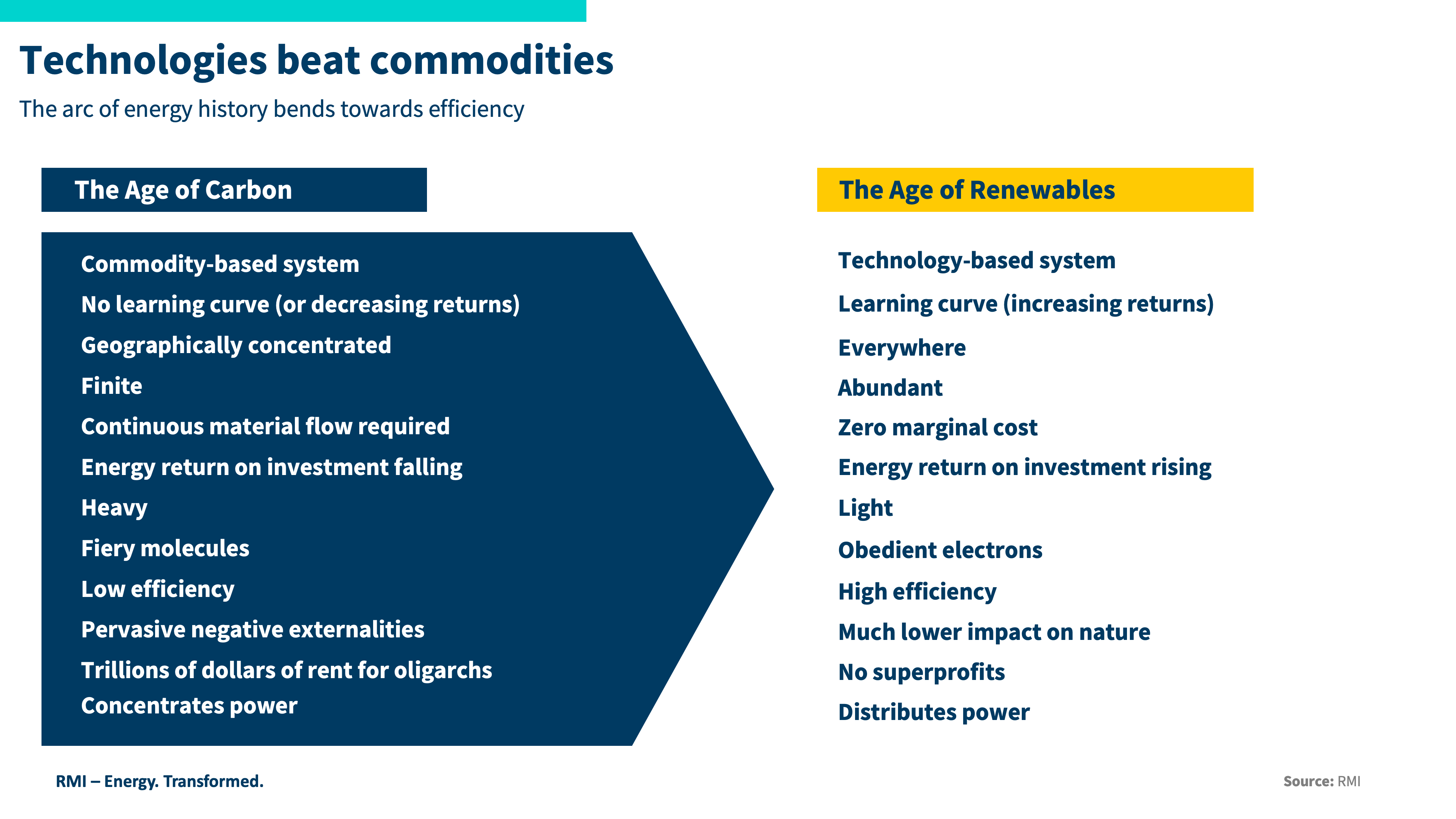
1. The energy transition is a technology revolution.
At the heart of the energy transition lies the fact that renewable technologies are far superior to fossil fuels. The energy transition is a shift from a concentrated, expensive, polluting commodity-based system with no learning curve, to an efficient, manufactured, technology-driven system that offers continuously falling costs and is available everywhere. It is moving from heavy, fiery molecules to light, obedient electrons; from hunting fossil fuels to farming the sun.
Like past technology shifts, it is a transformation, not merely a substitution. As RethinkX notes, this is not a brown caterpillar to a green caterpillar, but rather a caterpillar to a butterfly, which means different economics, geographies, winners, and energy carriers. Just like past technology shifts, the falling costs of the new render the old obsolete.
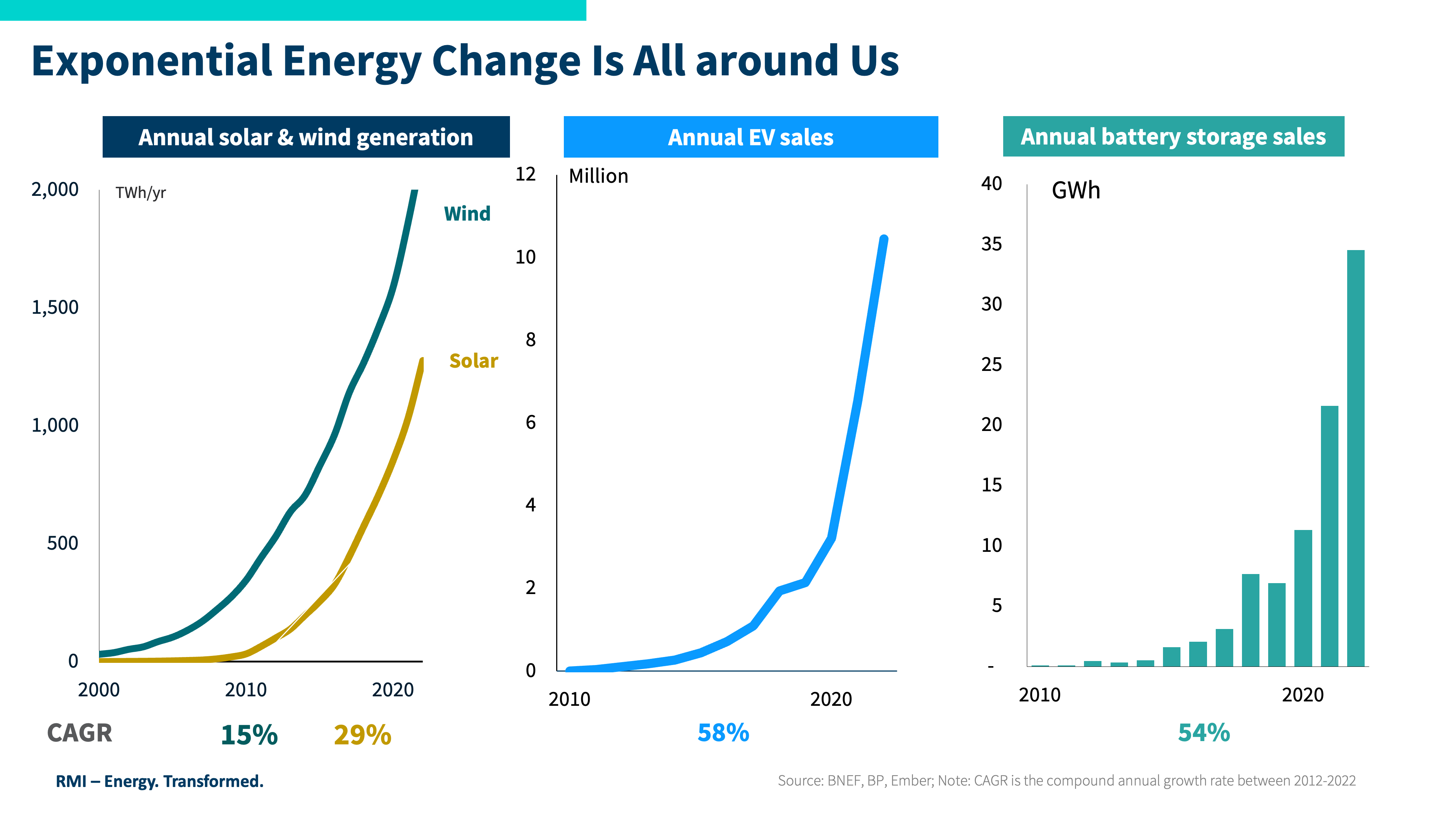
2. The renewables revolution is exponential, not linear.
When it comes to the renewables revolution, linear is the default perception, but exponential is the default reality. The growth of the key new energy technologies is exponential. It has been in the past, and it will continue to be for the foreseeable future. Companies and countries need to be quick to act, for it is hard to catch an exponential curve from behind.
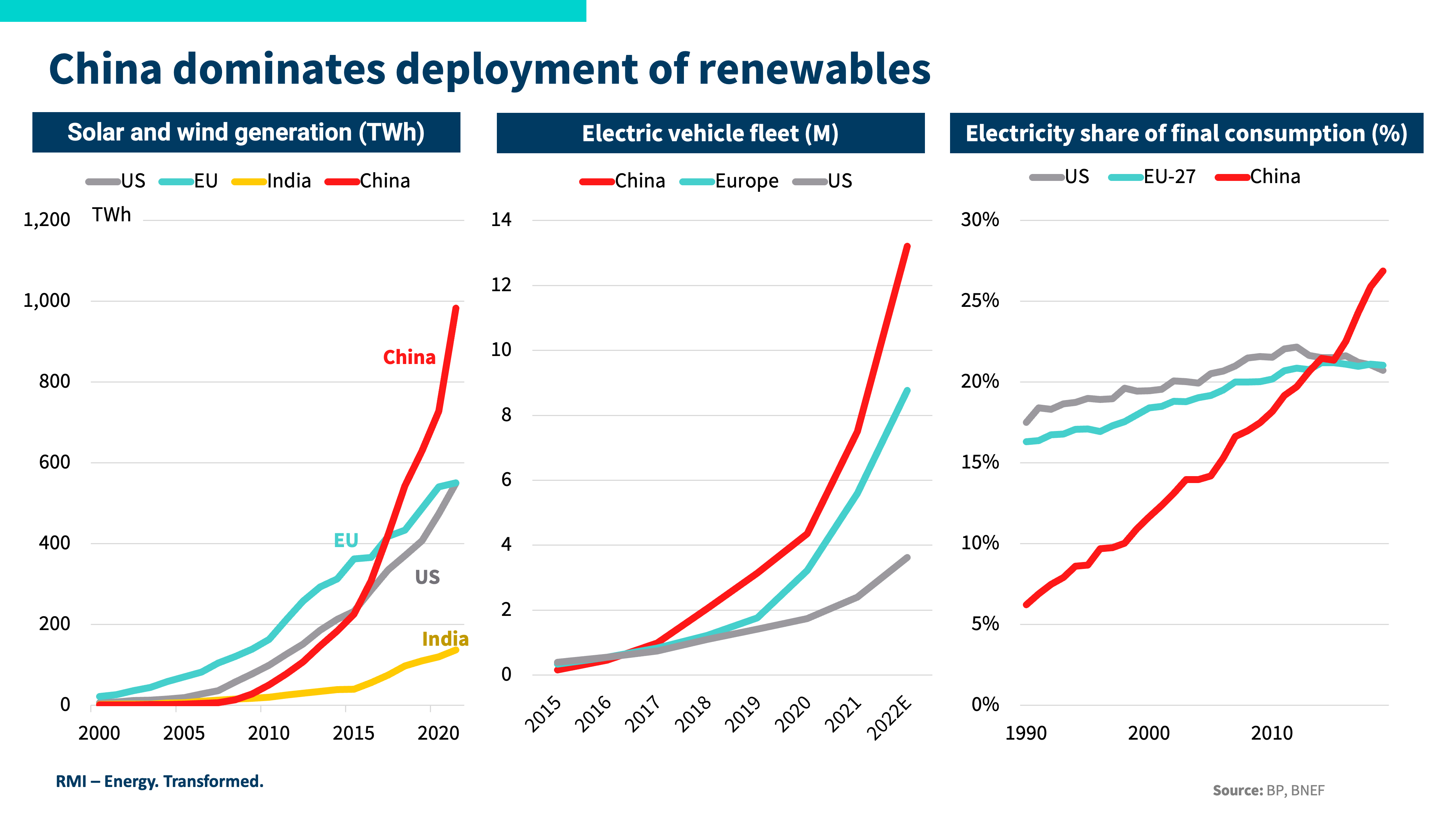
3. The renewables revolution is led by China.
Across manufacturing, deployment, and costs, China is far ahead of the rest of the world. As in past technology shifts, there is a geographical center that disseminates the superior technology around the world. If you wanted to understand the diffusion of the internet, you looked to and modeled the United States. If you want to understand the energy transition, you look to China.
China’s leadership creates a competitive race to the top, which can be seen in recently enacted policies in the United States and Europe.
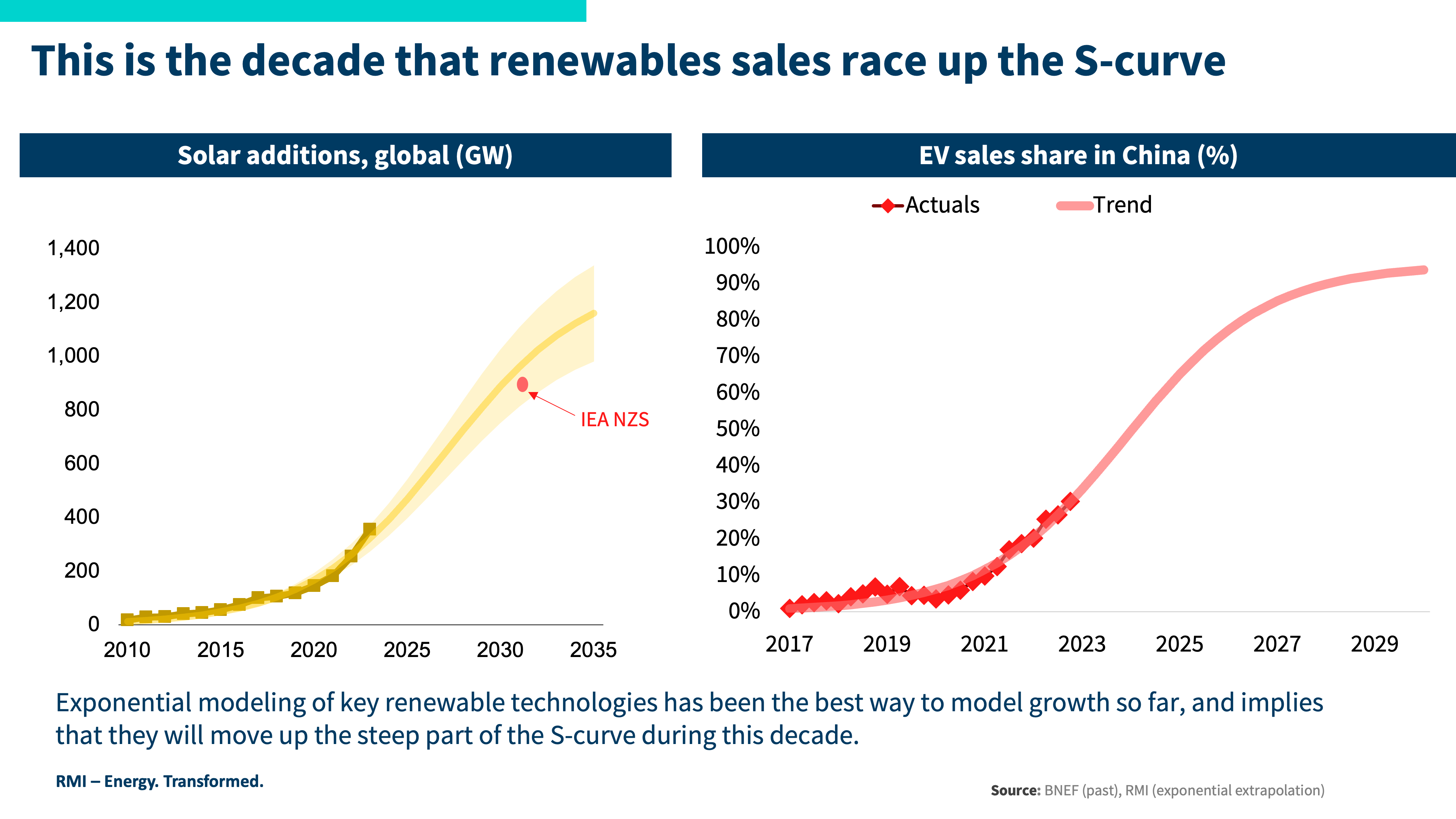
4. This is the decade of change.
The 2020s are the disruption decade, where renewable technology sales race up the S-curve. If the energy transition were a novel, this decade would be its climax.
The energy system is one of stocks (the bathtub) and flows (the dirty tap and the clean tap). By the end of the decade the clean tap will be on full and the dirty tap will be drying up. Heat pumps, electric vehicles, solar, and wind will all be near the top of their sales S-curves. Once the flow from the tap is clean, the drain (or natural retirement rates) will flush away the fossil system in succeeding decades.
5. By 2030 the debate will be very different.
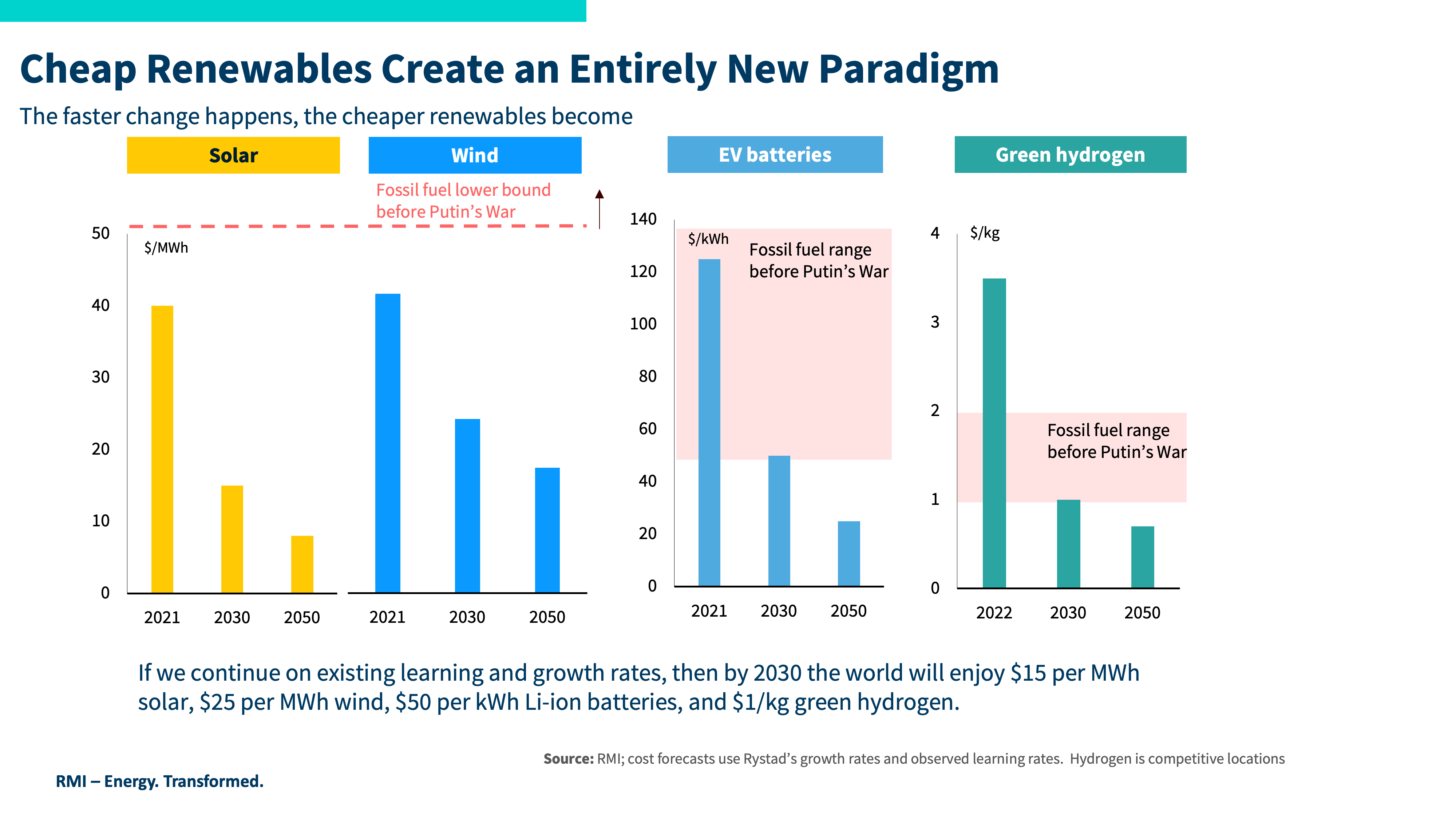
By 2030, renewables will dominate the sales of energy-producing and consuming technologies. The green prize will be evident. Cheap renewables will be even cheaper. Fossil fuel demand will be off the current plateau and in clear decline. The negative externalities of fossil fuels will be increasingly weaponized. Climate impacts will be more visible. In 2023, it is hard to imagine what this will look like, let alone model it in any detail.
This means we must do as much as we can to narrow our time horizons and focus on speeding up the deployment of key renewables. Four technologies (solar, wind, electric vehicles, and heat pumps), in four markets (China, the United States, the European Union, and India), over the next four years, set the direction. Meanwhile it is vital for other locations and technologies to get onto a similar path.
Authors

Sam Butler-Sloss
Kingsmill Bond
Related Insights
For Clean Energy Projects, How Community Benefits Are Delivered Matters

Tracking WestTEC: Where 100+ Transmission Projects Stand and What Comes Next
Help build the clean energy future. Donate today.
Independent research. Real-world solutions. Supported by donors.
RMI can pursue the highest-impact climate and energy solutions because we’re supported by people who believe change is possible. Every gift helps advance the work needed to make clean energy the default choice worldwide.
For other ways to give to RMI, including checks or gifts of stock, please visit Other Ways to Give.
