

Learn how we are working to transform how we use and produce energy.
Massive Investment is Accelerating the Era of Clean Electrification
Why we share this work for free
RMI is an independent nonprofit working to accelerate the clean energy transition. We publish research like this to inform decision-makers and drive real-world impact.
Our work is supported by philanthropy as well as partnerships, including fee-for-service engagements. This support makes it possible for us to share our independent insights for free.
If you find this work valuable, you can support it anytime.
Get more insights like this
Stay up to date with the latest research, analysis, and tools from RMI by opting in to receive occasional emails below. You’ll get new reports, event invitations, and practical insights to help us all accelerate the clean energy transition.
Loading form...
Your download should start automatically. If it doesn’t, click the download button below.
This work is made possible by philanthropy
RMI is a nonprofit supported by donors and partners. Philanthropy enables us to produce independent research and make resources like this freely available.
If you find this report valuable, please consider supporting our work. You can also explore how we partner with organizations to drive impact.
Jump to Section
The age of affordable battery technology is coming faster than experts previously thought possible. Thanks to massive investment, rapid performance improvements, and falling prices, breakthrough battery technologies are poised to revolutionize the way we power our lives and organize energy systems as early as 2030.
In the first half of 2019 alone, investors poured more than $1.4 billion into battery technology companies, bringing the reality of a global energy transition closer than ever. The manufacturing sector’s roughly $150 billion investment—combined with previous investments and those planned through 2023—is paving the way for renewables and electric vehicles (EVs) to revolutionize our energy system and play a vital role in addressing the climate crisis.
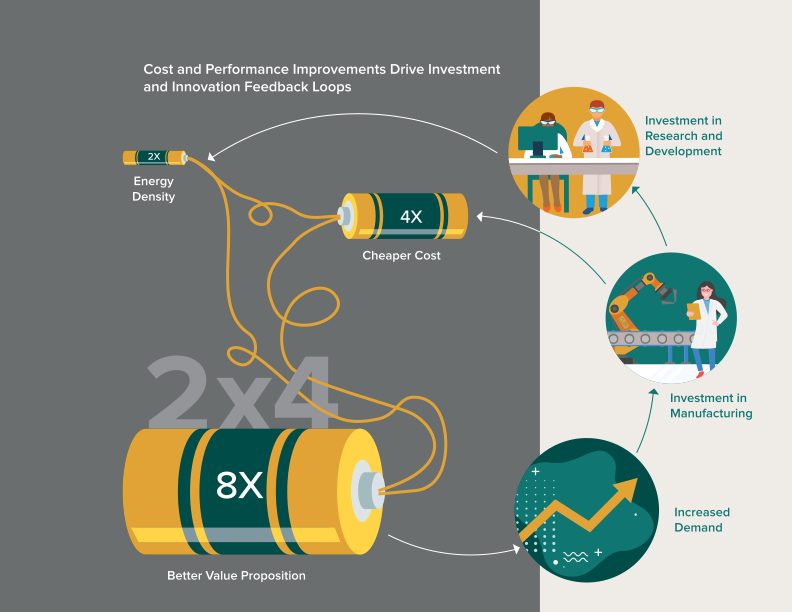
RMI’s latest report, Breakthrough Batteries: Powering the Era of Clean Electrification, shows that cost and performance improvements are quickly outpacing forecasts, as increased demand for EVs, grid-tied storage, and other emerging applications creates positive feedback loops for further investment and research, setting the stage for mass adoption. Now, analysts expect the capital cost for new battery manufacturing capacity to drop by more than half from 2018 to 2023.
This momentum is opening new markets, pushing both lithium-ion (Li-ion) and other battery technologies across competitive thresholds for legacy technologies faster than anticipated. That’s important because, although Li-ion remains the leading battery technology, alternative battery technologies nearing commercial readiness will be key to accelerating and scaling climate-critical solutions. For example, alternatives to Li-ion are likely better suited for applications such as long-duration energy storage, heavy trucking, aviation, and EV fast-charging infrastructure.
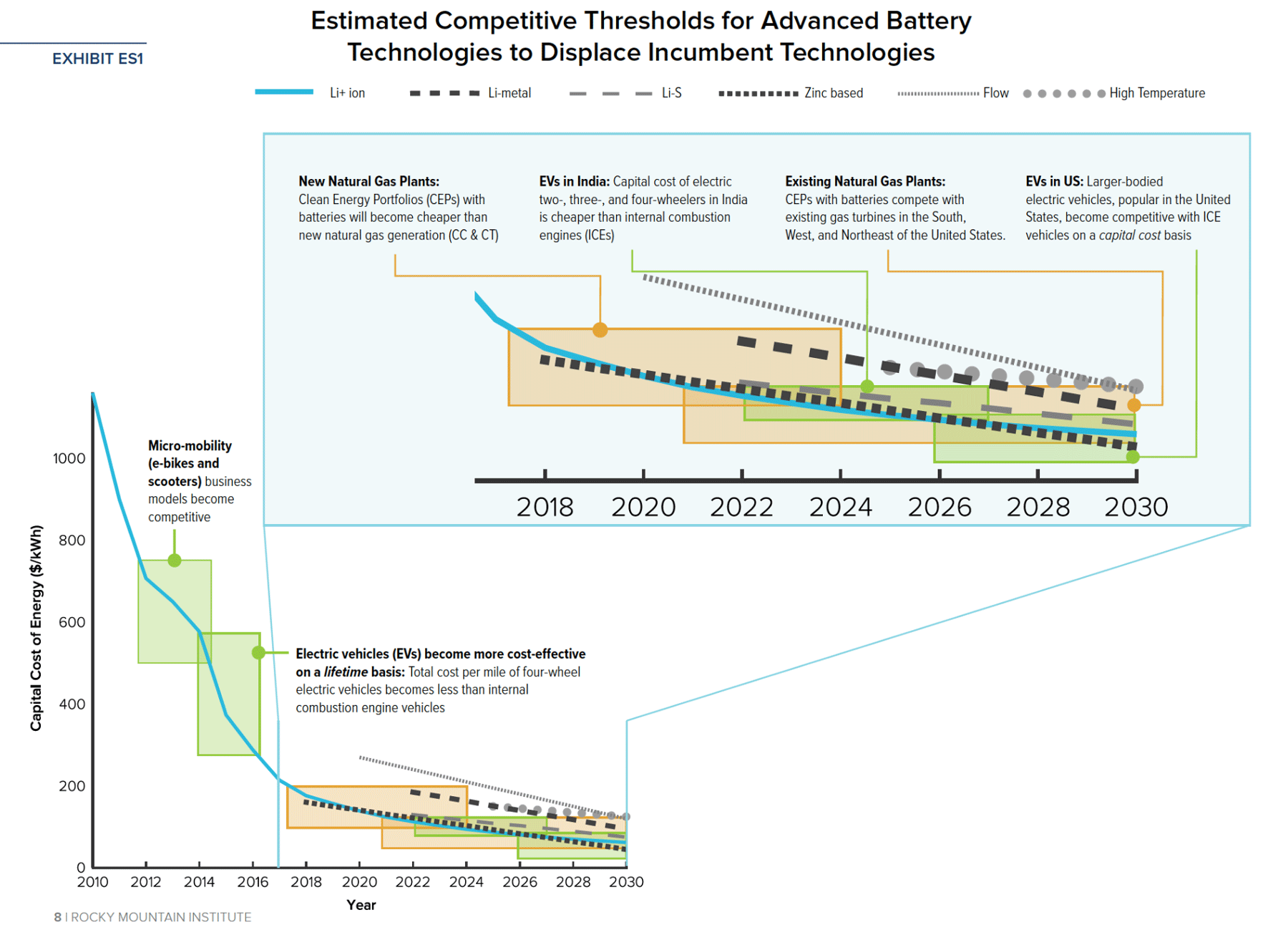
Currently, six other categories of battery technology have significant potential for achieving commercial production by 2025. (In the report, RMI lays out the commercialization pathway for each, with notes on early entry applications through mass-market capture.)
What to Do with All This Momentum? Keep It Up.
The future will include an increasingly divergent set of battery technologies and applications—and for good reason. Advanced battery technologies have the power to outcompete many fossil fueled energy systems in the near term and can help us meet ambitious carbon reduction goals on or ahead of schedule. Several such market development opportunities exist and can be leveraged for vast environmental and economic benefits.
Current investment, together with cost and performance improvements, has set this sector on a path to rapid success—but continued leadership remains key to fulfilling the potential. Investors, regulators, policymakers, and other energy industry players can stay in front of this shift by taking an ecosystem approach to supporting both investments in emerging technologies and demand for new battery applications.
A collaborative, systems-based approach to developing battery-enabled markets will be the key to achieving economic and climate-related goals alike. RMI’s report outlines key considerations and recommendations to help smooth the transition for both electric mobility and grid storage markets. By collaborating to support breakthrough battery technology success, energy industry leaders can have a meaningful opportunity to hasten the transition to resilient, clean, and affordable energy systems.
Breakthrough battery technologies may dramatically change the way we power our lives far sooner than many market actors realize. What part will you play?



Related Insights

For Clean Energy Projects, How Community Benefits Are Delivered Matters


Tracking WestTEC: Where 100+ Transmission Projects Stand and What Comes Next

Help build the clean energy future. Donate today.
Independent research. Real-world solutions. Supported by donors.
RMI can pursue the highest-impact climate and energy solutions because we’re supported by people who believe change is possible. Every gift helps advance the work needed to make clean energy the default choice worldwide.
For other ways to give to RMI, including checks or gifts of stock, please visit Other Ways to Give.
