

Learn how we are working to transform how we use and produce energy.
RMI Releases Deep Retrofit Value Practice Guide
Why we share this work for free
RMI is an independent nonprofit working to accelerate the clean energy transition. We publish research like this to inform decision-makers and drive real-world impact.
Our work is supported by philanthropy as well as partnerships, including fee-for-service engagements. This support makes it possible for us to share our independent insights for free.
If you find this work valuable, you can support it anytime.
Get more insights like this
Stay up to date with the latest research, analysis, and tools from RMI by opting in to receive occasional emails below. You’ll get new reports, event invitations, and practical insights to help us all accelerate the clean energy transition.
Loading form...
Your download should start automatically. If it doesn’t, click the download button below.
This work is made possible by philanthropy
RMI is a nonprofit supported by donors and partners. Philanthropy enables us to produce independent research and make resources like this freely available.
If you find this report valuable, please consider supporting our work. You can also explore how we partner with organizations to drive impact.
Jump to Section
Highly energy-efficient buildings offer more than just a low utility bill. They also often promise gains in employee productivity, better retention, improved occupant health, lower maintenance costs, increased occupancy, and higher lease-up and sales rates, among others.
Yet real estate professionals often ignore many of these additional values—they tend to focus on energy cost savings alone to justify investment in new green buildings or deep energy retrofits of existing buildings. Meanwhile, building occupants like you and me often suffer in poorly lit, stuffy, and generally inadequate offices, supermarkets, stores, classrooms, and numerous other spaces where we collectively spend the majority of our time outside the home. But no longer.
RMI has released a new guide to provide practical guidance to enable company leaders and real estate professionals to incorporate all the benefits of deep energy savings in their decision making. The first version of this guide, How to Calculate and Present Deep Retrofit Value: A Guide for Owner-Occupants, presents RMI’s Deep Retrofit Value Model and details how owner-occupants (responsible for roughly half of U.S commercial buildings) can calculate property-specific deep retrofit value.
“This is impressive work. Comprehensive, clear, and practical,” says Don Reed, Managing Director, Sustainable Business Solutions, PwC. “This definitely moves the ball down the field.”
The model breaks deep retrofit value down into nine value elements, provides the terminology and accounting to make sure values are not missed or double counted, and offers the flexibility to enable calculation of only those elements most relevant to a particular retrofit decision. Perhaps most importantly, the model comprehensively integrates risk analysis and mitigation into the retrofit decision-making process.
Each value element includes practical guidance on how you can calculate and present evidence in support of your retrofit capital decision. A final section offers an example report showing how to synthesize and defend such an analysis.
The report is the latest installment of resources RMI provides for driving the greater adoption of deep retrofits, and accelerating overall retrofit activity. Moving forward, RMI seeks partners who will use this report to refine their retrofit decision making, test enhanced retrofit strategies, and drive energy efficiency even deeper on new projects. In addition, RMI is currently working with CoreNet Global—the world’s leading association for corporate real estate professionals, service providers, and economic developers—to identify more examples and best practices for getting to deeper levels of energy savings.
Authors

Related Insights
The Opportunity for Heat Pumps to Put Downward Pressure on Electricity Rates
Building Smarter, More Efficient Air Conditioners for Real World Conditions

How Heat Pumps Reduce Energy Bills and Air Pollution in the San Francisco Bay Area
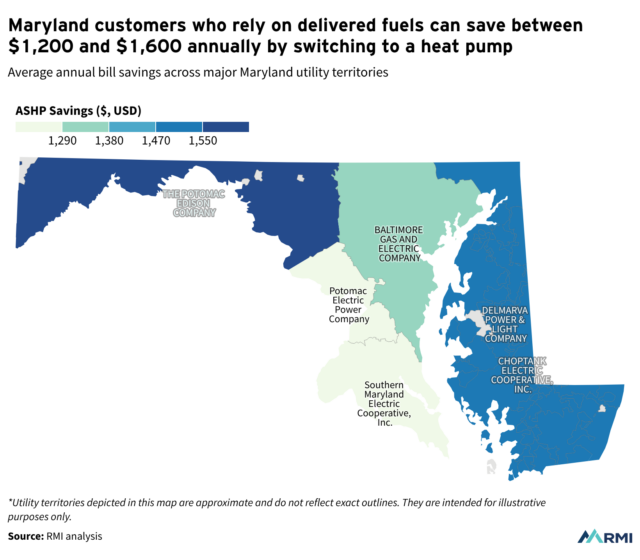
Delivered Fuel Customers in Maryland See Strong Energy Bill Savings in a Switch to Heat Pumps
Help build the clean energy future. Donate today.
Independent research. Real-world solutions. Supported by donors.
RMI can pursue the highest-impact climate and energy solutions because we’re supported by people who believe change is possible. Every gift helps advance the work needed to make clean energy the default choice worldwide.
For other ways to give to RMI, including checks or gifts of stock, please visit Other Ways to Give.
