

Learn how we are working to transform how we use and produce energy.
Charting a Circular Battery Future in India
Why we share this work for free
RMI is an independent nonprofit working to accelerate the clean energy transition. We publish research like this to inform decision-makers and drive real-world impact.
Our work is supported by philanthropy as well as partnerships, including fee-for-service engagements. This support makes it possible for us to share our independent insights for free.
If you find this work valuable, you can support it anytime.
Get more insights like this
Stay up to date with the latest research, analysis, and tools from RMI by opting in to receive occasional emails below. You’ll get new reports, event invitations, and practical insights to help us all accelerate the clean energy transition.
Loading form...
Your download should start automatically. If it doesn’t, click the download button below.
This work is made possible by philanthropy
RMI is a nonprofit supported by donors and partners. Philanthropy enables us to produce independent research and make resources like this freely available.
If you find this report valuable, please consider supporting our work. You can also explore how we partner with organizations to drive impact.
Jump to Section
Battery circularity in India represents a ₹75,500 crore (US$9 billion) market opportunity. By reusing batteries in vehicles, repurposing them for second-life stationary applications, and ultimately recycling them for material recovery, India can capture value at every stage of a battery’s life cycle. With battery demand expected to increase more than 40-fold by 2050, and early end-of-life volumes already appearing from commercial EV fleets, India has a limited window to establish a circular battery economy before fragmented, inefficient systems take hold.
This report delivers a unified strategy to scale battery reuse, repurposing, and recycling in India. Based on techno-economic modeling, policy analysis, and stakeholder input, the report details actionable pathways to embed circularity into India’s battery value chain — advancing national goals for energy security, self-reliance, and net-zero emissions. Key findings and recommendations include:
- Reuse strategies: Cumulative battery reuse potential is estimated at 220 GWh between 2025 and 2050, driven largely by high-utilization electric fleet segments.
- Repurposing applications: Annual repurposing potential could reach approximately 600 GWh by 2050, unlocking an estimated ₹58,738 crore (~US$7 billion) market opportunity.
- Recycling opportunities: Battery recycling is projected to avoid 2.9 million tons of CO₂ equivalent and lead to the creation of more than 106,000 direct green jobs.
- Critical mineral security: By 2050, domestic recycling infrastructure could supply over 40 percent of India’s lithium, nickel, and cobalt requirements — reducing exposure to volatile import markets.
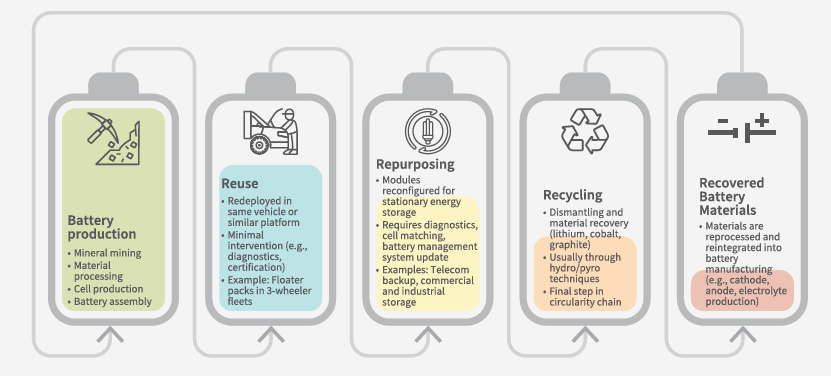
Scaling battery circularity in India will hinge on progress across five key enablers:
- Policy reform to strengthen collection systems and expand second-life markets.
- Digital traceability and certification to bridge information asymmetry and bring market accountability.
- Financing interventions to meet the diverse capital needs of differing technologies and stages of maturity; tools may include concessional capital, credit guarantees, and blended instruments.
- Technology development to support the advancement of indigenous diagnostics, repurposing, and recycling advancements.
- Workforce development via the initiation of skills training and
Ultimately, battery circularity is a strategic lever for India’s agile battery sector to differentiate itself and position the country as a leader in the global battery supply chain. Advancing reuse, repurposing, and recycling solutions will enable India to capture value across the battery life cycle, maximize resource efficiency, and strengthen domestic mineral security.
Acknowledgement: This publication was developed collaboratively by RMI and India Foundation.
Authors

Marie McNamara
Manager
Sudeshna Mohanty
Senior Associate
Marshall Abramczyk
Principal
Akshat Aggarwal
Akshima Ghate
Dimpy Suneja
Related Insights

India’s Used EV Battery Market Needs Trust. Battery Aadhaar Can Help.
Help build the clean energy future. Donate today.
Independent research. Real-world solutions. Supported by donors.
RMI can pursue the highest-impact climate and energy solutions because we’re supported by people who believe change is possible. Every gift helps advance the work needed to make clean energy the default choice worldwide.
For other ways to give to RMI, including checks or gifts of stock, please visit Other Ways to Give.
