

Learn how we are working to transform how we use and produce energy.
Intracity Public Charging Guidebook for Indian Cities
Why we share this work for free
RMI is an independent nonprofit working to accelerate the clean energy transition. We publish research like this to inform decision-makers and drive real-world impact.
Our work is supported by philanthropy as well as partnerships, including fee-for-service engagements. This support makes it possible for us to share our independent insights for free.
If you find this work valuable, you can support it anytime.
Get more insights like this
Stay up to date with the latest research, analysis, and tools from RMI by opting in to receive occasional emails below. You’ll get new reports, event invitations, and practical insights to help us all accelerate the clean energy transition.
Loading form...
Your download should start automatically. If it doesn’t, click the download button below.
This work is made possible by philanthropy
RMI is a nonprofit supported by donors and partners. Philanthropy enables us to produce independent research and make resources like this freely available.
If you find this report valuable, please consider supporting our work. You can also explore how we partner with organizations to drive impact.
Jump to Section
India’s urban centers are at the forefront of the electric mobility transition. Of the more than 25,000 public charging stations already deployed nationally, 79 percent are within cities. The next challenge is to scale access, optimize deployment, and align with EV growth. This guidebook from RMI and the State Climate Action Cell, Government of Maharashtra, provides a comprehensive, actionable roadmap to help Indian cities plan, tender, and operate effective public EV charging networks.
Intracity charging is essential to support India’s fast-growing fleet of electric 2-, 3-, and 4-wheelers and the country’s current charger-to-vehicle ratio of 212:1 must rapidly improve. The guide introduces a four-step framework to effectively improve that ratio:
- Target Setting – Demand-based, location-specific goals
- Stakeholder Coordination – Institutional roles and city EV cells
- Smart Tendering – Transparent, public-private partnership-enabled RFPs
- Monitoring and Optimization – Dashboards, service level agreements, and audits
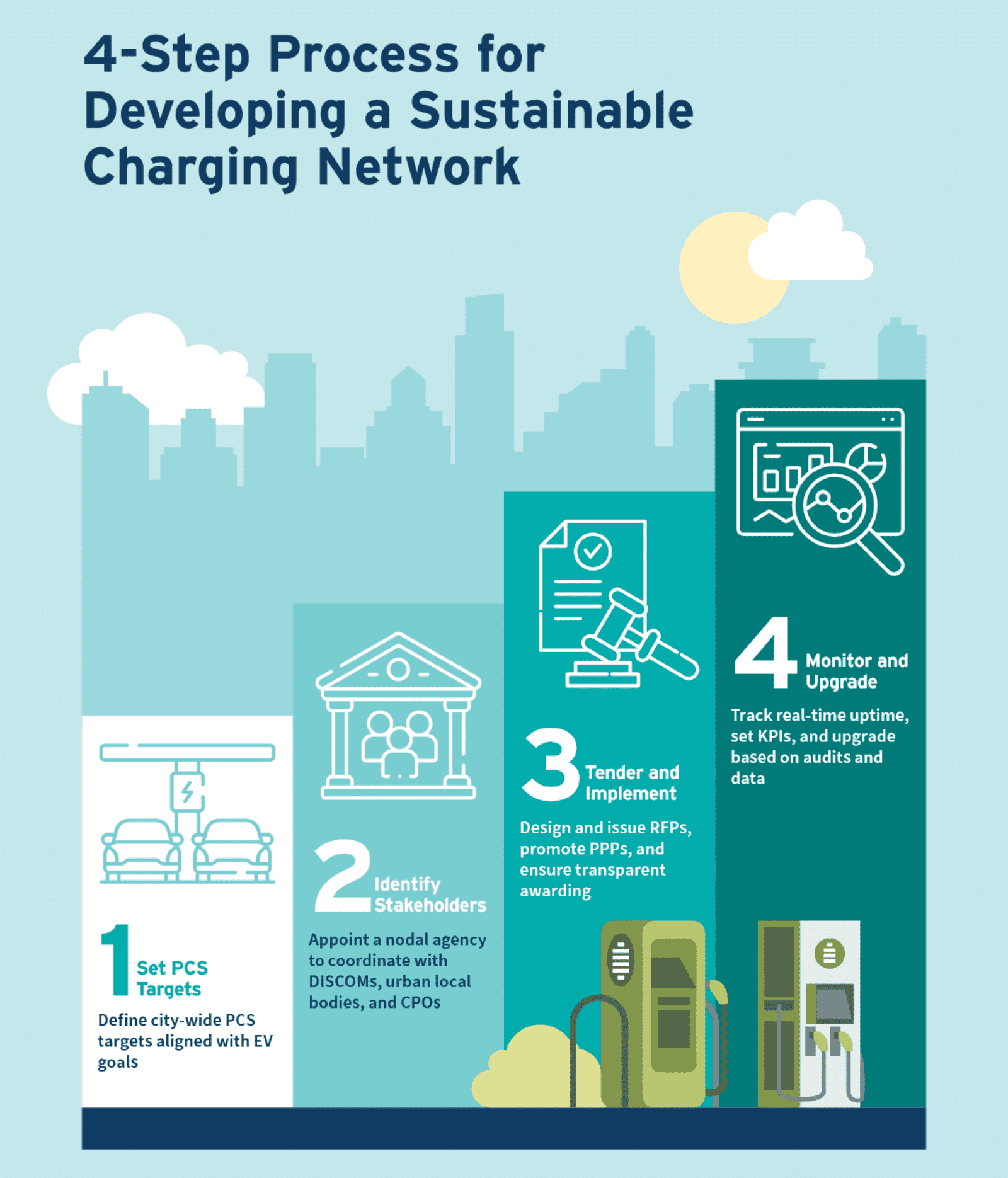
The guide also explores viable public–private models including revenue sharing, fixed rental, and energy-linked tariffs, along with insights on tariff reform, land utilization, and grid readiness.
The city of Pune exemplifies the guidebook’s framework, with 82 public charging locations deployed through strategic planning, cross-agency coordination, and a real-time operational dashboard.
This guidebook offers practical frameworks, policy insights, and implementation tools to support local governance bodies in building a robust EV-ready ecosystem.


Related Insights

India’s Used EV Battery Market Needs Trust. Battery Aadhaar Can Help.

Help build the clean energy future. Donate today.
Independent research. Real-world solutions. Supported by donors.
RMI can pursue the highest-impact climate and energy solutions because we’re supported by people who believe change is possible. Every gift helps advance the work needed to make clean energy the default choice worldwide.
For other ways to give to RMI, including checks or gifts of stock, please visit Other Ways to Give.